
You feel a deep ache low in your back, off to one side, just above the buttock. Sitting through a long drive makes it worse. So does standing on one leg, climbing stairs, or rolling over in bed. If that pattern sounds familiar, the sacroiliac joint, often shortened to the SI joint, may be the source. Sacroiliac joint pain physiotherapy Brooks patients receive at Mission Health is built around one simple idea: settle the irritation first, then rebuild the stability and strength that protect the joint.
The good news is that SI joint pain usually responds well to conservative care. In fact, physiotherapy is the first-line treatment, because the joint depends on the muscles around it for stability. As a result, most people improve with education, targeted strengthening, and hands-on care rather than injections or surgery. The key, however, is working out whether your joint moves too much, too little, or carries more load than it can handle.
This guide explains SI joint pain in plain language. First, it covers what the sacroiliac joint is and why it hurts. Next, it lists the symptoms to watch for. After that, it walks through how a physiotherapist assesses and treats it, the exercises that help most, and how long recovery takes. Finally, it explains the warning signs that need medical care.
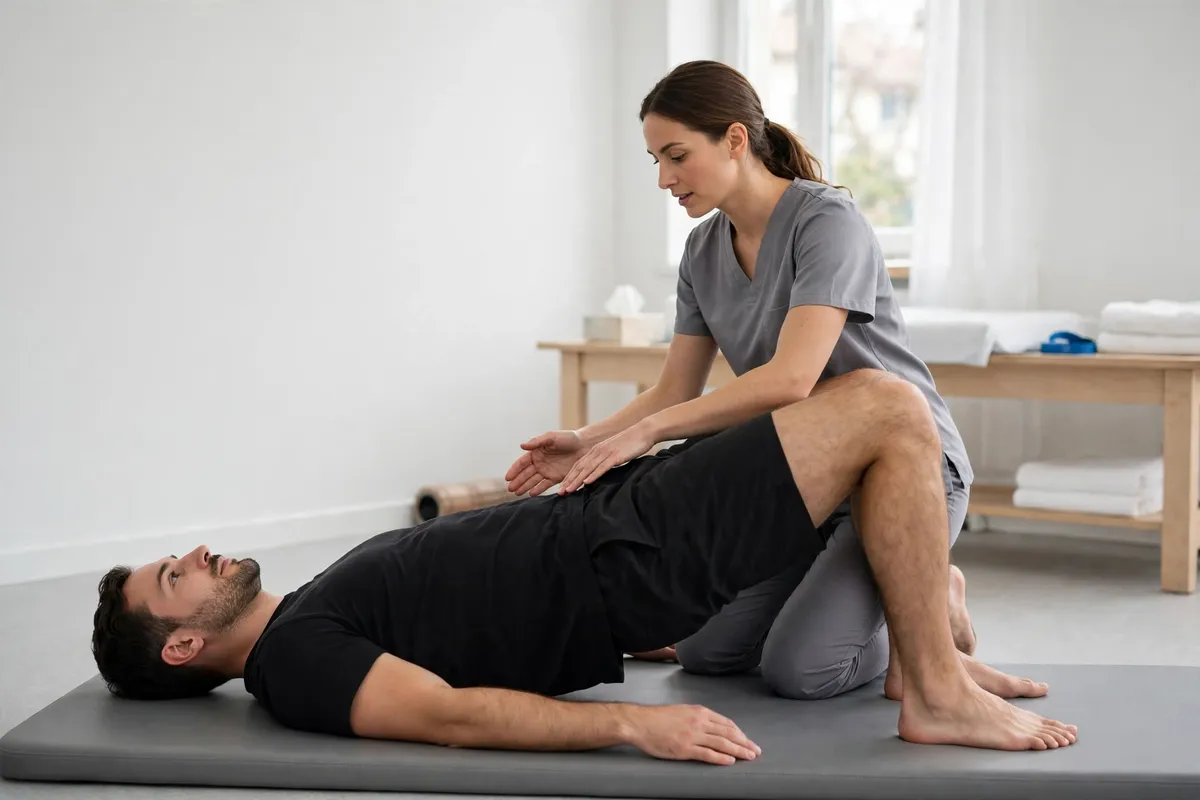
The sacroiliac joint connects the sacrum, the triangular bone at the base of your spine, to the ilium, the large bone of your pelvis. You have two of them, one on each side. Because they sit at the junction between the spine and the pelvis, they transfer weight from your upper body into your legs every time you stand, walk, or lift.
Unlike your hip or knee, the SI joint barely moves. It allows only a few millimetres of glide and a small amount of rotation. Nevertheless, that tiny movement matters. It acts like a shock absorber, and it depends on strong ligaments and surrounding muscles to stay stable. When those supports weaken, pain follows.
Importantly, SI joint pain is often mistaken for other problems. For example, a lumbar disc problem, hip arthritis, and even sciatica can produce pain in a similar area. Because of that, a proper assessment matters before you start treatment. Our general guide to physiotherapy for back pain in Brooks explains how different causes of low back pain are sorted out and treated.
Meanwhile, it helps to know that SI joint pain is usually an irritation and stability problem, not a damage problem. Therefore, the goal of treatment is to reduce that sensitivity while building the muscle support that lets the pelvis handle load again.
SI joint pain usually has more than one cause. Typically, it develops when the joint is asked to absorb more force than its ligaments and muscles can control. At the same time, stiffness or weakness elsewhere in the hips, back, or legs can shift extra load onto the joint. Here are the most common contributors.
When the ligaments around the SI joint become loose or stretched, the joint moves more than it should. Doctors call this hypermobility. Pregnancy is the most common reason, because hormones soften the ligaments and the growing baby changes how weight loads the pelvis. However, hypermobility can also follow an injury, such as a fall onto the buttock, or repeated heavy lifting with poor technique.
The opposite problem also causes pain. When the joint becomes stiff, it stops gliding smoothly, and the surrounding muscles tighten to protect it. This is called hypomobility. It is more common with aging or after long periods of inactivity. Because the stiff joint cannot absorb shock, everyday activities such as standing and walking become uncomfortable.
How you load the pelvis matters as much as how the joint itself behaves. For instance, a leg-length difference, a habit of always standing on one leg, or carrying a child on the same hip can load one SI joint far more than the other. Similarly, weak glute muscles let the pelvis drop and rotate with each step. This is why hip problems and SI joint pain so often appear together, and why our guide to hip pain physiotherapy in Brooks is relevant for many people with low back pain.
Finally, several life events can irritate the joint directly. A fall, a car accident, or a sudden twist can strain the ligaments. Pregnancy and the months after delivery are also common windows for SI joint pain. In addition, arthritis can affect the SI joint, and inflammatory conditions can target it specifically. Therefore, your physiotherapist will ask about your history, not just your pain.
SI joint pain symptoms vary, but they usually follow a clear pattern. The pain is low in the back and off to one side, and it gets worse with activities that load the pelvis unevenly. The most common symptoms are:
Notably, SI joint pain rarely travels below the knee. That is one clue that separates it from sciatica, where pain typically follows the nerve down the leg. However, the two can overlap, because an irritated SI joint can refer pain into the thigh. Our guide to sciatica physiotherapy in Brooks explains how nerve-related leg pain is identified and treated.
Because SI joint pain often builds gradually, many people ignore it at first. However, if the underlying stability problem is not addressed, flare-ups become more frequent. Early treatment, therefore, works better than waiting.
Most SI joint pain improves with physiotherapy and load management. Nevertheless, some signs mean you should see a doctor promptly, because they can point to a different or more serious problem:
If you notice any of these, book a medical assessment rather than pushing through. Otherwise, SI joint pain is well suited to a physiotherapy-first approach, which is what clinical guidelines recommend.
SI joint pain is diagnosed from your story and a hands-on assessment. Imaging is rarely needed at the start, because the diagnosis is clinical. Here is what the assessment involves.
First, your physiotherapist will ask when the pain started, what provokes it, and whether you have had a fall, a pregnancy, or a change in activity. Mention any previous back, hip, or pelvic problems. In addition, note whether pain eases with rest and how long it takes to settle. That pattern is often the strongest clue.
Next, the assessment looks at the whole pelvis, not just the sore joint. Your physiotherapist will use a cluster of provocation tests, which gently stress the SI joint in different ways, to see whether they reproduce your familiar pain. They will also test glute, core, and hip strength, check flexibility in the hips and low back, and watch how you walk and stand on one leg. Because the pelvic floor muscles help stabilize the pelvis from below, pelvic floor function is sometimes part of the picture too. Our guide to pelvic floor physiotherapy in Brooks explains how those muscles are assessed when they contribute to pelvic pain.
An X-ray shows the bones of the pelvis but not the soft tissues around the joint. An MRI can show inflammation and is useful when an inflammatory condition is suspected. However, imaging is usually reserved for significant trauma, unusual findings, or poor progress with conservative care. In most cases, you can start sacroiliac joint pain physiotherapy Brooks clinics offer based on assessment alone.
Physiotherapy for SI joint pain is a structured program, not a single treatment. It changes as your pain settles and your stability improves. In addition, it is built around your goals, whether that is getting through a work shift or returning to the gym. Here is what the process looks like at Mission Health in Brooks.
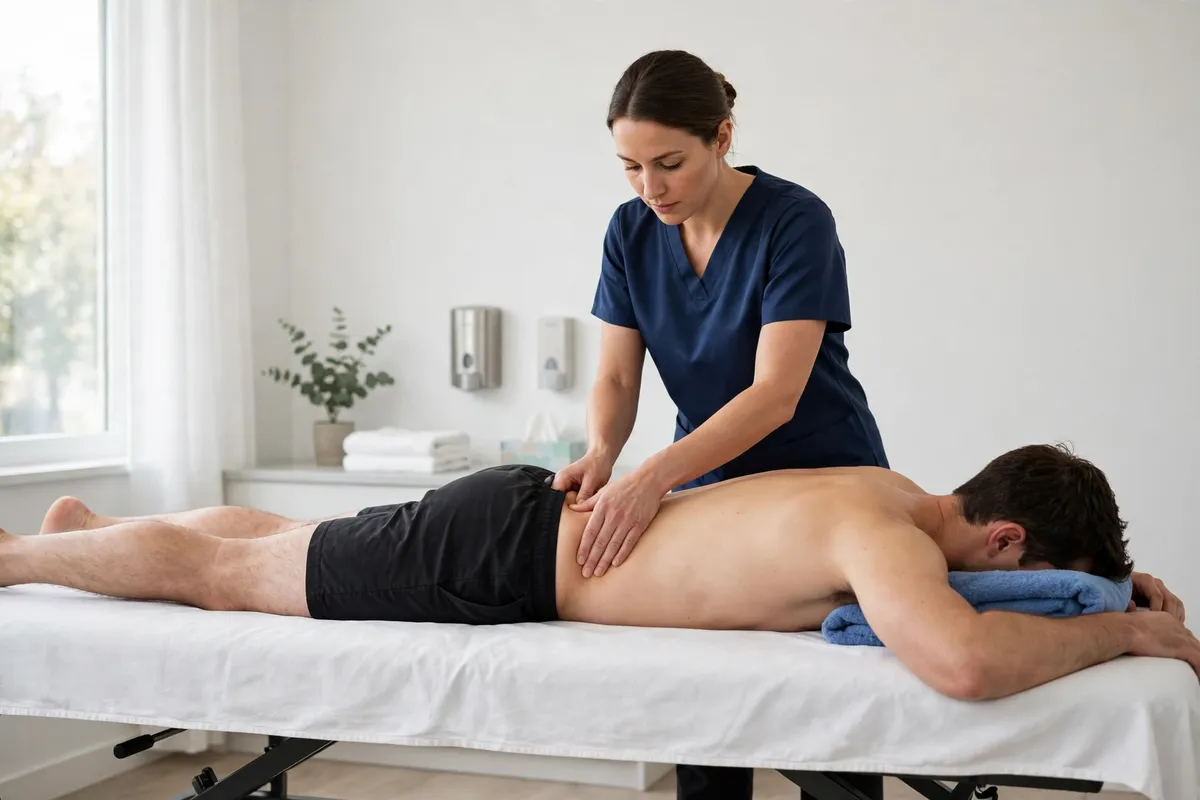
The first session is mostly assessment and planning. Your physiotherapist takes your history, examines your pelvis, back, and hips, and sets a baseline: pain with sitting and stairs, glute and core strength, and single-leg control. Together, you agree on goals. You will leave with a home exercise program and guidance on modifying activity.
First, the program reduces the load that irritates the SI joint. That usually means temporarily easing off the activities that provoke pain, such as standing on one leg, deep lunges, and long periods in one position. However, complete rest is rarely the answer, because rest alone does not fix the reason the joint became irritated. Instead, you switch to activities the pelvis tolerates, such as walking on flat ground, cycling, or swimming. Simple changes also help: sit with both feet flat, avoid crossing your legs, and change position every 30 minutes.
Stabilization is the core of treatment. The SI joint relies on the muscles around it, especially the glutes, deep core muscles, and hip stabilizers, to control movement. Therefore, your program will target those muscles with progressive exercises. Harvard Health describes this same approach, noting that strengthening the muscles that support the pelvis is central to easing sacroiliac joint pain. You can read more in the Harvard Health guide to sacroiliac joint pain. Strengthening progresses in stages, from gentle activation to loaded exercises for walking and lifting.
Next, hands-on treatment can help, especially when the joint is stiff. Gentle mobilization techniques aim to restore the small glide the SI joint needs, while soft-tissue work can ease tight muscles around the pelvis and low back. However, hands-on care always works alongside exercise rather than instead of it. Because the muscles at the back of the thigh attach to the pelvis, hamstring tightness can also affect how the joint is loaded. Our guide to hamstring strain physiotherapy in Brooks explains how hamstring problems are assessed when they contribute to pelvic symptoms.
Finally, several tools can support the exercise program. An SI belt worn low around the pelvis can add external compression, which helps when the joint is loose or hypermobile, including during pregnancy. Heat or ice can ease symptoms after activity. Supportive footwear matters too, because uneven loading through the feet travels up into the pelvis. Your physiotherapist will help you choose the tools that fit your presentation.
Every program is tailored to the individual, but most SI joint programs follow a similar progression. The right exercise should feel challenging but manageable. If pain spikes during an exercise or lingers for more than a day afterwards, the exercise usually needs adjusting. Do not start a new program on your own if you have leg weakness, numbness around the groin, or pain after a significant fall; get assessed first.
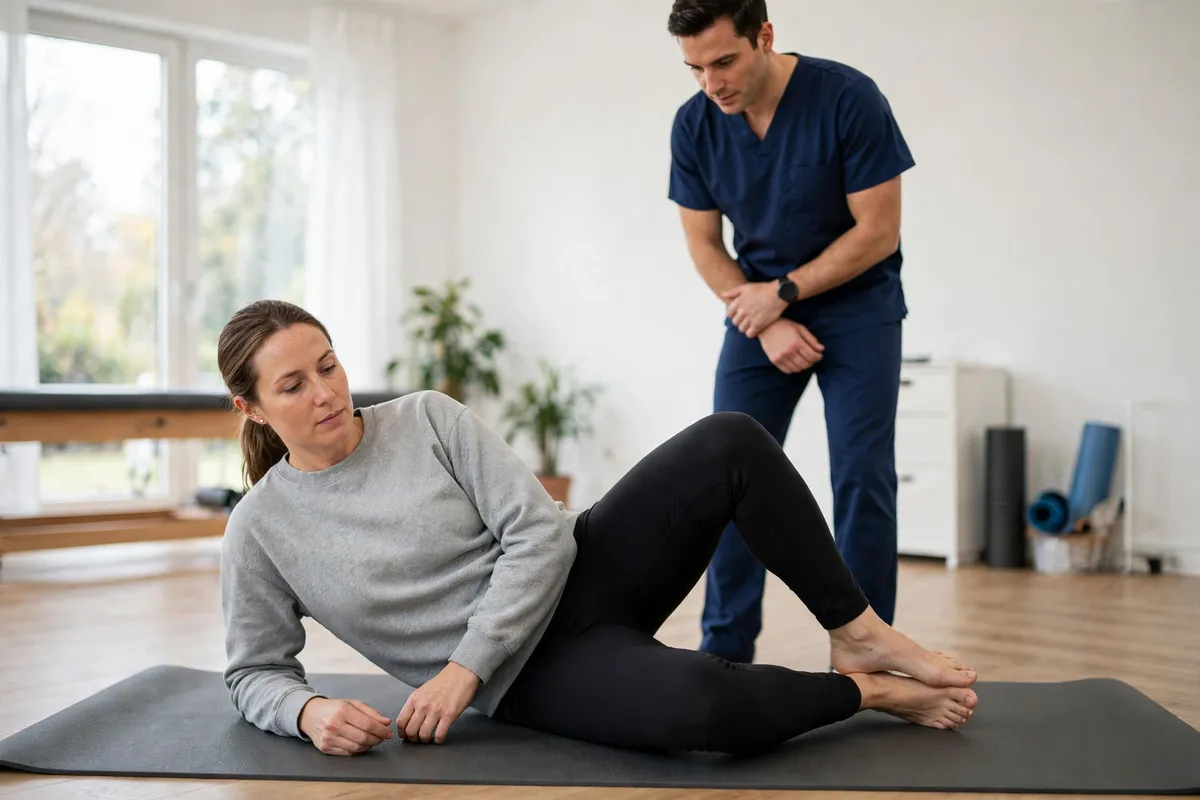
These exercises wake up the deep core and glute muscles without loading the joint heavily. They are usually the most comfortable starting point.
As the activation exercises become easy, the program adds strength work for the muscles that stabilize the pelvis.
Tight muscles around the pelvis can pull unevenly on the joint. Gentle stretching, guided by your assessment, helps restore balance.
Because the inner thigh muscles also attach to the pelvis, groin tightness or weakness can change how the SI joint is loaded. Our guide to groin strain physiotherapy in Brooks explains how inner-thigh problems are assessed when they appear alongside pelvic pain. Your physiotherapist will adjust the exercises as you progress. Mild muscle effort during exercise is normal. However, sharp pain or new numbness are signs the program needs adjusting.
SI joint pain improves with consistency, not with a single treatment. Rest may calm symptoms temporarily, but it rarely fixes the reason the joint became irritated. Instead, a progressive program gradually builds the pelvis’s tolerance.
First, activity modification and the activation exercises usually bring early relief. Sitting and standing often feel easier within a few weeks, and the deep core and glute muscles start switching back on. Aggravating activities, such as heavy lifting, are usually eased back during this phase.
Next, strength work progresses and balance training becomes more demanding. Bridges, clamshells, and bird dogs get harder, and walking tolerance improves. Many people notice they can roll over in bed or climb stairs with less ache by this stage.
Finally, loading builds toward your normal activities, with heavier lifting and sport added back one at a time. By three months, people who follow their program consistently usually report their best gains in pain and function. After formal treatment ends, the strengthening exercises usually continue two or three times a week as maintenance. If there has been no meaningful improvement after about three months of consistent physiotherapy, the diagnosis and treatment options should be reassessed with your doctor.
In Alberta, the funded post-surgical physiotherapy window covers hip and knee replacement surgery. It does not cover conservative care for SI joint pain. Most people fund sacroiliac joint pain physiotherapy in Brooks through extended health benefits, a workplace plan, a health spending account, or private payment. Check your plan for your annual allowance and whether a doctor’s referral is required.
Small changes in how you move through the day can make a real difference to your symptoms:
Because SI joint pain often appears alongside other pelvic and back problems, it is worth treating the whole pattern rather than one sore spot. A full assessment looks at the back, hips, pelvis, and legs together.
Most SI joint pain settles with conservative care. Guidelines recommend a fair trial of physiotherapy first, because strengthening the muscles that stabilize the pelvis addresses the most common causes. Injections and surgery are reserved for the minority of cases where a well-structured program does not bring relief.
If pain persists, a doctor may discuss a diagnostic injection into the joint, which can also confirm whether the SI joint is truly the pain source. Radiofrequency ablation, which quiets the small nerves carrying pain signals from the joint, is another option in selected cases. Surgery to fuse the joint is a last resort, considered only when severe symptoms persist after many months of conservative care and the diagnosis is confirmed. Even then, physiotherapy remains central before and after any procedure.
SI joint pain usually feels like a dull, deep ache low in the back, off to one side, just above the buttock. It often spreads into the buttock, groin, or back of the thigh, but rarely below the knee. It typically worsens with prolonged sitting or standing, climbing stairs, and rolling over in bed.
Most structured programs run for 8 to 12 weeks, with the best gains in pain and function often appearing over 2 to 3 months. Mild cases caught early can settle faster, while long-standing cases can take longer. Because SI joint pain is a stability problem, the strengthening exercises usually continue as maintenance after formal treatment ends.
There is no single best exercise for everyone. However, the best starting point is usually a combination of glute and deep core strengthening. Common options include glute bridges, clamshells, bird dogs, side-lying hip raises, and single-leg balance work. The right exercise should feel challenging but manageable, and your physiotherapist will choose based on your assessment.
Yes, it can. An irritated SI joint can refer pain into the buttock, groin, and back of the thigh. However, SI joint pain rarely travels below the knee, and it does not usually cause numbness or weakness. Pain that shoots below the knee, or comes with numbness or weakness, points more toward sciatica and should be assessed promptly.
An SI belt can help when the joint is loose or hypermobile, including during pregnancy, because the external compression adds stability while you strengthen the muscles. However, a belt does not fix the underlying weakness on its own. Think of it as short-term support while the exercise program does the long-term work.
SI joint pain does not have to mean giving up walking, lifting, or sleeping comfortably. For most people, a structured physiotherapy program restores stability, strength, and confidence, and the evidence supports exercise therapy as the core treatment. Sacroiliac joint pain physiotherapy Brooks patients receive at Mission Health follows that same evidence-based approach. The earlier you start, the sooner the glutes and core support the pelvis and daily life feels normal again.
If you have a deep ache low in your back on one side that worsens with sitting, standing, or stairs, book an assessment at Mission Health Physiotherapy in Brooks. Call (403) 794-0111 or email missionhealthpt@gmail.com to book an assessment. The clinic is at 740 Alberta St W, Brooks, AB T1R 1A9. You can usually book without a doctor’s referral, though some insurance plans require one for reimbursement, so check your policy before your first visit.
Your physiotherapist will assess your pelvis, back, and hips, explain what is going on in plain language, and build a plan around your goals.
This article is for general information only and is not a substitute for medical advice. If you develop leg weakness, numbness around the groin, changes in bladder or bowel control, fever, or severe pain after a fall, seek medical care promptly. Always follow the guidance of your physiotherapist or doctor for your individual situation.