
Get hip pain physiotherapy in Brooks with personalized treatment, exercises, and rehabilitation to improve mobility, strength, and function.
Hip pain can affect much more than the hip itself. Walking, climbing stairs, getting into a vehicle, exercising, working, or even sleeping on your side can become uncomfortable when hip movement is restricted.
Sometimes symptoms develop after an obvious injury. In other cases, discomfort gradually appears because of overuse, muscle or tendon problems, joint changes, reduced strength, or changes in activity.
For people dealing with persistent or recurring symptoms, Hip Pain Physiotherapy in Brooks can provide a structured approach to improving mobility, strength, movement, and physical function.
At Mission Health Physiotherapy & Sports Rehab in Brooks, treatment begins with an individualized assessment. The physiotherapy team considers your symptoms, movement patterns, strength, activity level, injury history, and personal goals when developing a rehabilitation plan.
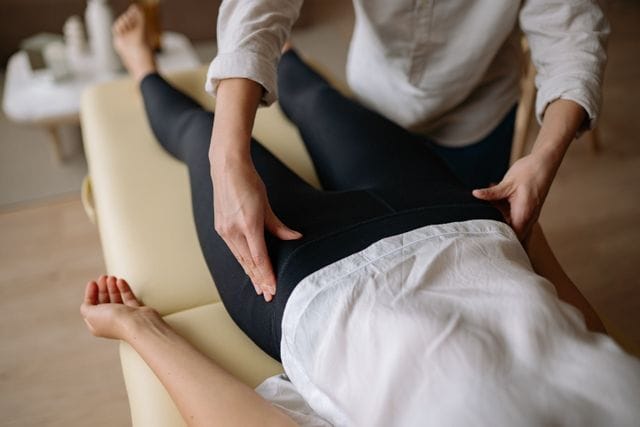
The hip is a large ball-and-socket joint surrounded by muscles, tendons, ligaments, and other structures that work together to support movement.
Because the hip is involved in walking, running, lifting, squatting, and many other activities, several different problems can contribute to pain.
Common causes include:
Hip symptoms can also sometimes be felt in the thigh, groin, buttock, or even the knee. MyHealth Alberta notes that hip problems can have many causes and that pain may sometimes be felt away from the actual hip joint.
Therefore, identifying the source of your symptoms is an important first step before deciding which treatment approach is appropriate.
Hip problems can produce different symptoms depending on the underlying condition.
You may experience:
Some people notice symptoms only during exercise, while others experience discomfort during everyday activities.
For example, a runner may feel pain after increasing training volume, while someone with joint-related problems may experience increasing stiffness during walking or stair climbing.
Minor symptoms may sometimes improve with activity modification and time. However, an assessment can be useful when discomfort persists, repeatedly returns, or interferes with normal activities.
Consider Hip Pain Physiotherapy in Brooks if:
MyHealth Alberta explains that treatment for hip problems can include physiotherapy and that management depends on the type and severity of the problem, as well as the individual’s activities and overall health.
Effective rehabilitation is not simply about temporarily reducing discomfort.
A physiotherapy program can also focus on restoring movement, improving strength, increasing physical capacity, and helping you return to activities that matter to you.
Mission Health’s physiotherapy approach starts with an assessment and uses personalized treatment plans based on the individual’s symptoms, lifestyle, and goals.
Your physiotherapist may assess:
This information helps identify potential contributing factors and guides the rehabilitation plan.
Stiffness can make activities such as walking, squatting, getting into a car, or climbing stairs more difficult.
Depending on the cause of your symptoms, rehabilitation may include controlled mobility exercises designed to improve comfortable hip movement.
The exercises should match your condition and current ability. A movement that is appropriate during later-stage rehabilitation may not be suitable when symptoms are highly irritable.
Hip strength plays an important role in many everyday and athletic movements.
A rehabilitation program may target:
Strengthening exercises can begin at an appropriate level and gradually become more challenging as your capacity improves.
For example, rehabilitation may progress from basic controlled movements to squats, step-ups, lunges, single-leg exercises, and more demanding functional activities.
Strength alone does not always solve a movement problem.
Your physiotherapist may also look at how you walk, squat, step, lift, run, or perform other activities.
Functional exercises can then be introduced to help connect rehabilitation with your everyday requirements.
This is particularly useful for people whose jobs or sports involve repetitive lifting, running, jumping, prolonged standing, or rapid changes of direction.
Athletes place considerable demands on their hips.
Running, kicking, jumping, skating, cutting, and lifting can all require significant hip strength and mobility.
Sports-related hip problems may involve muscles, tendons, joints, or other structures. Some develop suddenly, while others appear gradually through repetitive loading.
Mission Health’s sports injury rehabilitation program uses personalized plans based on the specific demands of an athlete’s sport and aims to support a safe return to activity.
Returning to sports should be progressive rather than based solely on how the hip feels during normal walking.
Depending on the injury, rehabilitation may progress through:
The appropriate progression varies from person to person.
Running involves repetitive loading through the hips and lower limbs.
A sudden increase in mileage, speed, hills, training frequency, or intensity can increase the demands placed on the body.
However, running itself is not necessarily the problem.
Instead, your physiotherapist may assess:
From there, your activity can be adjusted and gradually progressed.
For active Brooks residents, this approach can help connect rehabilitation with the actual demands of running rather than focusing only on isolated exercises.
Osteoarthritis can contribute to hip pain and stiffness, particularly during weight-bearing activities.
People may notice difficulty with:
Physiotherapy may be used as part of a broader management plan.
Exercise can help maintain physical capacity and support movement, while education can help you understand how to manage activity according to your symptoms.
MyHealth Alberta notes that hip osteoarthritis and other joint conditions can cause pain and stiffness, with treatment depending on the individual’s condition and activity requirements.
Some forms of lateral hip pain may involve irritation around the structures on the outside of the hip, including bursae and surrounding tendons.
Symptoms may include pain when lying on the affected side, walking, climbing stairs, or performing certain movements.
However, several conditions can produce similar symptoms.
Therefore, it is important not to assume that every case of outer hip pain is simply bursitis.
A physiotherapy assessment can help evaluate movement, strength, activity levels, and symptom behaviour before developing an appropriate rehabilitation strategy.
A hip injury may occur after a fall, direct impact, sudden movement, or repetitive activity.
MyHealth Alberta notes that hip injuries can include muscle strains, tendon problems, bursitis, fractures, dislocations, and other conditions. Treatment depends on the type and severity of the injury and may include physiotherapy.
Rehabilitation may focus on restoring:
More serious injuries may require medical assessment or other treatment before physiotherapy can safely progress.
Hip strength contributes to many movements involving the pelvis and lower limbs.
Weakness can make activities such as climbing stairs, running, squatting, or getting up from a chair more challenging.
A strengthening program can therefore form an important part of Hip Pain Physiotherapy in Brooks.
However, more exercise is not automatically better.
The right amount of resistance, repetitions, frequency, and progression depends on your condition and current physical capacity.
Your physiotherapist can help determine an appropriate starting point and modify the program as you improve.
Yes.
The hip, pelvis, knee, and ankle work together during walking and other lower-limb movements. A problem in one area can sometimes influence how another area moves or feels.
MyHealth Alberta also notes that people with hip problems may experience pain in the knee or thigh rather than directly in the hip.
Consequently, an assessment should consider the entire movement pattern rather than focusing only on the location where you feel discomfort.
Foot and lower-limb mechanics can influence how forces are distributed during walking and other activities.
For some people, evaluating foot mechanics may therefore be useful as part of a broader movement assessment.
Mission Health provides custom orthotics in Brooks and combines orthotic care with physiotherapy exercises and lifestyle modifications when appropriate.
However, orthotics are not necessary for everyone with hip pain. Their suitability depends on your individual assessment and treatment goals.
Your home management strategy should depend on the cause and severity of your symptoms.
Some general approaches may include:
MyHealth Alberta recommends protecting an irritated area, modifying aggravating activities, and gradually returning to normal activities and gentle stretching when appropriate.
Nevertheless, home exercises should not replace professional assessment when symptoms are severe, persistent, or getting worse.
Most hip pain is not an emergency, but some symptoms require prompt medical attention.
Seek medical care if you experience:
MyHealth Alberta recommends contacting a doctor when there is trouble bearing weight, new numbness, tingling or weakness, signs of infection, or symptoms that become more frequent or severe.
There is no universal recovery timeline.
A minor muscle-related problem may improve relatively quickly, while osteoarthritis, significant injury, chronic symptoms, or post-surgical rehabilitation may require a longer period of care.
Recovery can be influenced by:
For this reason, an individualized assessment provides a much more useful recovery estimate than a generic timeline.
Choosing a physiotherapy clinic is about more than finding a convenient location.
You want a rehabilitation plan that reflects your symptoms, lifestyle, activity level, and goals.
Mission Health Physiotherapy & Sports Rehab in Brooks uses individualized assessments and personalized treatment plans for people recovering from injuries, managing chronic conditions, or working toward improved physical performance.
Treatment may include:
The clinic also provides sports injury rehabilitation for active individuals and athletes who want to return to their preferred activities.

You can generally contact a physiotherapy clinic directly in Alberta. Mission Health also states that patients can book physiotherapy without a doctor’s referral.
However, insurance policies can have their own requirements, so check your individual coverage if you plan to claim treatment through benefits.
Physiotherapy may help people with hip arthritis improve movement, strength, physical function, and activity tolerance. Your program should be adjusted according to your symptoms and goals.
Yes. An old injury may continue to contribute to weakness, mobility limitations, altered movement, or reduced confidence. An assessment can help determine which factors may still be relevant.
In many cases, appropriate movement can remain part of rehabilitation. However, the right exercises depend on the cause and severity of your symptoms.
A physiotherapist can help you determine what to modify and how to progressively increase your activity.
Yes. Hip, pelvic, and lower-back problems can sometimes produce overlapping symptoms. A thorough assessment can help determine which structures and movements may be contributing to your discomfort.
Yes. Athletic rehabilitation can progressively address strength, mobility, movement control, conditioning, and sport-specific demands.
The appropriate frequency depends on your condition, goals, rehabilitation stage, and home exercise program. Your physiotherapist can recommend a schedule after your assessment.
If an exercise causes significant or worsening pain, or if you develop new symptoms such as weakness, numbness, or substantial swelling, stop and seek appropriate professional guidance.
Hip pain can affect walking, exercise, work, sleep, and many everyday activities. Ignoring persistent symptoms may also make it harder to maintain your normal activity level.
The right rehabilitation approach depends on the underlying cause and your individual goals.
Through assessment, progressive exercise, movement training, education, and hands-on treatment where appropriate, Hip Pain Physiotherapy in Brooks can support your journey toward better movement and physical function.
If hip pain is limiting your activities or continues despite your own efforts, consider an assessment with Mission Health Physiotherapy & Sports Rehab in Brooks.
Mission Health Physiotherapy & Sports Rehab
740 Alberta Street W
Brooks, AB T1R 1A9
Phone: (403) 794-0111