
It starts as a deep ache in one buttock. At first it only shows up after a long drive or a day spent sitting at a desk, then it follows you into your walks, your runs, and even your sleep. The pain can spread down the back of your thigh, and sitting on a hard chair becomes something you avoid. There was no fall and no single injury, so it is easy to wonder what is wrong. That pattern often points to piriformis syndrome, and piriformis syndrome physiotherapy Brooks patients receive at Mission Health starts with one important step: finding out whether the piriformis really is the cause, because several other problems feel almost the same.
Most people with piriformis syndrome improve well without surgery. The key is an accurate assessment, a program that calms the irritated muscle and nerve, and a gradual return to the activities you enjoy. This guide explains piriformis syndrome in plain language: what it is, the symptoms, how it differs from sciatica, the causes, the assessment, how physiotherapy helps, the stretches and exercises that work best, and how long recovery usually takes.
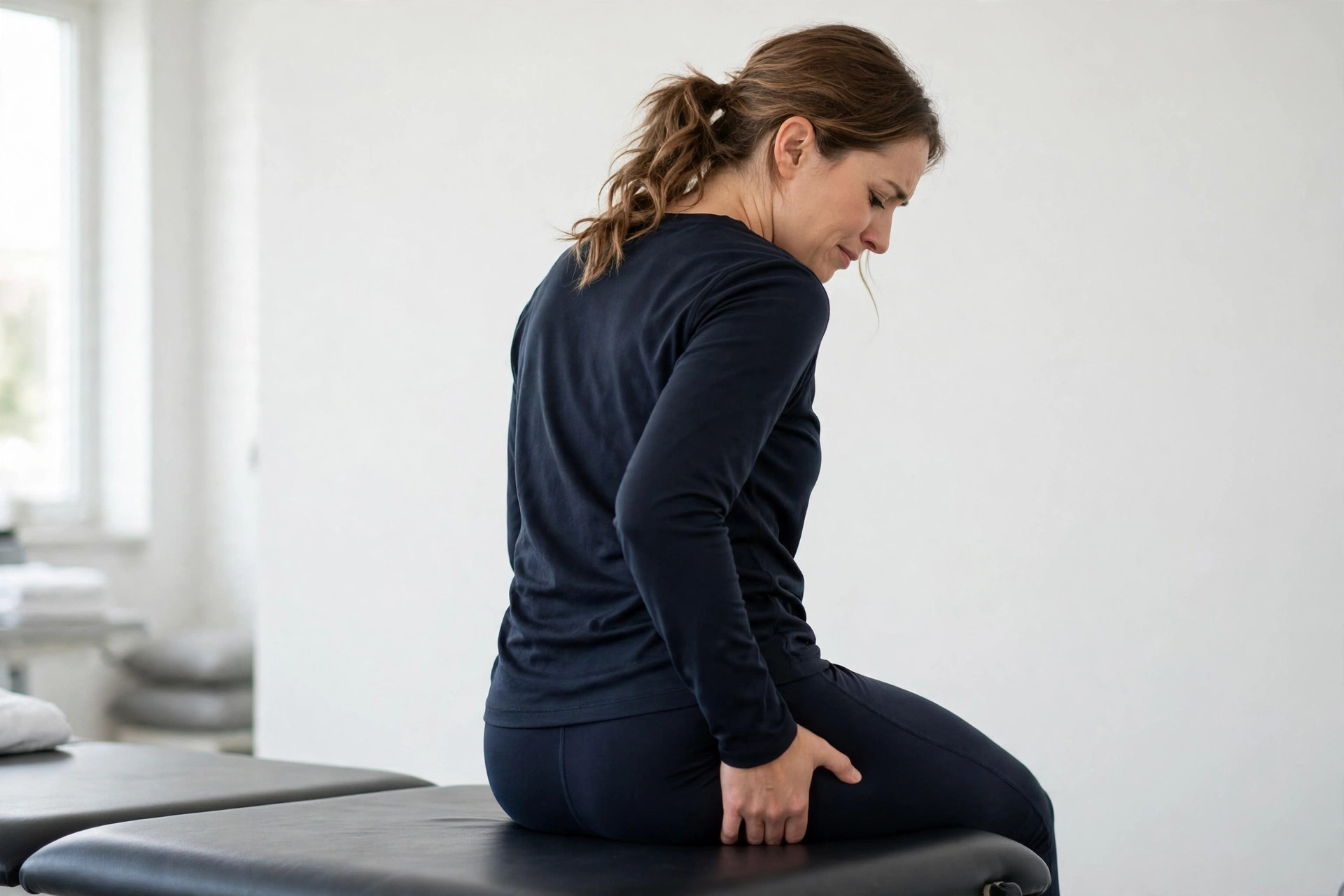
The piriformis is a small, flat muscle deep in the buttock. It runs from the front of the sacrum, the bone at the base of the spine, to the top of the thigh bone (femur). Its job is to turn the leg outwards and steady the hip every time you stand on one leg, which happens with every step you take.
The sciatic nerve, the largest nerve in the body, runs down the back of the leg. In most people it passes just underneath the piriformis, and in a small number of people it passes directly through it. When the muscle becomes tight, overworked, or goes into spasm, it can press on or irritate the nerve, and that irritation is what causes the pain. That is why piriformis syndrome is often described as a form of sciatica that starts outside the spine rather than in the back.
Piriformis syndrome is not a single injury with one cause. It is a pattern of symptoms that develops when the muscle and the nerve beside it stop getting along. It can develop after months of sitting, a sudden increase in running or walking, or a direct knock to the buttock. Because the symptoms overlap with several other conditions, the diagnosis is made by putting the history, the examination, and the response to treatment together rather than by a single test.
Piriformis syndrome is less common than back-related sciatica, but it is not rare. It is most often seen in people who sit for long hours, in runners and walkers, and in people on their feet on hard floors all day. It affects women somewhat more often than men, and most often appears between the ages of 30 and 60. In Brooks, it commonly shows up in people who drive long distances for work or take up running in spring after a quiet winter.
Piriformis syndrome pain has a pattern that sets it apart from ordinary muscle soreness: it sits deep in one buttock, and is often described as an ache, a burning feeling, or a sharp pain when the muscle is pressed. The most common symptoms are:
One of the most telling signs is the sitting test: the pain builds the longer you sit and eases when you stand and move, the opposite of many back problems, where standing and walking make things worse. Hip pain can come from many sources, and the piriformis is only one of them. Our general guide to hip pain physiotherapy in Brooks explains how different causes of hip pain are identified and treated.
Piriformis syndrome and sciatica are related, but they are not the same thing. Sciatica is a symptom, not a diagnosis: it means pain that travels along the sciatic nerve. A slipped disc is the most common cause of sciatica, but piriformis syndrome is another, and the two need different treatment. A stretch that calms a tight piriformis can make a disc problem worse, so telling them apart matters.
| Feature | Piriformis syndrome | Sciatica from a slipped disc |
|---|---|---|
| Main pain | Deep in the buttock | Lower back, spreading down the leg |
| Back pain | Usually mild or absent | Often present |
| Worse with | Sitting, crossing the leg, stairs, running | Bending forward, coughing, sneezing, lifting |
| Leg weakness | Uncommon | Can occur if the nerve is badly pressed |
| Back movement | Usually normal and pain-free | Often stiff and painful |
| Spine MRI | Often normal | Shows the disc pressing on a nerve |
There is overlap, and only an examination can tell them apart with confidence. A stiff back can change how the hip is loaded, and a tight piriformis can exist alongside a back problem, so a good assessment checks both the back and the hip. Our guide to physiotherapy for back pain in Brooks explains how different causes of low back pain are sorted out and treated.
Several other problems can mimic piriformis syndrome. Hip bursitis causes pain on the outside of the hip, usually tender over the bony point on the side of the hip. Sacroiliac joint pain sits in the back of the pelvis and often hurts when you stand on one leg or climb stairs. A hamstring strain causes pain in the back of the thigh that is tender in the muscle itself. Our guides to hip bursitis physiotherapy in Brooks and sacroiliac joint pain physiotherapy in Brooks explain how those conditions are assessed when they appear alongside buttock pain.
Piriformis syndrome rarely has a single cause. Usually several factors combine: a muscle asked to do too much, a hip that does not move well, and a daily routine that keeps the muscle shortened or irritated.
The most common cause is sitting for long hours. When you sit, the piriformis is held short, and the weight of your body presses it against the chair. Long drives, desk work, and sitting with a wallet in your back pocket all keep it compressed, and over weeks and months the muscle shortens, stiffens, and becomes more likely to irritate the nerve beside it.
Runners are the other large group. The piriformis works hard with every step to keep the pelvis level, and a sudden jump in running distance, hill work, or a return to running after time off can overload it. The same applies to people who start a job that involves walking on hard floors all day, or who take up a new exercise class. Our guide to runner’s knee physiotherapy in Brooks explains how running-related leg pain is assessed when it appears alongside hip and buttock pain.
A fall onto the buttock, a direct knock during sport, or a car accident can injure the piriformis and leave it in spasm. Problems in the hip can also contribute: weak glutes, a leg-length difference, flat feet, or hip arthritis can all change how the piriformis is loaded. A tight piriformis can even develop after another injury, such as an ankle sprain, because the way you walk changes while it heals.
Finally, the piriformis often becomes overactive because the bigger glute muscles are weak. When the gluteus maximus and gluteus medius do not do their share, the small piriformis tries to compensate, and it is not built for that job. That is why strengthening the glutes is such an important part of treatment, and why stretching alone rarely fixes the problem for good.
There is no single scan or test that proves piriformis syndrome. Imaging is usually normal, because the problem is a tight, irritated muscle rather than something a scan can see clearly. The diagnosis comes from a careful assessment, and from ruling out the conditions that feel similar.
First, your physiotherapist will ask when the pain started, what makes it worse, and what eases it. They will want to know how long you sit each day, whether you drive long distances, how much you walk or run, and whether there was a fall or a sudden change in activity. They will also ask about back pain, numbness, weakness, and bladder or bowel changes, because those point to a problem that needs medical attention rather than physiotherapy alone.
Next, the examination checks how your back, hip, and pelvis move. Your physiotherapist will press gently over the piriformis to find the tender spot, test hip strength and flexibility, and watch how you walk, sit, and stand on one leg. They will also check your back, because a back problem can cause the same leg symptoms, and groin pain needs sorting out too, since it can come from the hip joint or the inner thigh rather than the piriformis. Our guide to groin strain physiotherapy in Brooks explains how front-of-hip and inner-thigh problems are assessed when pain sits in the groin rather than the buttock.
Your physiotherapist may use specific tests that stretch or load the piriformis to see whether they reproduce your familiar pain. The FAIR test (flexion, adduction, and internal rotation) stretches the muscle by moving the hip into a crossed position, and the Beatty test asks you to lift the sore leg sideways while lying on the other side. A positive result supports the diagnosis, but no single test is reliable on its own, so the result is always read together with the rest of the examination.
Most people with piriformis syndrome do not need a scan. Your doctor may order an MRI of the hip or lower back if the diagnosis is unclear, if the pain does not improve with treatment, or if there are signs of nerve damage such as weakness or loss of reflexes. Imaging is mainly used to rule out other causes, such as a disc problem, a hip joint problem, or, rarely, a tumour pressing on the nerve.
Physiotherapy for piriformis syndrome is a staged program that changes as your symptoms settle. It is built around your goals, whether that is sitting through a workday without pain, driving comfortably, or getting back to running.
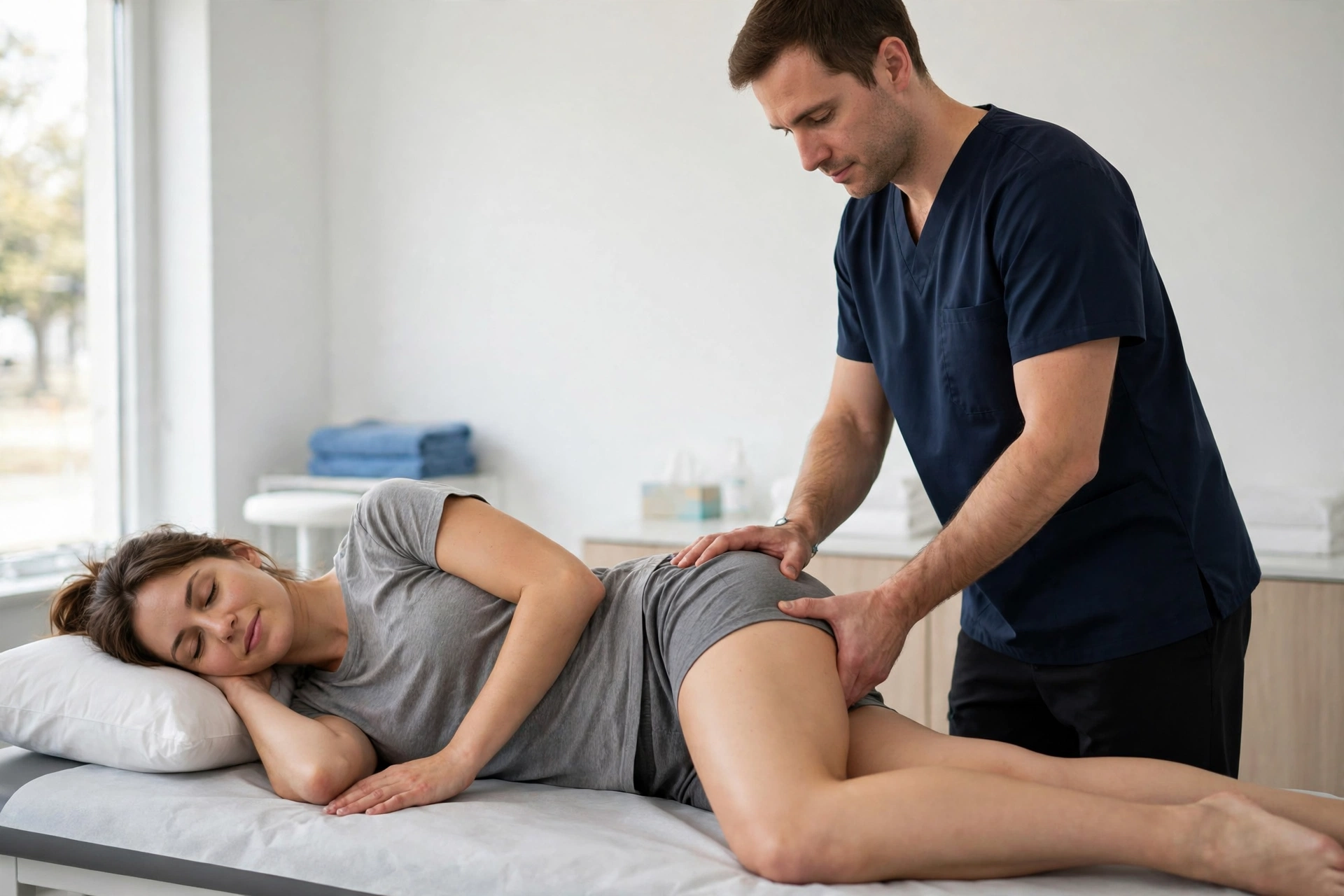
The first session is mostly assessment and planning. Your physiotherapist takes your history, examines your back, hip, and pelvis, and explains what is going on in plain language. Together, you agree on goals and on what you can and cannot do for now. You will usually leave with a few gentle stretches and clear advice about sitting, so the program starts on day one.
First, the program aims to calm the irritated muscle and nerve. Heat over the buttock can help the piriformis relax, and your physiotherapist may use hands-on treatment such as deep soft-tissue work or dry needling to ease spasm. Gentle stretching is introduced early, because a piriformis that is stretched regularly is less likely to keep pressing on the nerve. These steps are about reducing pain enough that you can move normally again.
Next, hands-on treatment can help when the hip joint and the muscles around it have stiffened. Soft-tissue work can ease tightness in the piriformis and glutes, while gentle joint mobilization can restore comfortable movement in the hip and pelvis. Your physiotherapist will also look at how you sit, stand, and walk, because the way you load the hip decides how much work the piriformis does.
As the pain settles, the program shifts to strengthening. Strong glutes take load off the piriformis, and a strong core keeps the pelvis steady when you walk and run. Exercises progress in stages, from gentle activation that does not provoke the nerve to loaded exercises for walking, stairs, and sport. Alberta Health Services publishes a short set of piriformis exercises, including the hip internal rotator stretch and the piriformis stretch, in their guide to piriformis syndrome exercises.
Finally, activity builds back in stages, each added only when the muscle tolerates the previous one. Sitting tolerance improves first, then walking distance, then running or sport if those are your goals. A typical program runs about six to eight weeks, with sessions two to three times a week at the start and less often as you improve. Some people feel much better in two to three weeks, while others need a few months, especially if the problem has been there a while.
Every program is tailored to the individual, but most follow a similar progression. The right stretch should feel like a gentle pull in the buttock, not a sharp pain, and it should not send pain further down the leg. If an exercise causes sharp pain, numbness, or pain that lingers for more than a day, it needs adjusting. Do not start a new program on your own if you have leg weakness, worsening numbness, or bladder or bowel changes; get assessed first.
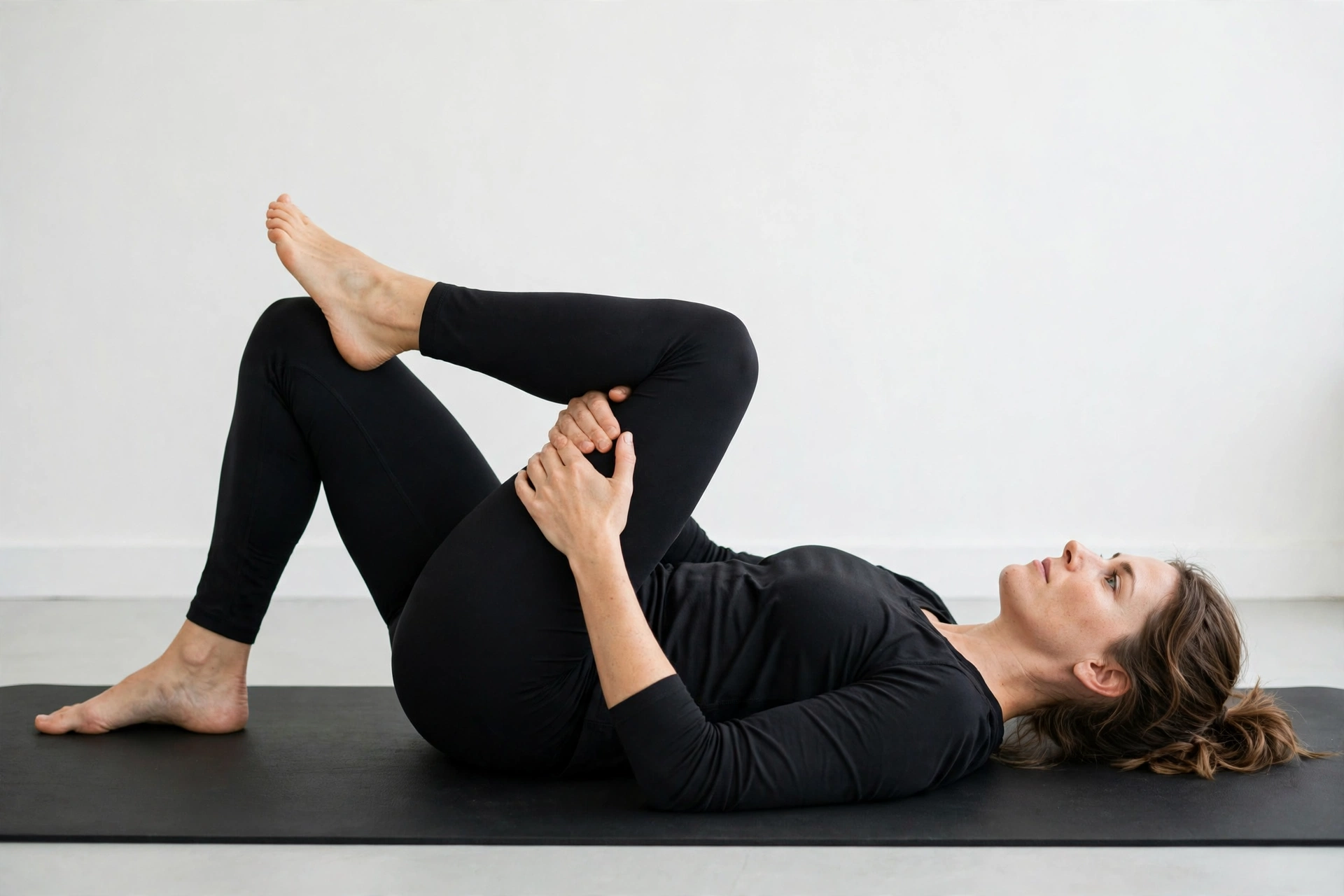
Your physiotherapist will adjust the exercises as you progress. Mild muscle effort during exercise is normal, but sharp pain, numbness, or pain that spreads further down the leg are signs the program needs adjusting.
Piriformis syndrome improves with consistency, not with a single treatment. Stretching once in a while will not fix it, and neither will resting completely. The muscle needs regular stretching, gradual strengthening, and changes to the habits that irritated it.
First, the focus is on reducing pain and finding comfortable ways to sit and move. Gentle stretches several times a day, heat over the buttock, and avoiding long sitting usually bring the first improvement, and sitting tolerance often improves before anything else.
Next, strength work progresses as the pain settles. The glute and core exercises get harder, walking distance increases, and sitting becomes comfortable for longer. Most people notice a clear improvement by this stage, though pain may still flare after a long drive or a hard training day.
Finally, loading builds toward your normal activities, with a graded return to running or sport. Most mild cases improve in about four to six weeks, while longer-standing cases can take two to three months. If there has been no meaningful improvement after about three months, or the pain keeps returning, the diagnosis and treatment should be reassessed with your doctor. A return to sport needs a plan, and our guide to sports injury physiotherapy in Brooks explains how return-to-sport testing works.
Once the pain settles, a few habits keep it away:
Most cases of piriformis syndrome improve well with physiotherapy, but some signs mean you should see a doctor promptly:
If you notice any of these, book a medical assessment rather than pushing through. Otherwise, piriformis syndrome is well suited to a physiotherapy-first approach once the diagnosis is confirmed.
Most mild cases improve in about four to six weeks with regular stretching, strengthening, and changes to sitting habits, while longer-standing cases can take two to three months. The exact time depends on how long the problem has been there, how much sitting or running you do, and how consistently you follow the program.
Yes, and walking usually helps. Standing and walking tend to ease piriformis pain, while sitting makes it worse. Short, frequent walks are better than one long walk, and you should stop and rest if pain spreads further down the leg or numbness appears.
Sitting is usually worse. The piriformis is held short and compressed while you sit, which irritates the nerve beside it, while walking keeps the muscle moving and the hip working. That is why most people feel better on their feet than in a chair.
There is no single quick fix, but the fastest route is usually a combination: an accurate assessment, daily piriformis stretches, glute strengthening, hands-on treatment to calm the muscle, and breaking up long sitting. People who stretch daily and keep up the strength work improve noticeably faster than people who rely on stretching alone.
Almost never. Surgery is only considered in rare cases where the nerve is severely compressed, other treatments have failed over many months, and imaging confirms the piriformis is the cause. Most people recover fully with physiotherapy and changes to their daily habits.
Deep buttock pain does not have to decide how long you can sit, drive, or run. For most people, a staged physiotherapy program calms the irritated muscle and nerve, rebuilds the strength that takes load off the piriformis, and returns them to activity with fewer flare-ups than before. The earlier you start, the sooner sitting, walking, and running feel comfortable again.
If you have a deep ache in one buttock that gets worse when you sit and spreads down the back of your thigh, book an assessment at Mission Health Physiotherapy in Brooks. Call (403) 794-0111 or email missionhealthpt@gmail.com. The clinic is at 740 Alberta St W, Brooks, AB T1R 1A9. You can usually book without a doctor’s referral, though some insurance plans require one for reimbursement, so check your policy before your first visit.
Your physiotherapist will assess your back, hip, and pelvis, explain what is going on in plain language, and build a plan around your goals.
This article is for general information only and is not a substitute for medical advice. If you develop leg weakness, worsening numbness, changes in bladder or bowel control, or severe pain after a fall, seek medical care promptly. Always follow the guidance of your physiotherapist or doctor for your individual situation.