
Whiplash Physiotherapy in Brooks: learn about whiplash symptoms, grades, treatment options, recovery stages and when to seek professional care after a car accident.
You were stopped at a red light when the car behind you did not stop in time. The impact was not huge, and you walked away from it. But the next morning, your neck was stiff, your head was pounding, and turning to check your blind spot hurt. That is whiplash, and it is the most common injury after a rear-end collision.
Whiplash happens when the head is thrown backward and then forward in a sudden, forceful motion, like the crack of a whip. The muscles, ligaments, and joints of the neck are stretched beyond their normal range in a fraction of a second. The damage is often invisible. There is no broken bone and no bleeding, so many people assume they are fine and wait. But whiplash symptoms often appear 24 to 72 hours after the accident, and without proper care, a simple neck strain can turn into months of pain, headaches, and stiffness.
The good news is that most whiplash injuries respond very well to physiotherapy, especially when treatment starts early. This guide explains whiplash physiotherapy in Brooks in plain language: what whiplash is, the symptoms to watch for, how it is graded and diagnosed, the treatment options that work, the stages of recovery, and how MVA insurance covers your care in Alberta.
Whiplash is a neck injury caused by a sudden acceleration-deceleration movement of the head. In a rear-end collision, the car is pushed forward, the body follows the seat, and the head lags behind, snapping backward. Then the head rebounds forward. This rapid back-and-forth movement strains the muscles and ligaments of the neck, irritates the small joints between the vertebrae, and can injure the discs and nerves.
Whiplash is also called a cervical acceleration-deceleration injury, or CAD injury. The term covers a range of injuries, from a mild muscle strain to more serious damage involving the discs, joints, and nerves. Doctors grade it using the Quebec classification, known as Whiplash Associated Disorders (WAD):
Most people after a car accident have Grade I or Grade II whiplash. These grades recover well with physiotherapy. Grade III needs more careful assessment, and Grade IV is a hospital emergency.
It is important to know that the severity of the car damage does not predict the severity of the injury. A low-speed collision at 15 km/h can cause significant whiplash, while a harder impact sometimes causes less. Your symptoms and your examination matter far more than the state of the bumper.
Rear-end car collisions are the number one cause of whiplash, but they are not the only one.
In Brooks, most whiplash cases we see come from motor vehicle accidents on Highway 1 and the surrounding roads, and from sports injuries. Whatever the cause, the injury and the treatment are the same: the neck needs assessment, gentle movement, and a graded return to normal activity.
Whiplash symptoms often do not appear right away. Adrenaline after an accident can mask pain for hours, and the inflammation that causes stiffness builds up over a day or two. It is common for symptoms to start 24 to 72 hours after the accident, which is why many people are surprised when they wake up sore two days later.
Common symptoms of whiplash:
Some people also notice that their symptoms flare up with certain movements, like looking over the shoulder while driving, or after sitting at a desk for a long time. Headaches after whiplash are very common and often come from the irritated joints and muscles at the top of the neck, not from a head injury. But any head strike, loss of consciousness, or worsening headache needs a medical check, because whiplash and concussion often happen together. You can read our guide on concussion physiotherapy in Brooks to understand the overlap.
If your symptoms are getting worse instead of better after a few days, or if you have numbness, weakness, or severe dizziness, book an assessment promptly. Early treatment makes recovery faster and reduces the risk of the pain becoming chronic.
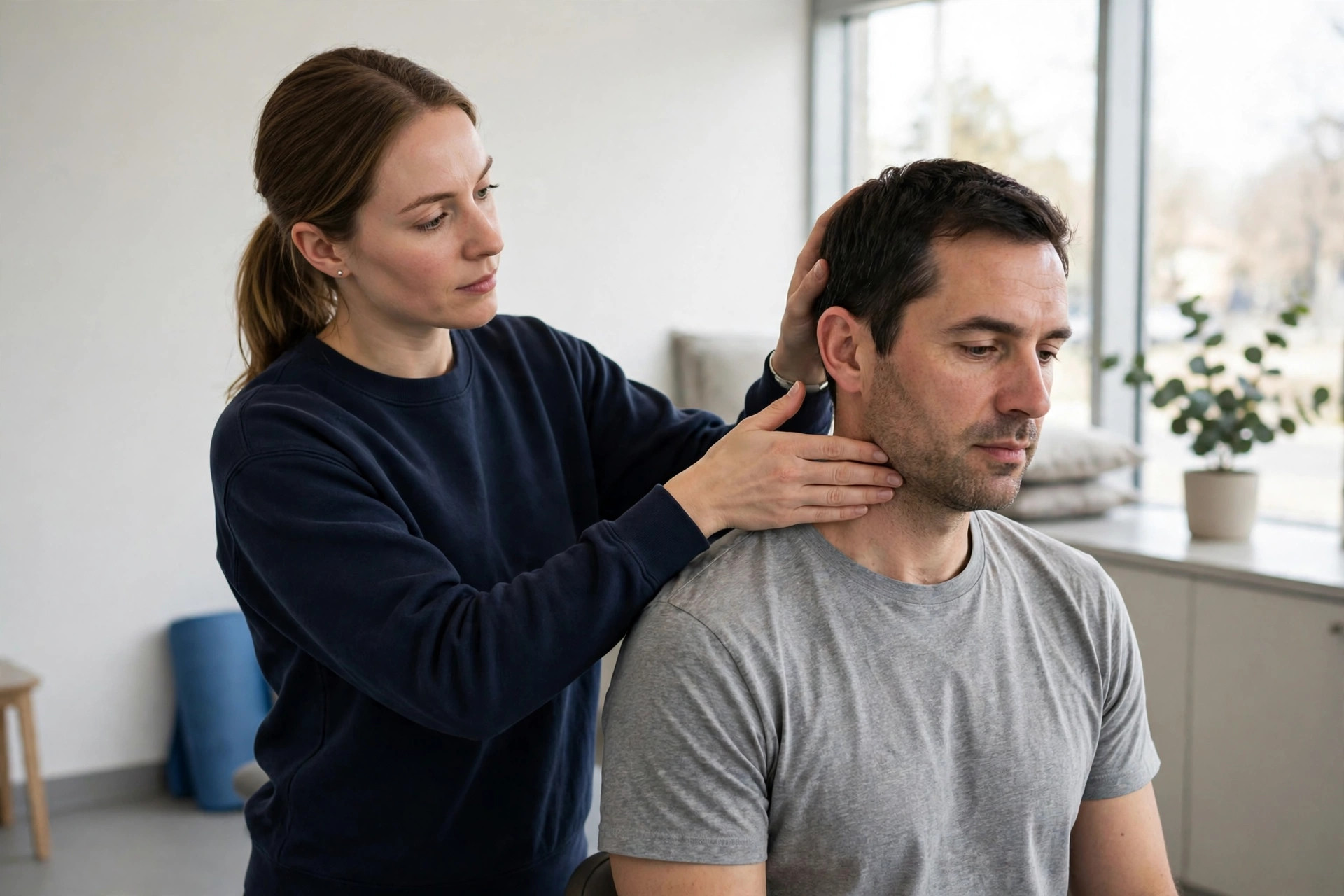
A whiplash diagnosis starts with a thorough physiotherapy assessment. There is no single test that proves whiplash. The diagnosis comes from your history, your symptoms, and a hands-on examination.
At your first visit, the physiotherapist will ask about the accident: how it happened, the direction of the impact, whether you were wearing a seatbelt, whether the airbags deployed, and whether you lost consciousness. They will ask about your symptoms, when they started, what makes them better or worse, and whether you have had neck problems before.
The physical examination includes:
Imaging is not always needed. X-rays are used when a fracture is suspected, for example after a high-speed crash or in older adults. An MRI is ordered when nerve symptoms persist, when the pain does not improve as expected, or when the doctor needs to check the discs and soft tissues. Most Grade I and Grade II whiplash is diagnosed and treated without any imaging at all.
Your physiotherapist will also screen for red flags that need a doctor’s attention right away: severe or worsening neurological symptoms, unexplained weight loss, fever, a history of cancer, or pain that wakes you at night and does not ease. If any of these are present, you will be referred to a physician the same day.
There is no single treatment for whiplash. The best results come from a combination of hands-on treatment, guided exercise, and education, matched to the stage of your recovery. Here are the options your physiotherapist may use.
Hands-on treatment is often the first step, especially when the neck is stiff and painful. Gentle joint mobilization restores movement in the small joints of the neck. Soft tissue release and massage ease muscle spasm and improve blood flow. The goal is not to force the neck, but to calm it down and restore normal movement a little at a time. Many people feel a clear difference after the first few sessions.
Exercise is the backbone of whiplash recovery. In the early days, the focus is on gentle range-of-motion movements: slow neck turns, chin tucks, and shoulder rolls. As pain settles, the program progresses to strengthening the deep neck muscles, the upper back, and the shoulders, which support the neck and prevent the pain from coming back. Your physiotherapist will teach you the exercises, watch you do them, and progress them as you improve. You will also get a home program, because what you do between visits matters as much as the treatment itself.
Dry needling targets the tight, painful knots in the neck and shoulder muscles, called trigger points, that often develop after whiplash. A fine needle is inserted into the tight muscle, which helps it relax and reduces pain. It is not the same as acupuncture, though it uses similar needles. Many people with stubborn neck pain after whiplash find dry needling helps where massage alone does not. You can read our guide on dry needling in Brooks to learn how it works.
Therapeutic massage reduces muscle tension, improves circulation, and helps with the headaches and sleep problems that often follow whiplash. It works best combined with exercise and manual therapy, not on its own. Our registered massage therapists work alongside the physiotherapy team, so your massage is part of your treatment plan, not a separate service. See our guide on massage therapy in Brooks for more detail.
For whiplash pain that has become chronic, particularly where tendons and soft tissues are involved, shockwave therapy can help. It uses sound waves to stimulate healing in damaged tissue and reduce pain. It is a short, in-clinic treatment, and it is often used when progress has stalled with exercise and manual therapy alone. Read our guide on shockwave therapy in Brooks to see who it helps.
This is the part people underestimate. Understanding what whiplash is, why it hurts, and what to expect changes the outcome. People who understand their injury recover faster than people who fear it. Your physiotherapist will explain what is safe to do, what to avoid, how to set up your workstation and your car seat, and how to sleep comfortably. Fear of movement is one of the biggest reasons whiplash becomes chronic, and good education prevents it.
Whiplash recovery follows a pattern, and treatment changes at each stage. Knowing the stages helps you understand where you are and what comes next.
Pain and stiffness are at their worst. The goal is to calm the tissues down: gentle movement, ice or heat as advised, manual therapy, and advice on sleeping positions and daily activities. Complete rest and neck collars are no longer recommended, except for a day or two in severe cases. Gentle movement from the start leads to a faster recovery than bed rest.
Pain starts to settle, and stiffness becomes the main problem. Treatment shifts to restoring full range of motion and starting light strengthening. Dry needling and massage are often added at this stage. Most people return to work and light duties during this period, with modifications if needed.
The focus is on building strength and endurance in the neck, shoulders, and upper back. Exercises get harder, and the program includes movements that mimic your work and sport. Headaches and dizziness usually fade during this stage. If symptoms persist beyond this point, your physiotherapist will reassess and adjust the plan, and may refer you for imaging or a medical review.
The final stage is a graded return to everything you did before the accident: full work duties, driving, sport, and heavy lifting. The program includes exercises that prepare the neck for sudden movements and sustained postures. Most people with Grade I and II whiplash are fully recovered within 6 to 12 weeks. A small number take longer, especially if treatment started late, if there are nerve symptoms, or if there was a previous neck injury. Even then, continued physiotherapy and a good home program lead to steady improvement.

These are general exercises your physiotherapist may teach you. Do not start them on your own if your pain is severe, if you have numbness or weakness, or if you have not been assessed yet. Your physiotherapist will confirm which ones are safe for you and how many repetitions to do.
Do these exercises slowly, breathe normally, and stop if you feel sharp pain, dizziness, or numbness. Mild discomfort that settles within a few minutes is normal. Pain that lasts for hours afterward means you did too much, and you should tell your physiotherapist so the program can be adjusted.
One of the most common questions after a car accident is who pays for physiotherapy. In Alberta, the answer is straightforward.
You do not need a doctor’s referral to see a physiotherapist after a motor vehicle accident. You can book directly. Most auto insurance policies in Alberta cover physiotherapy for injuries from a motor vehicle accident, and clinics that treat MVA injuries usually bill the insurer directly, so you do not pay out of pocket for your approved treatment.
At Mission Health in Brooks, we work with MVA claims every week. We help you understand your coverage, we document your injuries and your progress for your claim, and we communicate with your insurer and your lawyer if you have one. The sooner you start treatment, the stronger your recovery and your claim, because early assessment creates a clear record of your injuries.
If you were in an accident, book an assessment even if your symptoms seem mild. Whiplash symptoms often appear days later, and a baseline assessment on day one protects both your health and your claim. You can read about our full MVA service on our motor vehicle accident injury care page.
Book an assessment promptly after any car accident, even if you feel fine on the day. And seek urgent medical care, or go to the emergency department, if you notice any of these red flags:
For most people, the right time to see a physiotherapist is within the first few days after the accident. Early treatment means less pain, faster recovery, and a much lower chance of the problem becoming chronic. If you have been living with whiplash pain for months, it is still worth booking an assessment. Chronic whiplash responds to physiotherapy too, it just takes a longer, more gradual program.
Mission Health Physiotherapy and Sports Rehab in Brooks treats motor vehicle accident injuries every week, and whiplash is one of the most common injuries we see. Our physiotherapists assess the full picture, not just the sore neck: your range of motion, your strength, your nerves, your posture, and how the injury affects your work, your sleep, and your daily life.
We offer the full range of whiplash care under one roof: hands-on manual therapy, guided exercise programs, dry needling, therapeutic massage, and shockwave therapy, so your treatment is not limited to one approach. We also handle the MVA paperwork, direct billing to your insurer, and communication with your care team, so you can focus on recovery instead of administration.
Our clinic is at 740 Alberta Street West in Brooks, with free parking and a team that knows the local roads, the local workplaces, and the realities of life in Brooks and the County of Newell. If your neck pain is linked to back pain or headaches, we treat those together, because the body does not work in separate parts. You can read our guides on physiotherapy for neck pain in Brooks and physiotherapy for back pain in Brooks to see how we approach these connected problems.
Most people with mild to moderate whiplash (Grade I and II) recover within 6 to 12 weeks with physiotherapy. Some feel much better in 2 to 3 weeks. Recovery takes longer if treatment starts late, if there are nerve symptoms, if you had a previous neck injury, or if the accident was severe. A small number of people have symptoms for several months, and they still improve with continued treatment and a good home exercise program.
In most cases, no. Soft collars were once routine, but research now shows that wearing a collar for more than a day or two slows recovery. Gentle movement from the start leads to better outcomes than immobilization. A collar may be used briefly in severe cases, or for comfort during a long drive, but your physiotherapist will advise you on this. Never wear a collar for days without guidance.
It depends on your symptoms. If turning your head to check blind spots is painful or restricted, driving is not safe, and you should not drive until your range of motion improves. Your physiotherapist can test your neck rotation and tell you when it is safe. Most people return to driving within 1 to 3 weeks.
In Alberta, most auto insurance policies cover physiotherapy for injuries from a motor vehicle accident. You do not need a doctor’s referral. Clinics experienced in MVA care, including ours, bill the insurer directly for approved treatment. Bring your claim number and your insurer’s details to your first visit, and we will help you with the paperwork.
That is normal. Whiplash symptoms commonly start 24 to 72 hours after the accident, and sometimes up to a week later. Delayed onset does not mean the injury is less serious, and it does not affect your insurance claim. Book an assessment as soon as you notice symptoms, and tell your physiotherapist when the accident happened and when the symptoms started.
Whiplash is painful and frustrating, but it is very treatable. The people who recover fastest are the ones who get assessed early, keep moving gently, follow their exercise program, and stay in touch with their physiotherapist. Waiting and hoping it goes away on its own is the one approach that consistently makes things worse.
If you were in a car accident in or around Brooks, or if your neck has been sore since a collision weeks ago, book an assessment at Mission Health Physiotherapy and Sports Rehab. We will find out exactly what is injured, explain it in plain language, and build a treatment plan that gets you back to work, driving, and living without neck pain.
Mission Health Physiotherapy and Sports Rehab
740 Alberta St W, Brooks, AB T1R 1A9
Phone: +1 403-794-0111
Email: missionhealthpt@gmail.com
Website: www.missionhealthphysio.ca
Book your whiplash assessment today and take the first step toward a pain-free neck.