
You twisted your knee during a game of hockey, or you stood up from a crouch at work and felt something catch inside the joint. Now every step reminds you of it. The knee aches along the joint line, it swells after activity, and stairs have become a negotiation. If that sounds familiar, you may be dealing with a meniscus tear, one of the most common knee injuries we see at Mission Health Physiotherapy in Brooks.
A torn meniscus does not always mean surgery. In fact, for many people, structured physiotherapy is the first and best treatment, and research supports it. A well-known trial of middle-aged adults with degenerative meniscus tears found that 12 weeks of supervised exercise therapy produced results at two years that were not meaningfully different from keyhole surgery. The 2024 International Consensus Statement on meniscal injuries likewise recommends physiotherapy as the first-line treatment for degenerative tears.
This guide explains meniscus tear physiotherapy in Brooks in plain language: what the meniscus is, how tears happen, the symptoms to watch for, how a physiotherapist assesses and treats the injury, the exercises that rebuild strength, how long recovery usually takes, when surgery is worth discussing, and how to protect the knee afterwards.
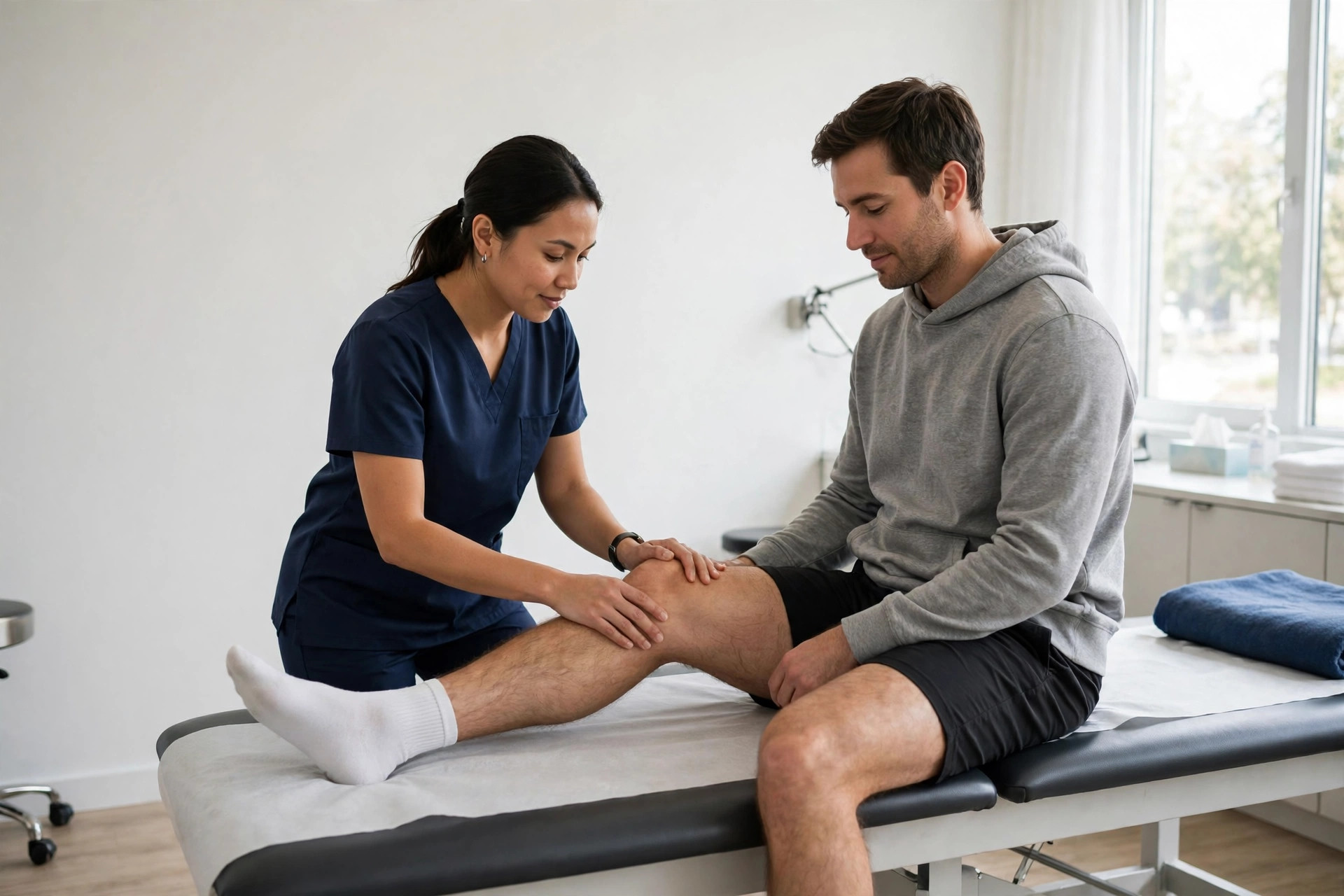
Inside each knee sit two C-shaped pads of cartilage called the menisci. One sits on the inner side of the knee (the medial meniscus) and one on the outer side (the lateral meniscus). They act as shock absorbers between the thigh bone and the shin bone, spreading weight across the joint, cushioning impact, and helping the knee move smoothly.
A meniscus tear is damage to one of these pads. The tear can be small and stable, or larger and unstable, with a flap of cartilage that catches as the knee moves. The type of tear matters because it shapes the treatment plan. Tears are described by their pattern and location, and some patterns, such as a bucket-handle tear, where a larger section of cartilage shifts toward the centre of the knee, can cause the knee to lock and may need prompt medical attention.
The meniscus has a limited blood supply. The outer edge receives blood and can heal better, while the inner portion has almost no blood supply and heals poorly on its own. That is why physiotherapy does not try to glue the cartilage back together. Instead, it rebuilds the strength, control, and movement around the knee so the joint can work well again even when the cartilage itself stays changed.
Meniscus tears happen in two main ways, and the cause shapes the recovery plan.
In younger, active people, a meniscus tear usually follows a sudden movement. The classic story is a planted foot with a twisting knee: turning quickly during soccer, basketball, or hockey, landing awkwardly from a jump, or pivoting while the foot stays fixed. Contact sports add the risk of a direct blow to the knee while it is bent. Deep squatting under load, especially combined with a twist, can also tear the meniscus.
These acute tears often arrive with a clear moment. You remember the twist, the pop, or the landing. Pain and swelling follow within hours, and the knee may feel unstable for days afterwards.
In people over 40, the meniscus gradually becomes thinner, drier, and less flexible. The cartilage loses some of its resilience, and a tear can happen during an ordinary movement: turning to reach for something, squatting to pick up a box, kneeling in the garden, or stepping awkwardly off a curb. There may be no single moment of injury at all. The pain builds over days or weeks, and the knee starts to feel stiff, achy, and unreliable.
Work can play a role too. Jobs that involve frequent kneeling, crouching, heavy lifting, climbing, or working in tight spaces put repeated load through the knee. Over years, that load adds up. A degenerative tear often appears alongside early knee arthritis, and both can contribute to the same pain and stiffness, which is why a proper assessment looks at the whole knee, not just one structure.
Weakness in the quadriceps, hamstrings, and hip muscles leaves the knee less protected. Poor balance and stiff ankles or hips can also change how load travels through the knee. Previous knee injuries, including ligament damage, raise the risk, and meniscus tears often occur together with an ACL injury in twisting sports injuries. Our guide to ACL rehabilitation in Brooks explains how the two injuries are managed when they happen together.
A meniscus tear does not always announce itself the same way. Some people feel a sharp pain at the moment of injury, while others notice a dull ache that grows over days. The most common symptoms are:
A locked knee deserves special attention. If the knee physically will not bend or straighten, and it feels stuck rather than just stiff, a piece of cartilage may be blocking the joint. That needs prompt medical review rather than waiting to see if it settles.
Not every click means a tear. Knees click for many harmless reasons. But clicking combined with swelling, joint-line pain, catching, or reduced movement should be assessed. If you are unsure whether your pain fits this pattern, our guide to knee pain physiotherapy in Brooks explains how different knee problems are told apart.
A meniscus tear is diagnosed from your story, a hands-on assessment, and imaging only when it is needed.
Your physiotherapist will ask how the pain started, whether there was a twist or a fall, how long the symptoms have lasted, what makes them better or worse, and what your work and activity demands are. Bring a list of medicines you take, and mention any previous knee injuries or surgery. The pattern of your symptoms often points toward the meniscus before any test is done.
The assessment looks at the whole leg. Your physiotherapist will check how far the knee bends and straightens, feel along the joint line for tenderness, test the strength of the quadriceps, hamstrings, and hip muscles, and watch how you walk, squat, and balance. A few specific clinical tests can suggest a meniscus tear, but no single test confirms every tear, so the findings are always considered together. The assessment also checks the hip, ankle, and lower back, because stiffness or weakness above and below the knee changes how the joint is loaded.
An X-ray does not show the meniscus, because cartilage does not appear clearly on it. It may still be used to rule out a fracture or to look at joint-space changes and early arthritis. An MRI can show a meniscus tear clearly, but it is not always needed before starting physiotherapy. Imaging is usually considered when there is persistent locking, significant trauma, unusual findings, or limited progress with conservative care. Many people begin the meniscus tear physiotherapy Brooks clinics offer without an MRI, because the treatment plan is built around your symptoms and function, not the picture alone.
Knee pain has many causes, and some look similar to a meniscus tear. An ACL injury, a ligament sprain, patellar tendinopathy, iliotibial band syndrome, or arthritis can all cause pain in the same area. A careful assessment sorts these out, because the treatment for each is different. Our guide to IT band syndrome physiotherapy in Brooks covers one of the common lookalikes for outer knee pain.
Physiotherapy for a meniscus tear is not a single treatment. It is a structured program that changes as your knee improves, built around your goals, your work, and the activities you want to return to. Here is what the process looks like at Mission Health in Brooks.
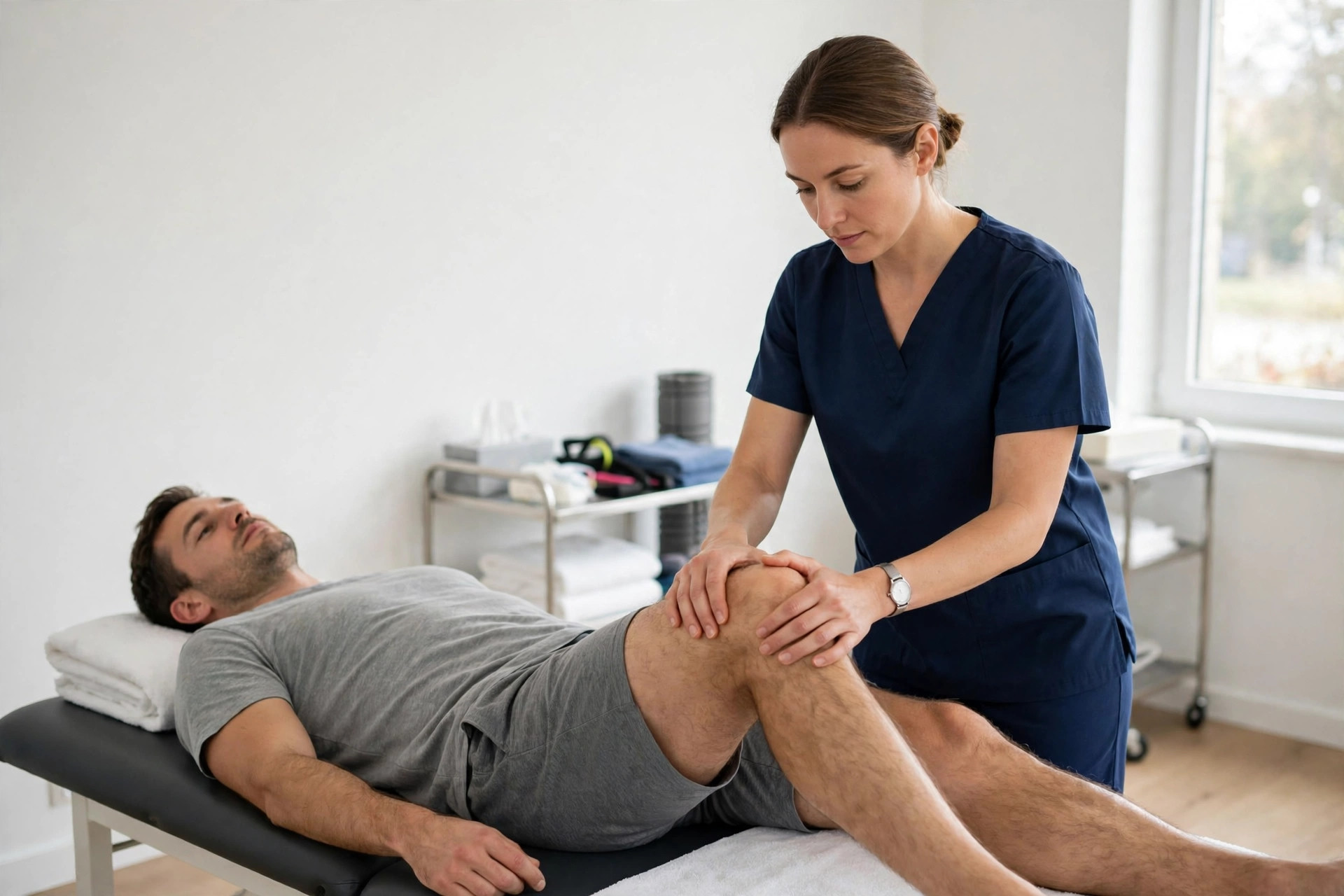
The first session is mostly assessment and planning. Your physiotherapist takes your history, examines the knee, and sets a baseline: how far the knee moves, how strong the leg is, how you walk, and which movements hurt. Together you agree on goals that matter to you, whether that is walking without a limp, getting back to the rink, kneeling at work, or simply climbing stairs without thinking about it. You will leave with a home exercise program and clear guidance on what to do and what to avoid in the first days.
The early phase has one job: settle the joint. Pain and swelling make the quadriceps switch off, and a quiet quadriceps lets the knee stay weak. Treatment in this phase may include ice, gentle hands-on techniques to restore movement, and advice on activity modification. Complete rest is rarely the answer unless your doctor advises it. Relative rest is the approach: you avoid the movements that flare the knee, while keeping comfortable movement going so the joint stays mobile and the muscles stay active.
Hands-on treatment can reduce joint stiffness, ease muscle tension around the knee, thigh, and hip, and help restore the ability to bend and straighten fully. It is always combined with exercise, because manual therapy alone does not rebuild strength. Think of it as opening a window: it makes movement more comfortable so the strengthening work can happen.
Strength is the core of meniscus tear physiotherapy in Brooks. The quadriceps, hamstrings, and hip muscles act as a living brace for the knee. When they are strong and well coordinated, the meniscus carries less load. The program progresses in stages, from gentle activation to loaded strengthening, always guided by how the knee responds. Mild discomfort during exercise can be normal, but sharp pain, or pain that lingers for more than an hour afterwards, is a sign the load was too high and the program needs adjusting.
A torn meniscus often leaves the knee feeling unstable, partly because the joint’s sense of position is disturbed. Balance training retrains that sense, teaching the knee where it is in space and how to react to uneven ground. Gait retraining, how you walk, and coaching on how to squat, step, and turn without twisting the loaded knee are part of the later phases. These skills matter most for people returning to sport or to physically demanding work.
Understanding the injury changes how you manage it. You will learn which movements to avoid for now, how to pace activity through the day, and how to tell the difference between normal exercise soreness and a flare-up. For people whose work involves kneeling or heavy lifting, the plan includes practical strategies for the job site, not just the clinic.
Every program is tailored to the individual, but most meniscus tear rehabilitation programs follow a similar progression. These are the exercises commonly used. Do not start a new exercise program on your own if your knee is locked, severely swollen, or unable to bear weight; get assessed first.
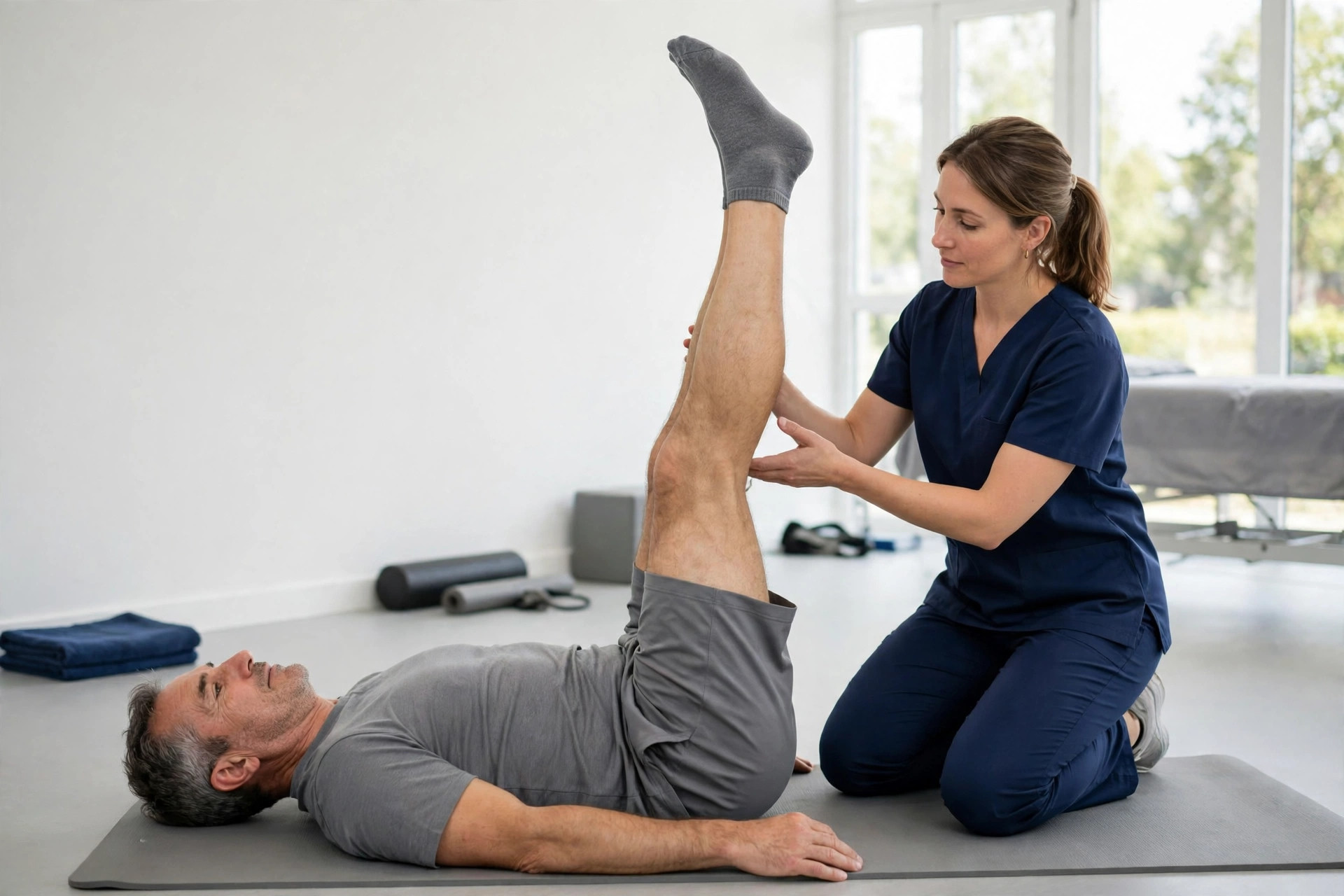
The first exercises are gentle and low-load. Their purpose is to reduce swelling, restore movement, and wake the quadriceps up.
As pain and swelling settle, the program adds load. The goal is a leg that can handle walking, stairs, and work without the knee complaining.
When strength and movement are close to normal, the program adds the skills you need for real life.
Your physiotherapist will adjust the exercises, the repetitions, and the resistance as you progress. What matters is not the exact exercise list, but the principle behind it: load the knee a little more each week, and let the symptoms guide the pace.
Recovery from a meniscus tear is measured in milestones, not dates on a calendar. The timeline below is a realistic guide for tears managed without surgery, but your own timeline depends on the tear, your age, your starting strength, and how consistently you follow the program.
Swelling begins to settle and pain at rest eases. The focus is on restoring full straightening of the knee, switching the quadriceps back on, and walking with a normal pattern. Most people can walk short distances, though stairs may still hurt.
Walking becomes noticeably more comfortable. Bending improves, and the strengthening program moves from gentle activation to loaded exercises such as bridges and step-ups. If there has been no meaningful improvement after about six weeks of consistent physiotherapy, the diagnosis and tear characteristics should be reassessed rather than simply pushing the exercises harder.
Most people can climb and descend stairs with little or no pain by this stage. Strength work progresses, balance training begins in earnest, and cycling or swimming may return. Many people feel substantially better by eight to twelve weeks, which matches the length of the structured exercise programs used in the research.
Noticeable change from non-operative rehabilitation typically appears within three to six months. People who follow their program consistently can often return to light recreational activity without recurring symptoms. Return to demanding sport takes longer and depends on strength testing, not just on how the knee feels day to day.
Recovery after a partial meniscectomy, where the unstable fragment is trimmed, is often faster, with light activity possible within days to a few weeks and a return to sport or strenuous activity in about six to eight weeks with post-operative physiotherapy. A meniscal repair, where the tear is stitched rather than trimmed, needs a slower course, often three to six months, because the repaired tissue must be protected while it heals. Your surgeon sets the limits, and your physiotherapist works within them.
In Alberta, the funded post-surgical physiotherapy window covers hip and knee replacement surgery. It does not cover meniscus tear rehabilitation. Most people fund meniscus tear physiotherapy in Brooks through extended health benefits, a workplace plan, a health spending account, motor vehicle accident benefits, or private payment. Check your plan for your annual allowance, whether a doctor’s referral is required, and whether direct billing is available.
Most meniscus tears do not need surgery. For the common age-related degenerative tear, structured physiotherapy gives results comparable to keyhole surgery, and surgery is reserved for specific situations.
Surgery may be discussed when the knee locks or cannot straighten, when a large unstable tear causes repeated catching, when symptoms do not settle after a fair trial of rehabilitation, usually around three months, or when the tear is combined with a ligament injury that needs surgical repair. Younger, active people with a traumatic tear in the blood-rich outer zone may also be candidates for repair, because their tissue has a better chance of healing.
The two common operations are different. A meniscus repair stitches the torn tissue together to preserve as much cartilage as possible, and it requires a slower, protected recovery. A partial meniscectomy trims away the unstable fragment, which often allows a faster return to activity but leaves less cushioning in the joint. Your surgeon will explain which option, if any, fits your tear and your goals. Physiotherapy is valuable on either side of surgery: before it, to build strength and movement, and after it, to restore function safely.
If your tear is similar to the kind that follows a joint replacement, the recovery principles overlap. Our guide to knee replacement rehabilitation in Brooks explains how post-surgical knee rehabilitation is structured.
You cannot make the meniscus new again, but you can reduce the chance of another tear and keep the knee working well for years.
People with early arthritis alongside a meniscus tear need the same long-term approach, and our guide to arthritis physiotherapy in Brooks explains how the two are managed together.
Yes, many meniscus tears improve with physiotherapy, activity changes, and strengthening. The cartilage itself may not heal fully, especially in the inner zone where there is little blood supply, but the knee can become pain-free and strong because the muscles and movement around it compensate. Healing potential depends on the tear’s location, size, and blood supply, your symptoms, and how the knee responds to rehabilitation.
Recovery varies with the tear type, your age, your activity demands, and how consistently you follow the program. Milder tears managed conservatively often improve within four to six weeks, while a fuller structured program to restore strength and function typically spans eight to twelve weeks. Noticeable change from non-operative rehabilitation usually appears within three to six months. A surgical repair often needs four to nine months before demanding activity is cleared.
Not usually. An MRI is not always needed before beginning physiotherapy, and many people start treatment based on the assessment alone. Imaging may be considered when symptoms involve persistent locking, significant trauma, unusual findings, or limited progress with conservative care.
Many people can walk with a torn meniscus, although pain, swelling, limping, or reduced confidence may occur. Walking distance and intensity should be adjusted according to how the knee responds. If the knee is locked, severely swollen, or unable to bear weight, seek prompt medical care rather than walking on it.
Avoid deep squats, deep lunges, and twisting or pivoting on the loaded knee in the early phase. Forced deep bending and sudden direction changes can irritate the tear and increase swelling. These movements can return gradually as strength, control, and pain-free movement improve, but only when your physiotherapist clears them.
A meniscus tear does not have to mean months on the sidelines or an operation. For many people, a structured physiotherapy program restores strength, movement, and confidence, and the evidence supports trying it first. Meniscus tear physiotherapy Brooks patients receive at Mission Health follows that same evidence-based approach. The earlier you start, the sooner the quadriceps wakes up, the swelling settles, and the knee starts to feel like yours again.
If your knee has been catching, swelling, or aching after a twist or a simple everyday movement, book an assessment at Mission Health Physiotherapy in Brooks. Call (403) 794-0111 or email missionhealthpt@gmail.com to book an assessment. The clinic is at 740 Alberta St W, Brooks, AB T1R 1A9. You can usually book without a doctor’s referral, though some insurance plans require one for reimbursement, so check your policy before your first visit.
Your physiotherapist will assess the knee, explain what is going on in plain language, and build a plan around your goals, whether that is walking without pain, getting back to work, or returning to the sport you love.
This article is for general information only and is not a substitute for medical advice. If your knee is locked, severely swollen, unable to bear weight, or accompanied by fever, increasing redness, numbness, or major weakness, seek prompt medical care. Always follow the guidance of your physiotherapist or doctor for your individual situation.