
ACL rehabilitation Brooks patients trust starts the day the knee is injured, not the day of surgery, and it is the part of recovery that decides whether you get back to your sport, your work, and your life without the knee giving way again. Surgery can rebuild the ligament, but the months of guided exercise afterwards teach the new ligament how to hold, the muscles how to protect the knee, and you how to trust the leg again.
If you have torn your ACL, or your surgery is coming up soon, this guide explains exactly what to expect: what the ACL does and how it tears, whether you need surgery, what the first 12 months look like, which exercises matter most, how return-to-sport testing works, and what physiotherapy costs in Alberta.
Most people in Brooks have their ACL surgery at a hospital in Medicine Hat, Lethbridge, or Calgary, and then come home to recover. That is where ACL rehabilitation Brooks begins, and where Mission Health Physiotherapy can help you through every step. This guide is general information. Always follow your own surgeon’s instructions first.
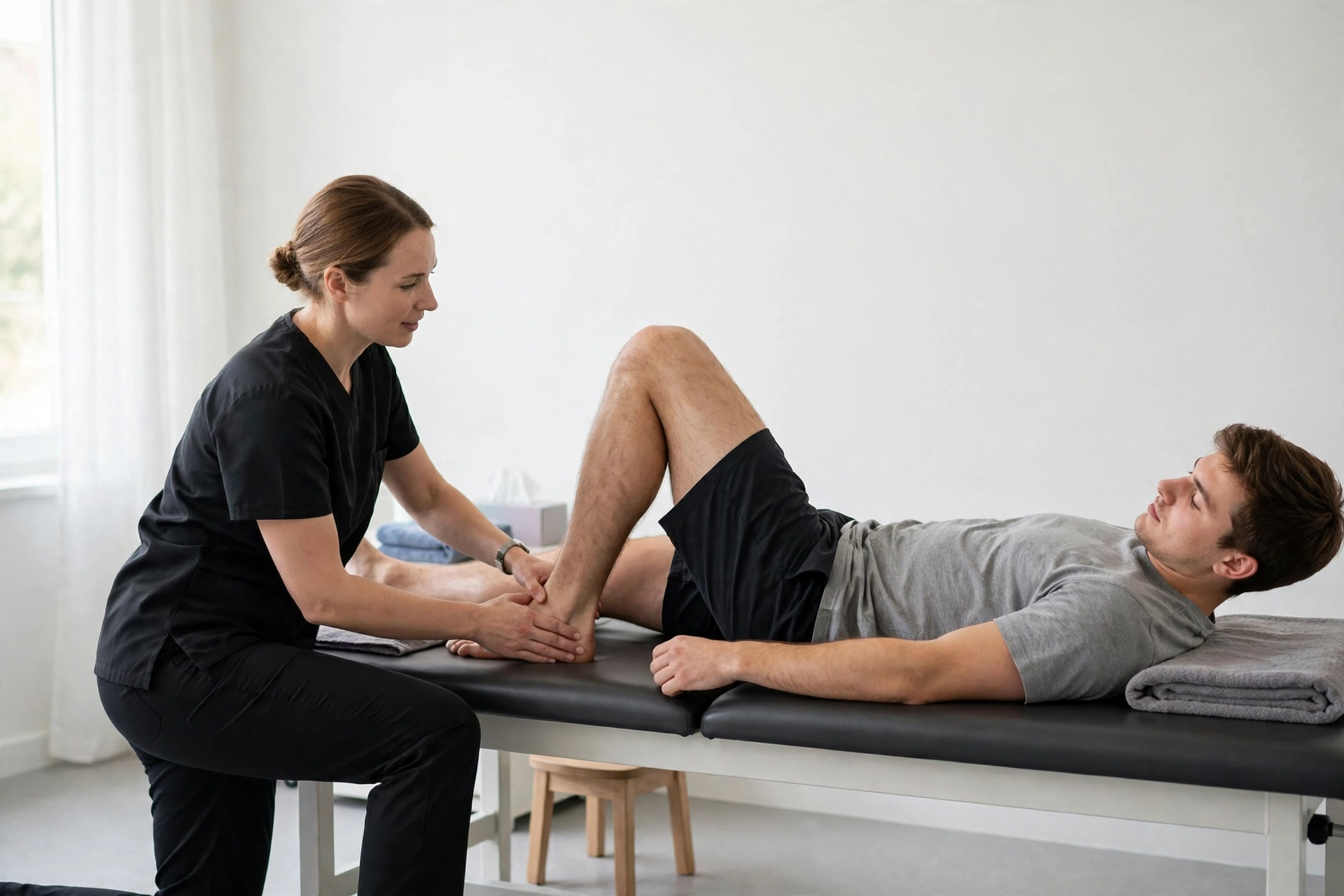
The ACL, or anterior cruciate ligament, is one of the four main ligaments inside your knee, a short, strong band connecting your thigh bone to your shin bone. Its job is to stop the shin bone from sliding too far forward and to control the twisting of the knee. When you cut, pivot, land from a jump, or stop suddenly, the ACL is what keeps the knee stable.
An ACL tear usually happens in a moment. Players describe hearing or feeling a pop, then the knee swells within a few hours, and the leg feels unstable, as if it might give way. It is one of the most common serious knee injuries in soccer, basketball, volleyball, skiing, and hockey, and it also happens in everyday life, on an icy sidewalk, on a ladder, or in a fall at work. The meniscus, the cushion of cartilage inside the knee, is often injured at the same time.
Not every ACL tear needs surgery. That is a decision you make with your surgeon, based on your age, how active you are, how unstable the knee feels, and whether other parts of the knee are damaged. Young, active people who want to return to pivoting sports usually have surgery. People who do not play pivoting sports can sometimes manage well without it.
In simple words, ACL rehabilitation Brooks physiotherapists provide is a guided program of exercise, hands-on treatment, and education that helps you move again after an ACL tear. It is for you whether or not you have surgery, and it runs in phases: first calm the knee down and get it moving, then build strength, then train balance and control, and finally prepare you for your sport.
Why does it matter so much? Because an ACL injury is not only a ligament problem. Within days, the quadriceps muscle starts to switch off and shrink, the knee stiffens, and the brain changes how you walk to protect the leg. That changed pattern can strain your other knee, your hip, and your lower back. If you have already noticed back pain from walking differently, our guide to physiotherapy for back pain in Brooks explains how that kind of pain is treated. Rehabilitation reverses all of this, step by step, and protects you from a second injury, because a knee that returns to sport weak is far more likely to tear again.
Most ACL rehabilitation Brooks plans follow the same broad pattern, but the pace is personal. Your age, your strength before the injury, the type of surgery you had, and your surgeon’s instructions all shape the timeline. The most important idea is that progress is based on tests, not on dates: you move to the next phase only when your knee passes its checks.
The first two weeks are about protecting the healing knee while getting it moving again. The goals are to control swelling, regain full knee extension, wake up the quadriceps muscles, and reach about 90 degrees of bending. Full extension, getting the knee completely straight, is the single most important early goal. A knee that cannot fully straighten early on is much harder to fix later.
Exercises in this phase are gentle: quad sets, heel slides, ankle pumps, and kneecap glides. You will walk with crutches and put only as much weight through the leg as your surgeon allows. Ice and elevation, 15 to 20 minutes several times a day, keep the swelling down.
If you are still waiting for surgery, physiotherapy before surgery, called prehab, focuses on reducing swelling, restoring full movement, and building strength. People who go into surgery with a calm knee and strong quadriceps recover faster afterwards.
By two to six weeks, the swelling has settled and the knee bends more easily. The goals now are a normal walking pattern, full knee extension, bending to about 120 degrees or more, and enough quadriceps strength to straighten the knee against gravity. Most people move from two crutches to one, then to walking without any aid, usually by four to six weeks.
Your physiotherapist will add straight leg raises, mini squats, step-ups, stationary cycling with very little resistance, and gentle hamstring curls. The bike is one of the best tools in this phase, because it moves the knee through its range many times without loading it heavily. Balance work begins too, with weight shifts and standing on the operated leg.
Walking well matters more than walking far. A limp that feels harmless now can become a lasting habit, so your physiotherapist will watch your step length and whether you are leaning away from the operated leg. If walking differently has left your knee sore, our guide to knee pain physiotherapy in Brooks can help.
From six to twelve weeks, the work gets serious. The graft, the new ligament your surgeon placed, is at its weakest around this time, which sounds worrying, but it is normal. The graft is slowly turning into a living ligament, and your job is to build the muscles around it so the knee is protected while that happens.
The exercises now include loaded strength work: leg press, squats, Romanian deadlifts, hamstring curls with weight, calf raises, and single-leg balance work. Your physiotherapist will measure your quadriceps strength regularly, aiming for the operated leg at roughly 70 to 80 percent of the other leg by three months. Gentle jogging in a straight line on a treadmill starts too, but only if your strength tests allow it and your surgeon clears it.
This is the phase where many people stop coming, because the knee feels good enough for daily life. But daily life is not sport, and a knee that feels fine around the house is not ready for cutting or pivoting.
From three to six months, the program shifts from the gym to movement. Straight-line running becomes outdoor running, then come hopping, landing practice, and cutting at low speed. Your physiotherapist will teach you how to land: knees bent, knees over toes, soft and quiet, never stiff-legged with the knee collapsing inward.
Strength work continues and gets heavier. Single-leg squats, single-leg Romanian deadlifts, lateral lunges, and jumping drills build the power and control your sport demands. Balance and agility training now includes reacting to a ball or a sudden cue, because sport is never predictable. If you play a sport with a lot of cutting, like soccer or basketball, our guide to sports injury physiotherapy in Brooks explains how sport-specific training fits into recovery.
By six months, most people feel close to normal. But feeling ready and being ready are two different things, and that is what the final phase is for.
The last phase is about proving the knee is ready, not just feeling ready. Return to sport usually happens between 9 and 12 months after surgery, and the exact timing depends on your test results, not the calendar. Returning to pivoting sport before 9 months carries a much higher risk of tearing the graft again, so patience here is protection.
This phase is built around your sport: sprinting, cutting at full speed, and jumping and landing under fatigue, because injuries happen late in games when muscles are tired, not in the first five minutes. Your physiotherapist will also work on confidence, because many athletes hold back on the operated leg without realising it, and that hesitation itself raises the risk of a second injury.
These are the exercises your physiotherapist will most likely give you across the phases of ACL rehabilitation Brooks programs. Do them exactly as instructed, and never push through sharp pain. Your surgeon may set limits, especially if your meniscus was repaired at the same time.
Early exercises, in the first weeks, wake the muscles up without stressing the healing ligament. Quad sets: with your leg straight, tighten the thigh muscle and press the back of your knee flat into the bed, hold for 5 seconds, and repeat 10 to 15 times. Heel slides: lying on your back, slowly slide your heel toward your buttocks to bend the knee, then slide back. Straight leg raises: tighten your quadriceps first, then lift the straight leg a short distance off the bed and lower it slowly. Ankle pumps: flex your foot up and down, 20 times every hour while you are awake.
Strength exercises, from about six weeks onward, rebuild the muscles that protect the knee. Mini squats: stand holding a counter and lower into a shallow squat, knees tracking over your second toe. Step-ups: step up onto a low step with the operated leg leading, then step down slowly. Hamstring curls: bend the knee to bring your heel toward your buttocks, with a light ankle weight once your physiotherapist clears it. Bridges: lying on your back with knees bent, lift your hips until your body forms a straight line from shoulders to knees. Calf raises: rise onto your toes slowly and lower slowly, first with both feet, then on one foot.
Balance and control exercises teach the knee to react quickly. Single-leg balance: stand on the operated leg for 30 seconds, first on firm ground, then on a cushion. Weight shifts: stand with feet apart and slowly shift your weight from side to side, keeping your knees soft.
Agility exercises come last, from about four to six months: lateral shuffles, figure-eight running, and cutting drills at increasing speed. Landing practice: jump off a low box and land softly on both feet, knees bent, knees over toes, then progress to landing on one foot. Deceleration drills: sprint a short distance and stop under control, because stopping is when the ACL is loaded most.
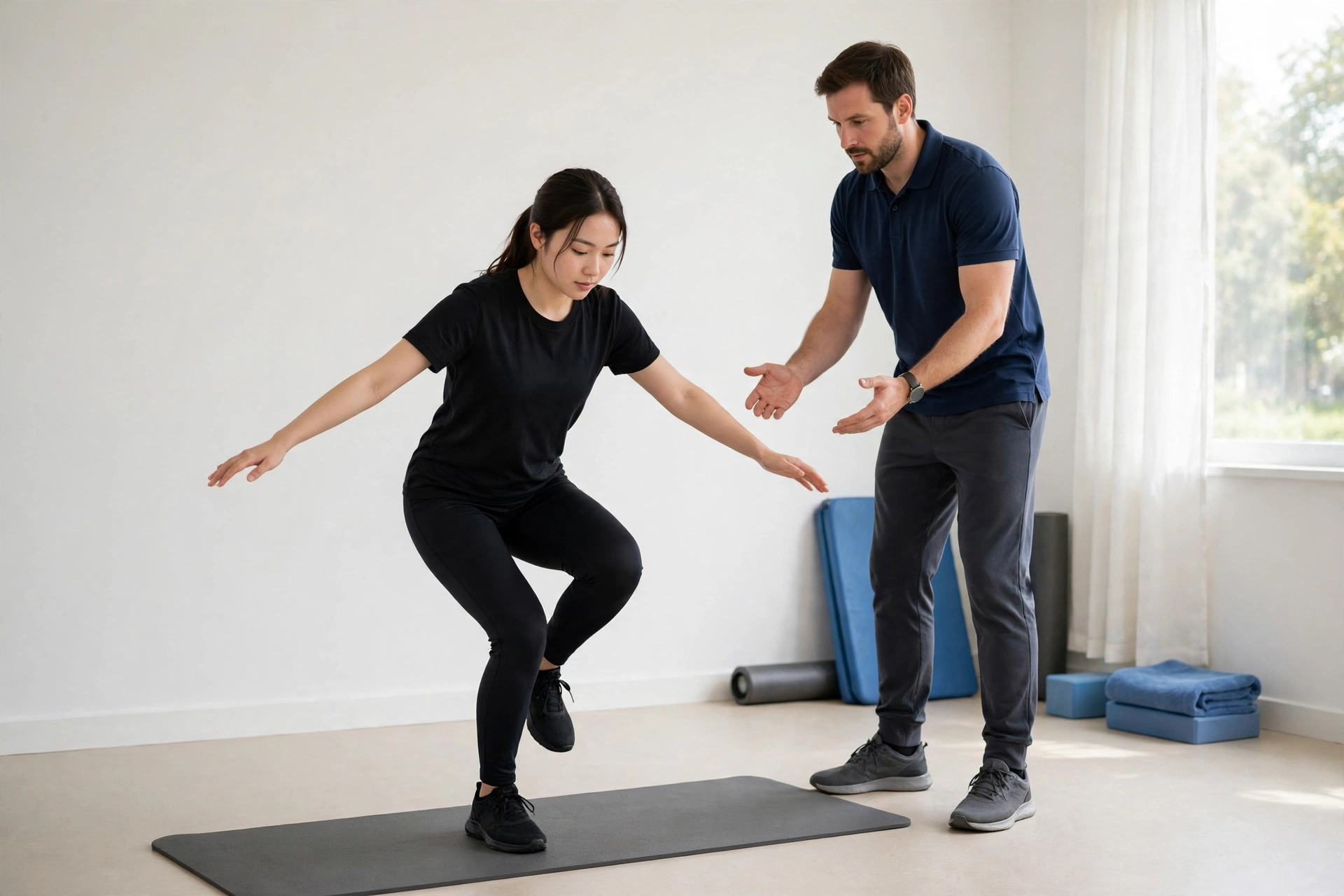
Frequency matters more than duration. Two or three short sessions a day, 10 to 15 minutes each, work better than one long session that leaves the knee hot and swollen. Do your exercises even on days the knee feels good, because strength is built by consistency.
Feeling ready is not the same as being ready. Return-to-sport testing is a set of measurements that proves the knee can handle your sport. At Mission Health, we test before we clear you, and we do not clear you until you pass.
Strength testing compares the operated leg with the other leg. Your quadriceps and hamstrings are measured, and the operated leg should reach at least 90 percent of the strength of the other leg. This matters because the quadriceps protects the ACL most, and it is also the muscle that loses the most strength after injury and surgery. A leg that is still 30 percent weaker is not ready for sport, no matter how good it feels.
Hop testing measures power and control: a single hop for distance, a triple hop, a crossover hop, and a timed hop, each done on both legs and compared. The operated leg should reach at least 90 percent of the other leg on every test, and the landing should look clean, with the knee tracking over the toes. A knee that hops far but lands with the knee caving inward is not ready.
Movement quality is tested too. Your physiotherapist watches you squat, land, cut, and change direction, looking for the patterns that load the ACL: the knee collapsing inward, the trunk leaning away from the operated leg, or landing stiff-legged. These patterns can be retrained, but only if they are spotted before you return.
Psychological readiness counts as well. Many athletes pass the physical tests but still do not trust the knee, and that hesitation changes how they move. If fear is holding you back, we work on it gradually until the knee feels like yours again.
The rule is simple: you return to sport when you pass the tests, not when the calendar says so. Most people pass between 9 and 12 months. Some need longer, and that is fine. A few extra months of training is a small price for a knee that lasts.
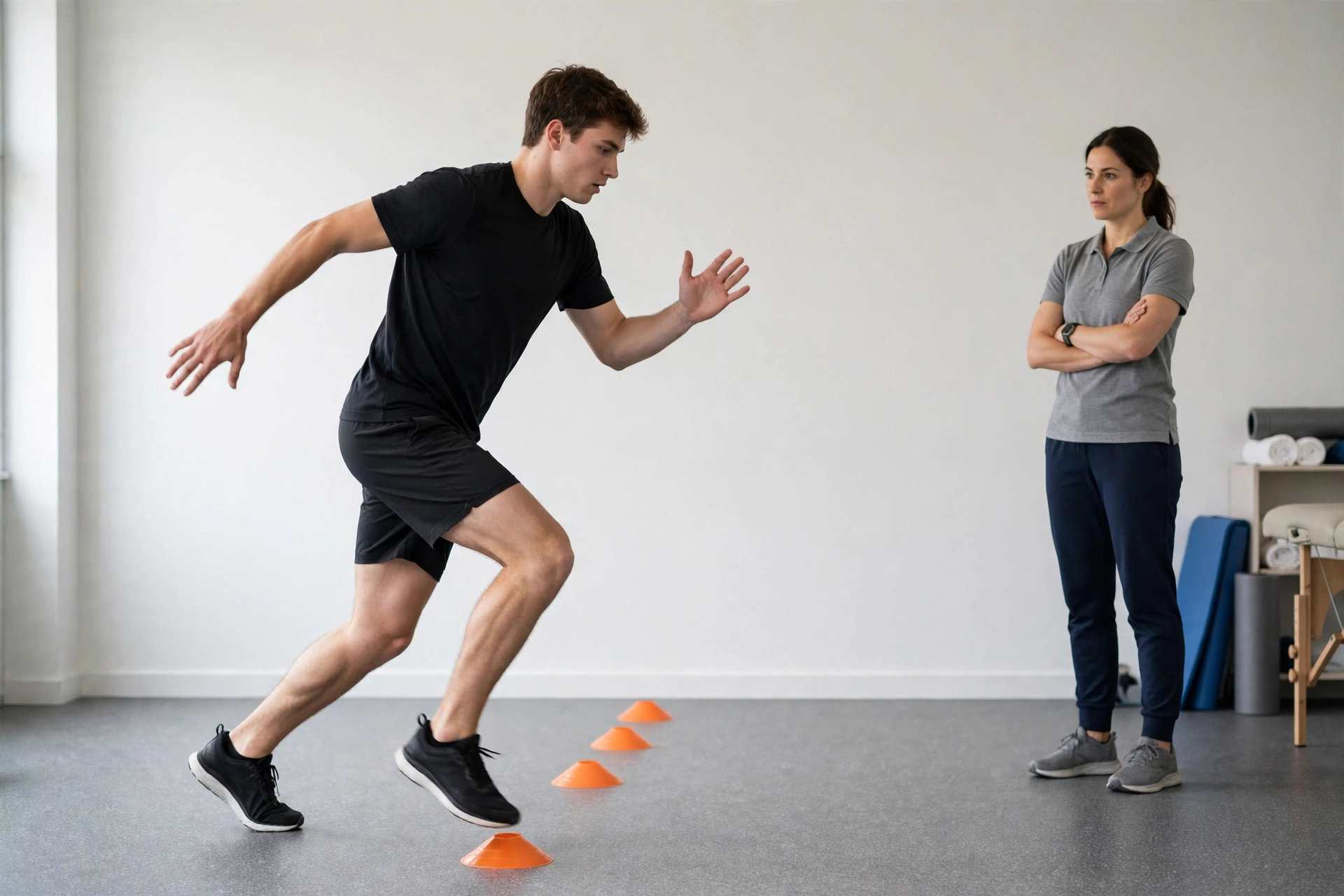
Some pain and swelling after ACL surgery is normal, and it lasts longer than most people expect. Swelling often comes and goes for three to six months, usually worse after a busy day or a hard exercise session. That does not mean something is wrong.
Ice is your best friend in the first weeks. Apply an ice pack to the knee for 15 to 20 minutes, several times a day, especially after exercise, with a thin cloth between the ice and your skin. Never fall asleep with ice on your knee. Elevation helps too: when you rest, raise the leg so the foot is above the level of your heart.
Take your pain medicine as prescribed, especially in the first two weeks. Medicine works better when it is taken before the pain peaks, so do not wait until the pain is severe. If you are worried about your medicine, talk to your surgeon or pharmacist rather than stopping it on your own.
Learn the difference between hurt and harm. A mild ache or tightness during and after exercise is normal. Sharp pain, a sudden increase in swelling, a knee that locks or catches, or pain that keeps you awake all night is a signal to slow down and talk to your physiotherapist.
Most slow recoveries during ACL rehabilitation Brooks programs are not caused by the injury. They are caused by a handful of avoidable mistakes, and knowing them in advance is half the protection.
The first is stopping too early. The knee feels good at three months, but the graft is at its weakest between three and six months, exactly when the knee needs guided strengthening most.
The second is skipping strength work. Walking and cycling are not enough. Only loaded strength training, squats, deadlifts, and single-leg work, rebuilds the quadriceps to the level your sport needs.
The third is returning to sport too soon. Every month before 9 months that you return to pivoting sport raises the risk of tearing the graft again.
The fourth is ignoring the other leg. It takes more load while the operated leg recovers, so a good program trains both legs.
The fifth is training through sharp pain or swelling that does not settle within 24 hours. Soreness is normal, but pain that changes how you walk means the load was too much. Tell your physiotherapist so the program can be adjusted.
Not everyone with an ACL tear has surgery, and rehabilitation without surgery, called conservative management, works well for the right person. It is a realistic choice if you do not play pivoting sports, if your knee feels stable in daily life, or if surgery is not possible for medical reasons.
The program looks similar to the post-surgery program, but without the early protection phase. The focus is on building very strong quadriceps and hamstrings, excellent balance, and movement patterns that keep the knee stable without a ligament. Some people, called copers, adapt so well that they return to most activities without the knee giving way. Others, called non-copers, keep feeling the knee slip, and usually go on to have surgery later.
There are honest limits to this choice. Without an ACL, pivoting and cutting sports carry a real risk of the knee giving way, and each episode can damage the meniscus or the cartilage. That is why the decision should be made with your surgeon, and why the rehabilitation needs to be taken just as seriously as it would be after surgery. If your knee keeps giving way, surgery remains an option later.
If your knee pain is not from an ACL injury at all, but from general wear or arthritis, our guide to arthritis physiotherapy in Brooks explains how that kind of knee pain is treated, and if your knee has already been replaced, our guide to knee replacement rehabilitation in Brooks explains that recovery week by week.
This is a fair question, and the answer is different from hip and knee replacement. Alberta Health Services funds an initial assessment and a set number of physiotherapy visits for people who have had a total or partial hip or knee replacement within the last 12 weeks. ACL reconstruction is not part of that program, so the AHS 12-week funded window does not apply to ACL rehabilitation Brooks patients.
Most people cover ACL rehabilitation through private health insurance, employer benefits, or a health spending account. If your injury happened at work, the Workers’ Compensation Board, WCB, may cover your treatment, and we can help with that paperwork. If you were injured in a car accident, your auto insurance may cover physiotherapy. The worst choice is to skip rehabilitation because of cost, because a second injury costs far more than the first program.
Book your first appointment early, even if your surgery is still weeks away. Prehab improves your result, and having your program ready means you start moving the moment your surgeon clears you.
ACL rehabilitation Brooks patients do at Mission Health starts with a full one-on-one assessment. We measure how far your knee moves, test your strength and balance, watch how you walk, and listen to what matters most to you, whether that is getting back on the soccer field, getting back to work, or simply walking without fear that the knee will give way.
From there, we build a program around your goals: hands-on treatment to improve movement, a home exercise program that progresses week by week, gait retraining so you walk evenly again, strength and balance work that builds toward your sport, and return-to-sport testing so you know, with numbers, when you are ready. We also help with the practical side: stairs, getting in and out of a car, driving, and talking to your surgeon about your progress.
You do not need to travel to Medicine Hat or Calgary for your rehabilitation. Our Brooks clinic is at 740 Alberta St W, Brooks, AB T1R 1A9. Call us at +1 403-794-0111 or email missionhealthpt@gmail.com to book an assessment. The sooner you start, the stronger your knee will be.
Full ACL rehabilitation Brooks programs usually run 9 to 12 months. Daily activities often feel normal by 3 to 6 months, but pivoting sport needs the full timeline, because the graft is still maturing and the knee needs strength and hop testing first. People who manage without surgery usually need 2 to 4 months of guided rehabilitation.
Not always. It depends on your age, how active you are, how unstable the knee feels, and whether other parts of the knee are damaged. Young, active people who want to return to pivoting sports usually have surgery. People who do not play pivoting sports can sometimes manage well without it. Make the decision with your surgeon, and start physiotherapy either way.
Most people move from two crutches to one around two to three weeks, and walk without any aid around four to six weeks. Your surgeon sets the weight-bearing rules, especially if your meniscus was repaired, and your physiotherapist will make the call based on your strength and walking pattern, not just the calendar.
Straight-line jogging usually starts around three to four months, but only if your strength tests allow it and your surgeon clears it. Agility, cutting, and pivoting come later, from six months onward, and full return to sport needs passing your strength and hop tests, usually between 9 and 12 months.
It is possible for some people, but returning to pivoting sport before 9 months carries a much higher risk of tearing the graft again. That is why we test strength, hop performance, and movement quality before clearing you, rather than clearing you on a date.
The AHS 12-week funded physiotherapy program covers total and partial hip and knee replacement, not ACL reconstruction. Most people use private insurance, employer benefits, WCB, or auto insurance. Ask us and we will help you check your coverage before you start.
ACL rehabilitation Brooks patients stick with is the difference between a knee that works and a knee that keeps giving way. Surgery gives you a new ligament. Rehabilitation teaches that ligament how to hold, teaches your muscles how to protect it, and teaches you how to trust your leg again.
Start early, do your exercises little and often, keep your appointments, and ask for help the moment something stalls. If you have recently torn your ACL, or your surgery is coming up, call Mission Health Physiotherapy in Brooks at +1 403-794-0111 to book an assessment.