
Reaching for a shelf, lifting a bag of groceries, or throwing a ball should not hurt. But if every overhead movement sends a sharp pinch through the front of your shoulder, you may be dealing with shoulder impingement. It is one of the most common causes of shoulder pain in adults, and it affects office workers, tradespeople, athletes, and parents alike. The good news is that most cases improve without surgery, and physiotherapy is the treatment with the strongest evidence behind it.
Shoulder impingement physiotherapy Brooks residents rely on starts with finding out exactly what is being pinched and why. At Mission Health Physiotherapy in Brooks, your physiotherapist looks at how your shoulder blade moves, how strong your rotator cuff is, and how your posture and daily habits affect the joint. From there, you get a plan built around your shoulder, your work, and your goals, not a generic handout.
This guide explains what shoulder impingement is, what causes it, the symptoms to watch for, how physiotherapy helps, the exercises that work, and when you should get checked sooner rather than later. If you live or work in Brooks and shoulder pain is limiting your day, this is your starting point. If your shoulder pain does not match the pattern described here, our shoulder pain physiotherapy guide in Brooks covers the other common causes.

Your shoulder is a ball-and-socket joint, and it has the largest range of motion of any joint in the body. That freedom comes with a trade-off: the joint relies heavily on muscles and tendons to stay stable. At the top of the shoulder sits a bony roof called the acromion. Between the acromion and the ball of the upper arm bone (the humerus) is a narrow gap called the subacromial space. Through that gap pass the tendons of the rotator cuff, most often the supraspinatus tendon, and a small fluid-filled cushion called the subacromial bursa.
Shoulder impingement happens when the tendons or the bursa get pinched or rubbed in that narrow space as you lift your arm. The pinching irritates the tissue, the tissue swells, the space gets even narrower, and the cycle continues. Clinicians often call this subacromial pain syndrome, and it accounts for roughly 44 to 65 percent of all shoulder pain complaints, making it the most common shoulder problem physiotherapists see.
It is worth knowing that the word “impingement” describes a set of symptoms rather than a single injury. Some people have a hooked-shaped acromion that leaves less room. Others have weak rotator cuff muscles that let the ball of the joint ride upward. Many have a stiff upper back, tight chest muscles, or a shoulder blade that does not move well. In most cases, several of these factors work together. That is why a proper assessment matters more than a label: two people with the same diagnosis often need quite different plans, and shoulder impingement physiotherapy Brooks physiotherapists provide always starts with finding your particular mix.
Shoulder impingement usually builds up slowly, though it can also start after a sudden strain, such as lifting something heavy overhead or a fall onto the shoulder. The most common symptoms include:
Pain from impingement usually stays in the shoulder and upper arm. It does not normally travel below the elbow. If you have numbness, tingling down the arm, or pain that shoots below the elbow, the cause may be in the neck instead, and that changes the plan. If you are unsure whether your pain is coming from your shoulder or your neck, a physiotherapist can sort that out in the first visit. Our guide to physiotherapy for neck pain in Brooks explains how neck problems can mimic shoulder pain.
If your symptoms match this list, you do not need to wait for them to get worse. Early treatment is simpler, shorter, and more effective than waiting until the shoulder becomes stiff and weak. With shoulder impingement physiotherapy Brooks residents can access close to home, most people improve without surgery.
Impingement is rarely caused by one thing alone. The space under the acromion is small, so anything that narrows it or changes how the shoulder moves can start the problem. The most common causes include:
Overuse and repetitive overhead work. Painters, electricians, warehouse workers, carpenters, and anyone who lifts overhead all day load the rotator cuff tendons again and again. Athletes who throw, swim, or play racquet sports face the same pattern. Over time, the tendons become irritated and thickened, and the space narrows further.
Weak rotator cuff muscles. The rotator cuff is a group of four small muscles that hold the ball of the shoulder centred in its socket. When they are weak, the ball drifts upward during lifting and squeezes the tendons. This is one of the most fixable causes, and it is the main reason strengthening is the centrepiece of treatment.
Poor shoulder blade movement. The shoulder blade must rotate upward smoothly as you lift your arm. If the muscles around the shoulder blade are weak or poorly coordinated, the blade does not move enough, and the space under the acromion stays tight. Slouched posture and a stiff upper back make this worse.
Bone shape and bone spurs. Some people are born with a curved or hooked acromion. Others develop small bone spurs under the acromion or at the acromioclavicular joint as they age. These narrow the space and make pinching more likely.
Bursitis and tendon irritation. The subacromial bursa can become inflamed, and the rotator cuff tendons can develop tendinopathy. Swollen tissue takes up more room, so even normal movement can pinch.
A stiff shoulder joint or tight posterior capsule. When the back of the shoulder capsule tightens, the ball of the joint shifts forward and upward during movement, which increases pinching. Stretching the back of the shoulder is often part of the fix.
A previous injury. A fall, a dislocation, or an old rotator cuff strain can change how the shoulder moves and leave it vulnerable to impingement months or years later.
Age plays a role too. Impingement is most common between the ages of 40 and 60, when tendons naturally become less elastic and years of use add up. But it also shows up in younger athletes and workers whose jobs demand repeated overhead movement. Whatever the cause, shoulder impingement physiotherapy Brooks patients receive follows the same principle: calm the irritation, restore strength and movement, and change the habits that keep provoking it.
Physiotherapy is the first-line treatment for shoulder impingement, and the research behind it is strong. A large study published in The Lancet in 2018, known as the CSAW trial, followed 313 people with subacromial shoulder pain and found that keyhole surgery to widen the space worked no better than a sham procedure or no treatment at all. A separate review of 36 clinical trials found that exercise improves pain and function in shoulder impingement. In plain terms, most people get better with a good exercise programme and do not need an operation.
Here is what shoulder impingement physiotherapy Brooks patients can expect at Mission Health:
A thorough assessment first. Your physiotherapist will ask about your pain, your work, your sport, and your sleep. Then they will test your range of motion, your strength, how your shoulder blade moves, and your posture. Simple clinical tests, such as the Neer and Hawkins tests, help confirm impingement. This assessment is what makes the plan personal: it shows whether your problem is mainly weakness, stiffness, poor shoulder blade control, or a mix.
Manual therapy to restore movement. Hands-on techniques can loosen a stiff shoulder joint, stretch a tight posterior capsule, and improve how the shoulder blade glides on the rib cage. Manual therapy is not a cure on its own, but it can reduce pain and make it easier to do the exercises that drive long-term recovery.
A progressive strengthening programme. This is the core of treatment. You will start with gentle isometric exercises that load the rotator cuff without moving through the painful arc, then progress to resistance band work, then to loaded overhead movement as your shoulder allows. The programme targets the rotator cuff, especially external rotation, and the muscles that control the shoulder blade, such as the lower trapezius and serratus anterior.
Posture and movement coaching. Small changes make a big difference: how you sit at your desk, how you lift at work, and how you sleep. Your physiotherapist will show you how to keep the shoulder in a better position during the tasks that hurt, so you stop re-irritating it all day.
Pain management and advice. Ice, activity modification, and pacing are often part of the early plan. Your physiotherapist will also advise you on which movements to avoid for now and which are safe to keep doing. The goal is to keep you moving without flaring the pain up.
Additional treatments when needed. Some people benefit from dry needling to release tight, painful muscle trigger points, or from massage therapy to ease muscle tension around the shoulder and neck. Your physiotherapist will tell you honestly whether these are likely to help you or whether exercise alone is the better path. Our dry needling page explains how that treatment works and who it suits.
Most people notice their pain easing within a few weeks, with steady improvement over 8 to 12 weeks. The key is consistency: the exercises at the heart of shoulder impingement physiotherapy Brooks patients follow work, but only if you do them regularly.
For a clear, plain-language overview of impingement from a leading orthopaedic hospital, see the Hospital for Special Surgery guide to shoulder impingement syndrome.
If you have never seen a physiotherapist before, the first visit is simple and nothing to worry about. It usually takes 45 to 60 minutes.
First, your physiotherapist will talk with you about your shoulder: when the pain started, what makes it better or worse, what your work and hobbies demand, and what you want to get back to. Bring a list of any medications you take and note whether you have had imaging, such as an X-ray or ultrasound.
Next comes the physical examination. You will be asked to move your arm in different directions, and the physiotherapist will test your strength and feel how the joint moves. You may be asked to wear a sleeveless top or a loose shirt so the shoulder can be seen and tested properly.
After the examination, your physiotherapist will explain what they found in plain words, what is likely causing your pain, and what the plan looks like. You will usually leave with a few exercises to start that day, advice on sleep and daily tasks, and a realistic idea of how long recovery may take.
You do not need a doctor’s referral to see a physiotherapist in Alberta. If your physiotherapist finds something that needs a doctor’s opinion, such as a suspected full rotator cuff tear or signs of another condition, they will tell you and help you get the right referral.
These exercises are the ones physiotherapists prescribe most often for shoulder impingement. They are general guidance, not a prescription for your shoulder. Start gently, keep pain at 3 out of 10 or less during the exercise, and stop if pain lingers more than a day after. If you are unsure, get assessed first and have your physiotherapist check your form.
1. Pendulum swings. Lean forward and let your sore arm hang loose. Rest your other hand on a table for support. Gently swing the hanging arm in small circles, then forward and back, for about two minutes, twice a day. This relaxes the joint and eases stiffness without loading the tendons.
2. Isometric external rotation. Stand with your elbow bent to 90 degrees and tucked at your side. Push the back of your hand gently against a door frame. Hold for 10 seconds at about half effort, then relax. Repeat five times, three times a day. This wakes up the rotator cuff without moving through the painful arc.
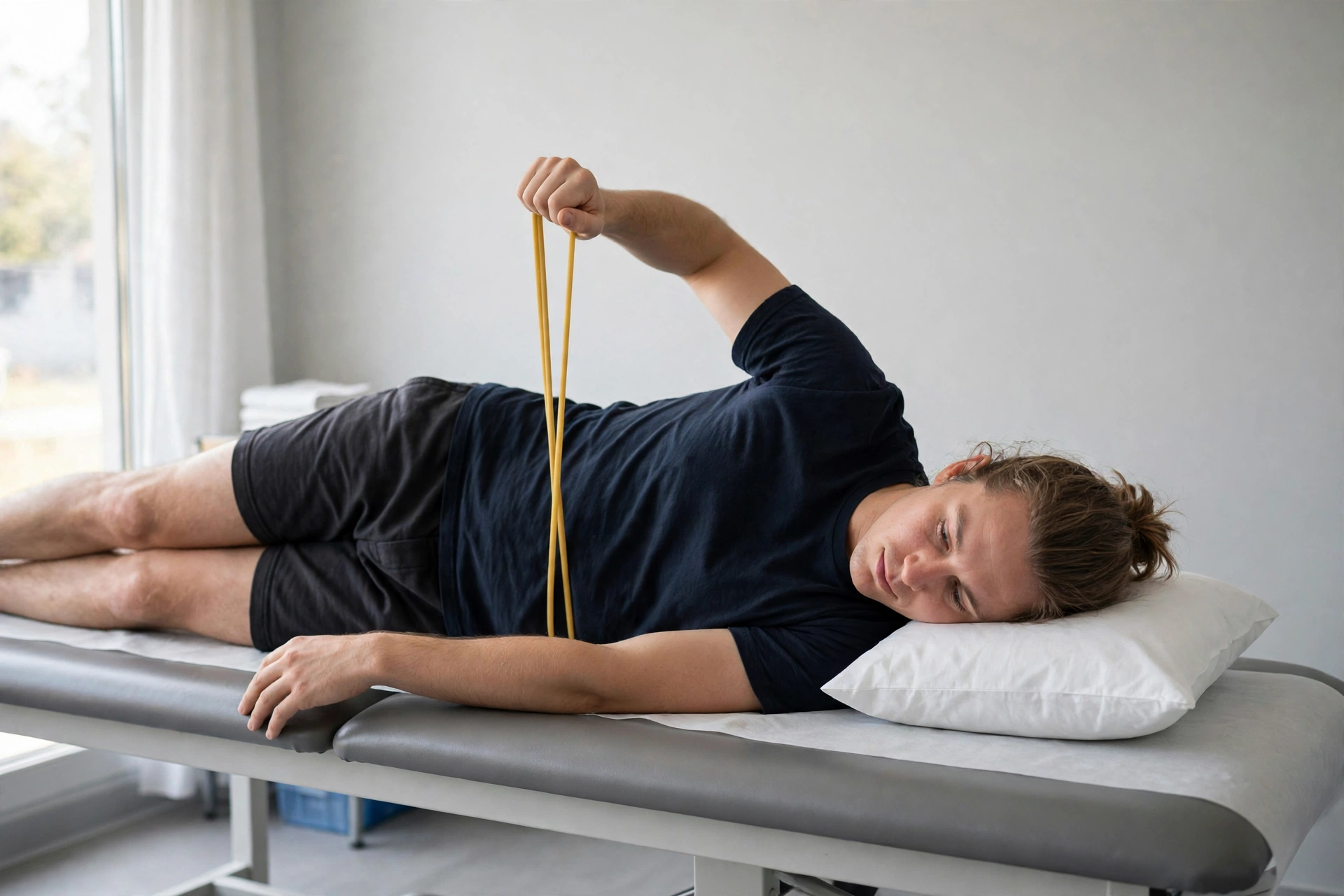
3. Side-lying external rotation. Lie on your pain-free side with a folded towel between your sore arm’s elbow and your body. Hold a light weight or a resistance band in the top hand, elbow bent to 90 degrees. Slowly rotate your forearm upward, hold for two seconds, and lower slowly. Aim for three sets of 10 to 15 repetitions. This is one of the best exercises for the infraspinatus, a key rotator cuff muscle.
4. Doorway chest stretch. Stand in a doorway, place your hand on the frame just below shoulder height, palm facing forward. Keep your shoulder down and back, and slowly turn your body away from the frame until you feel a gentle stretch across the front of your chest. Hold for 30 seconds and repeat three times. Tight chest muscles pull the shoulder forward and shrink the space under the acromion, so this stretch helps create room.

5. Scapular retraction (band rows). Hold a resistance band at chest height with both hands. Squeeze your shoulder blades together as you pull the band apart, keeping your elbows low and your chest open. Hold for two seconds, then return slowly. Do three sets of 10. Strong shoulder blade muscles help the blade rotate properly when you lift your arm.
6. Prone Y, T, and W. Lie face down on a bed or bench with your arms hanging. Raise your arms into a Y shape, then a T shape, then a W shape, holding each for a few seconds. These strengthen the lower trapezius and the muscles that stabilise the shoulder blade.
7. Scaption raises. Stand with a light weight in each hand, thumbs pointing up. Raise your arms to about 45 degrees in front of your body, in line with your shoulder blades, stopping before pain starts. Lower slowly. Do three sets of 10. The thumbs-up position keeps the space under the acromion as open as possible while the rotator cuff works.
Do these exercises most days, and progress gradually. If an exercise causes sharp pain, skip it and ask your physiotherapist for a different version. Recovery is not a no-pain, no-gain process. Mild discomfort that settles quickly is normal; sharp or lasting pain is a sign to back off.
These three conditions are often confused because they all cause shoulder pain, but they are different problems with different treatments. Getting the diagnosis right matters.
Shoulder impingement causes pain mainly with overhead movement and at night, but the shoulder usually keeps most of its range of motion, especially when someone else moves it for you. Strength may feel reduced, but the joint is not frozen.
Frozen shoulder causes a major loss of movement in all directions, including when someone else tries to move the arm. It develops in stages over months and is most common in people aged 40 to 60, especially those with diabetes or thyroid conditions. If your shoulder feels stuck as well as sore, read our guide to frozen shoulder physiotherapy in Brooks.
A rotator cuff tear can cause weakness, especially when lifting the arm, and pain at night. A small tear may feel very similar to impingement, which is why assessment and sometimes imaging are needed. A full tear may need a specialist referral. Our rotator cuff physiotherapy guide in Brooks explains how tears are assessed and treated.
While your shoulder is irritated, some movements and habits will keep the pinching going. Avoid these until your physiotherapist says otherwise:
None of these need to be avoided forever. They are temporary limits while the tissue calms down and the muscles get stronger. Most people return to all of them, including overhead sport and heavy work, with the right progression.
Recovery time depends on how long the problem has been there, how irritated the tissue is, and how consistently you do the exercises. As a rough guide:
Most people avoid surgery entirely. Surgery is usually considered only when pain persists after at least 3 months of good physiotherapy, or when imaging shows a large rotator cuff tear that needs repair. Even then, the evidence shows that surgery offers no advantage over a well-run exercise programme for most people with impingement alone.
The biggest predictor of a good outcome is not the treatment you choose, but whether you stick with the exercises. A few minutes a day, done consistently, beats an occasional long session. That is the approach shoulder impingement physiotherapy Brooks clinics build their programmes around.
Physiotherapy is the right first step for most shoulder impingement, but some signs need a doctor’s attention sooner. Book a medical appointment promptly if you notice:
If any of these apply, tell your physiotherapist. They can help you get the right medical assessment quickly.
Sometimes mild cases settle with rest, but most do not fully resolve without treatment. The tendons stay weak and the movement pattern that caused the pinching remains, so the pain often comes back with the next busy week. A structured exercise programme fixes the underlying weakness and movement, which is why it works better than rest alone.
Yes, and you should. Walking, lower-body strength work, and gentle shoulder exercises are all fine. Avoid overhead pressing and movements that reproduce sharp pain. Your physiotherapist will adjust your gym or sport routine so you stay active without flaring the shoulder.
Not usually at first. Impingement is diagnosed by history and physical examination. Imaging is useful if the pain does not improve with physiotherapy, if a tear is suspected, or if surgery is being considered. Your physiotherapist will tell you if imaging is worth pursuing.
They overlap. Bursitis means the bursa is inflamed. Impingement is the pinching mechanism that often causes the bursa to become inflamed. Many people have both at once, and the treatment is the same: reduce irritation, strengthen the rotator cuff, and restore normal movement.
Most people need 6 to 10 sessions of shoulder impingement physiotherapy Brooks clinics provide spread over 8 to 12 weeks, with a home exercise programme between visits. Mild cases need fewer; long-standing cases need more. Your physiotherapist will give you a realistic estimate after the first assessment.
Massage can ease muscle tension and reduce pain in the short term, especially around the neck and upper back. It works best as a support to an exercise programme, not as a replacement for it. Our massage therapy page in Brooks explains what to expect from a session.
You do not have to live with shoulder pain, and you do not have to figure it out alone. If reaching overhead hurts, if sleep is broken by shoulder pain, or if your work and sport are suffering, an assessment is the fastest way to find out what is going on and what will fix it. When you book shoulder impingement physiotherapy Brooks appointments at Mission Health, your plan is built around your shoulder, your job, and your goals.
Mission Health Physiotherapy is located at 740 Alberta Street West in Brooks. Our physiotherapists assess and treat shoulder impingement every day, and we build every plan around your shoulder, your job, and your goals. If your pain is linked to a sport or a work injury, our sports injury physiotherapy team can also help you return to activity safely.
Call us at (403) 794-0111 or book online to get started. Most people feel the difference within a few weeks, and the sooner you start, the simpler the recovery.
This article is for general information only and is not a substitute for professional medical advice, diagnosis, or treatment. Shoulder pain can have many causes, and the exercises in this article may not suit everyone. If you are unsure whether they are safe for you, or if your symptoms are getting worse, please speak with a physiotherapist or your doctor before starting them.
Published by Mission Health Physiotherapy, Brooks, Alberta. Last updated November 28, 2026.