
Stairs that used to be easy now make you pause at the bottom. Getting up from a chair takes a little more effort than it did last year. And on cold mornings in Brooks, your knees feel stiff before you have even had your coffee.
If any of that sounds familiar, you are not alone. Knee osteoarthritis is one of the most common causes of knee pain in adults over 50, and it affects about 5 million Canadians. The good news is that it is very treatable, and surgery is not the first step. International guidelines now recommend exercise and education as the first-line care for knee osteoarthritis, ahead of injections, imaging, or surgery for most people.
In this guide, we explain what knee osteoarthritis is, how physiotherapy helps, and what knee osteoarthritis physiotherapy Brooks patients can expect at their first visit. You will also find seven gentle exercises you can start at home, everyday habits that protect your knees, and clear answers to the questions we hear most often in our Brooks clinic.
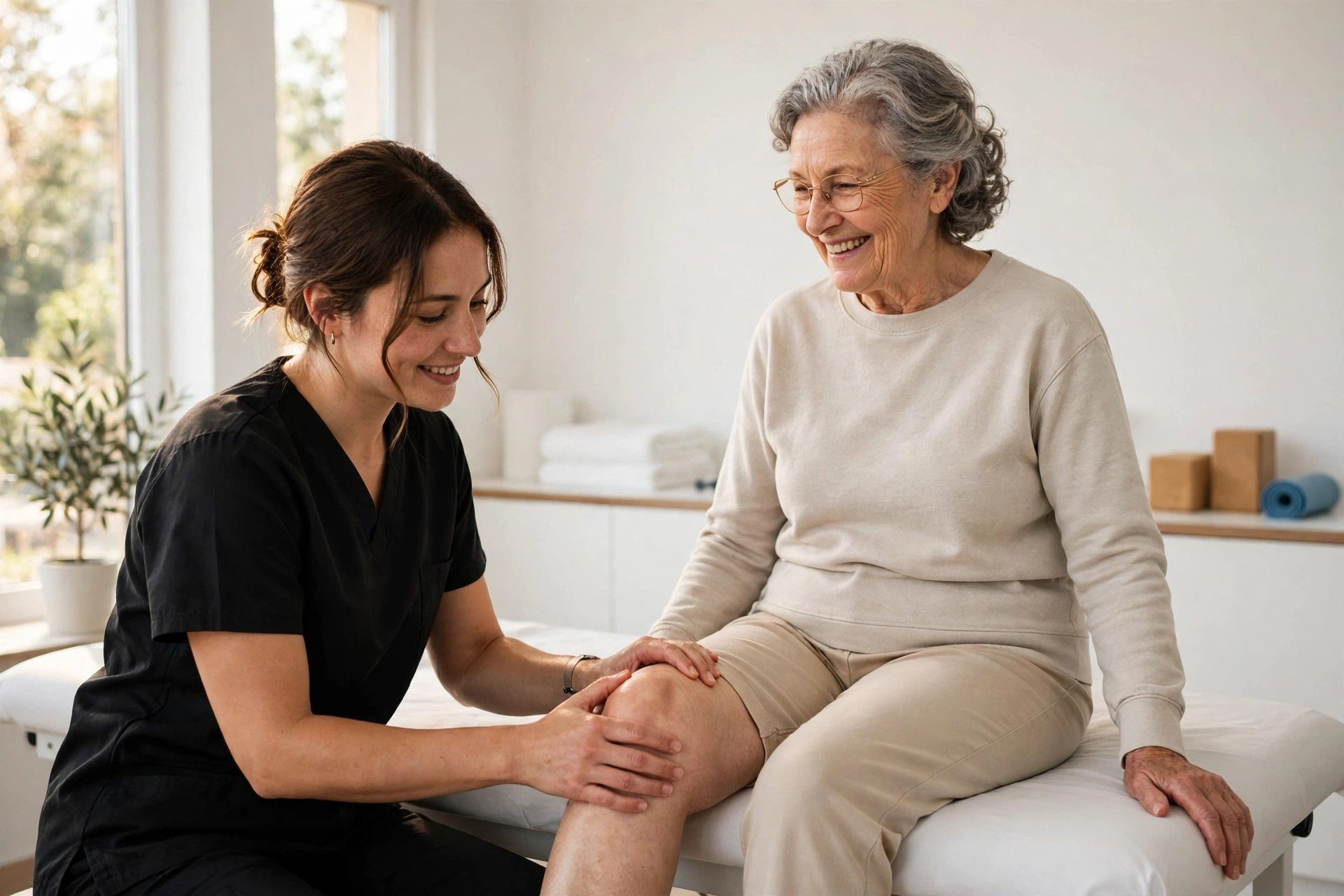
Osteoarthritis, often shortened to OA, is the most common form of arthritis. It affects the whole knee joint: the smooth cartilage that cushions the ends of the bones, the bone underneath, the joint lining, and the muscles around the knee.
Think of cartilage as the smooth, slippery surface that lets your knee bend and straighten without friction. Over time, that surface can wear down and become rough. The joint may also make less of the fluid that keeps it moving smoothly. The result is pain, stiffness, and sometimes swelling.
It helps to clear up a common misunderstanding. Osteoarthritis is not simply “wear and tear” that means your knee is worn out and you should stop using it. It is a living joint that responds to how you use it. The right kind of movement actually helps the joint stay healthier. Cartilage has no blood supply of its own, so the gentle loading and unloading of the joint during movement helps fluid and nutrients move through it. Understanding this is the first step in knee osteoarthritis physiotherapy Brooks treatment, because it explains why movement helps instead of harming.
Several things can raise the chance of developing knee osteoarthritis:
Osteoarthritis usually develops slowly. Many people notice it first as stiffness in the morning or after sitting for a while, and the stiffness eases once they get moving. Over time, pain may show up during longer walks, on stairs, or when getting up from a low chair.
It is also worth knowing that what an X-ray shows and how much pain you feel do not always match. Some people have X-rays that look quite worn but feel very little pain. Others have mild changes on an X-ray and a lot of discomfort. That is why a physiotherapist looks at how your knee actually moves and works, not just at a picture of it. If you want a fuller picture of how arthritis care works in general, you can read our guide to arthritis physiotherapy in Brooks.
Knee osteoarthritis does not look the same for everyone, but there are a few patterns we see again and again:
One thing to watch is that not all knee pain is osteoarthritis. Pain at the front of the knee in a runner, for example, is often a different problem, and you can learn more about it in our article on runners knee physiotherapy in Brooks. A sharp pain after a twist, or a knee that locks and will not straighten, can point to a meniscus problem instead, which we cover in our guide to meniscus tear physiotherapy in Brooks. A proper assessment sorts out which problem you actually have, because the right treatment depends on it. For a general overview of knee problems and their treatment, see our page on knee pain physiotherapy in Brooks. If several of these symptoms sound familiar, a knee osteoarthritis physiotherapy Brooks assessment can confirm what is going on and what will help.
Physiotherapy is the most recommended non-surgical treatment for knee osteoarthritis, and the reason is simple: it works on the things that actually drive the pain. A large Cochrane review of 54 trials found that land-based exercise reduces knee osteoarthritis pain and improves physical function, with benefits similar to common pain medications, and without their side effects.
Here is what good knee osteoarthritis physiotherapy Brooks care includes, and how each part helps.
The thigh muscles, especially the quadriceps at the front of the thigh, are the knee’s main shock absorbers. When they are weak, more force goes straight through the joint. Strengthening them spreads the load and often brings the pain down. Hip muscles matter just as much. They control how your knee lines up when you walk, climb stairs, or stand on one leg. If you have ever wondered why your physiotherapist spends time on your hips when your knee hurts, this is why. Our article on hip pain physiotherapy in Brooks explains how closely the hip and knee work together.
Gentle hands-on treatment, known as manual therapy, can ease stiffness and help the knee move more freely. It is never a replacement for exercise, but it can make the early weeks of a program more comfortable and help you move well enough to do the exercises properly.
Many people with knee osteoarthritis are afraid that moving will damage the joint further. That fear is understandable, and it is also one of the biggest barriers to getting better. A physiotherapist explains what osteoarthritis is, what it is not, and why the right kind of movement helps rather than harms. When you understand your knee, you stop avoiding the activities you love, and that confidence alone makes a real difference. That is why clear, honest education sits at the centre of knee osteoarthritis physiotherapy Brooks care.
No two knees are the same, and no two people are either. A good program is built around what you want to get back to, whether that is walking the dog, working in the garden, playing with grandchildren, or getting through a full shift at work without pain. It is reviewed and updated as you get stronger, so you keep progressing instead of plateauing.
Even a modest loss of body weight reduces the load on the knee with every step. Your physiotherapist can talk honestly and kindly about weight, suggest supportive footwear, and discuss whether a brace or walking aid would help you for now. These are practical tools, not judgments, and they are always your choice.
Structured programs such as GLA:D Canada, which stands for Good Life with osteoArthritis in Denmark, bring education and supervised exercise together over several weeks. The program pairs learning sessions with guided neuromuscular exercise classes that focus on knee control and alignment in everyday movements. Whether or not you join a formal program, the same principles apply: education, graded strengthening, and movement control, tailored to your starting point.
If you have never seen a physiotherapist before, it helps to know what happens. There is nothing to be nervous about, and you do not need a referral. In Alberta, you can book directly with a physiotherapist, although some extended health plans ask for a referral for reimbursement, so it is worth checking your policy.
At your first knee osteoarthritis physiotherapy Brooks appointment, your physiotherapist will:
Most people notice changes within 6 to 8 weeks of regular exercise, with further improvement over several months. Consistency matters far more than intensity. Two or three short sessions a week, done well, beat one heroic workout followed by a week on the couch.
The exercises below are the kind of movements used in knee osteoarthritis physiotherapy Brooks programs every day. They are the same starting points recommended by physiotherapy clinics across Canada, and they focus on the quadriceps, hips, and calves, the muscles that protect the knee.
Do them 2 to 3 times a week on non-consecutive days. Warm up first with 5 to 10 minutes of walking or gentle cycling. Start at the lower number of repetitions, move slowly, and build up gradually. If an exercise feels easy for the full number of repetitions, progress it: add a set, slow down the lowering phase, or use a lower chair or a slightly higher step.
Stop and get advice if you feel sharp or catching pain, the knee gives way, or the joint becomes hot and very swollen. Mild to moderate discomfort during exercise is normal and does not mean you are damaging the joint. A useful rule: discomfort that settles within an hour or two and is no worse the next morning is acceptable. Pain that is clearly worse the next day, or swelling that builds up after sessions, means you should reduce the repetitions, range, or load next time rather than stopping altogether.
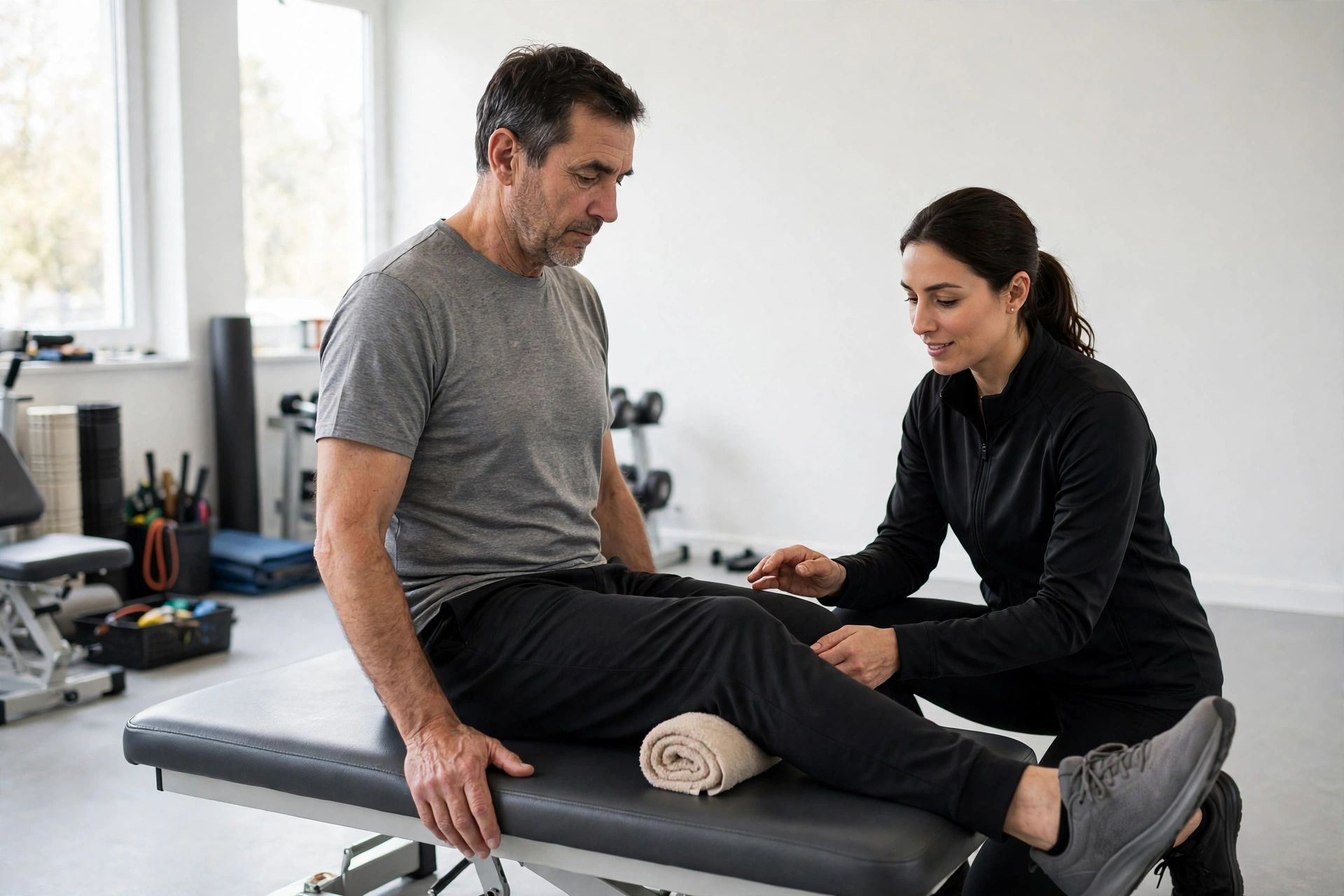
Sit with your leg straight and a small rolled towel under your knee. Tighten the muscle on the front of your thigh to press the knee down into the towel. Hold for 5 seconds, then relax. Repeat 10 times. This is a good starting point if your knee is very sore.
Lie on your back with one knee bent and the other leg straight. Tighten the thigh of the straight leg, then lift it to the height of the other knee. Hold for 3 to 5 seconds and lower slowly. Do 2 sets of 8 to 10 on each leg.
Sit near the front of a sturdy chair, feet hip-width apart. Lean forward slightly and stand up without using your hands if you can, then sit down slowly with control. Use a higher seat or a cushion to make it easier. Do 2 sets of 8 to 10.
Lie on your back, knees bent and feet flat on the floor. Squeeze your buttocks and lift your hips until your body is in a straight line from shoulders to knees. Lower slowly. Do 2 sets of 10. This works the glutes and hamstrings, which support the knee from behind.
Lie on your side with the bottom knee bent. Keep the top leg straight and in line with your body, and lift it toward the ceiling without rolling backward. This strengthens the hip muscles that keep the knee tracking properly. Do 2 sets of 8 to 10 on each side.
Holding a rail or the back of a sturdy chair, step up onto a low step, starting at 10 to 15 cm, with the sore leg. Straighten fully, then step down slowly with the other leg. Keep your knee in line with your second toe. Do 2 sets of 6 to 10 on each leg.
Stand holding the back of a chair. Rise up onto your toes, pause, and lower slowly. When this becomes easy, try one leg at a time. Do 2 sets of 10 to 15. Strong calves help with walking and with pushing off on stairs.
A note on form: quality beats quantity. Slow, controlled movement with the knee tracking over the second toe is worth far more than rushing through extra repetitions. If you are unsure about your technique, that is exactly what a physiotherapist is for. A single knee osteoarthritis physiotherapy Brooks session to check your form can save weeks of doing an exercise wrong.
Exercise is the foundation, but small daily choices support the work you do in knee osteoarthritis physiotherapy Brooks sessions. Together, they add up.

Very few activities are completely off-limits with knee osteoarthritis, but some are best modified, especially during a flare:
Running and cycling are not automatically harmful. Whether they suit you depends on your symptoms and how you build up. Many people with knee osteoarthritis keep cycling for years, because it loads the knee gently and keeps the joint moving. If running matters to you, talk it through with your physiotherapist rather than giving it up on your own. If you are unsure whether an activity suits your knee, ask about it at your next knee osteoarthritis physiotherapy Brooks appointment.
Many people wait far too long before asking for help, often because they assume nothing can be done or that surgery is the only option. In fact, the earlier you start, the more you tend to gain, because you build strength and confidence before the knee limits you further.
If any of these sound familiar, knee osteoarthritis physiotherapy Brooks care can help you:
There are also times to seek care more urgently. See a doctor or physiotherapist promptly if your knee becomes hot, very swollen, and red, especially with a fever, or if you cannot put weight on the leg at all after an injury, or if the knee locks and will not straighten. These are uncommon, but they need checking.
Appropriate exercise does not speed up joint damage, and it is recommended for people with knee osteoarthritis in every major guideline. Some discomfort during exercise is normal. If pain is clearly worse the next day or the knee swells, reduce the amount rather than stopping completely. The goal is steady, tolerable progress, not pain-free perfection from day one.
Yes, for most people. Start with distances that feel comfortable and build up gradually. Supportive footwear helps, and a walking pole or cane in the opposite hand can make walking easier. If walking brings on pain that lasts, shorten the distance and build up more slowly, or mix walking with cycling or water exercise.
There is no cure for osteoarthritis, but symptoms can improve a great deal. Many people reduce their pain, walk further, and get back to activities they had stopped through exercise, education, and weight management. The aim is not a perfect X-ray. It is a knee that lets you live the way you want to.
Many people notice changes within 6 to 8 weeks of regular exercise, with further improvement over several months. Consistency matters more than intensity. If you do the exercises two or three times a week, most weeks, you are doing it right.
No. In Alberta, you can book directly with a physiotherapist without a doctor’s referral. Some extended health plans ask for a referral for reimbursement, so check your policy before your first visit. If you have questions about coverage or booking, our clinic team can help.
A structured trial of exercise and education is the recommended first step, and it often changes the picture. Many people who assumed surgery was inevitable find they manage well without it once they are stronger and more confident. If a replacement is eventually the right choice, going into surgery stronger leads to a smoother recovery. Either way, physiotherapy is part of the answer, not a delay tactic.
Both can help, in different situations. Ice is usually best after activity if the knee feels swollen or hot. Heat is often better for morning stiffness or before exercise, because it relaxes the muscles and helps the joint move. Try both and use whichever feels better for you. If you are unsure, ask your physiotherapist.
Knee osteoarthritis can make everyday life smaller: shorter walks, fewer stairs, activities quietly given up one by one. But it does not have to stay that way. Exercise and education are the most recommended treatments for a reason. Stronger muscles, better movement, and a clear understanding of your knee can reduce pain, rebuild confidence, and bring back the things you enjoy.
If knee pain is shrinking your world, knee osteoarthritis physiotherapy Brooks care at Mission Health Physiotherapy can help you take it back. Our team will assess your knee properly, build a program around your goals, and work with you step by step until walking, stairs, and daily life feel easier again.
Book your assessment today at Mission Health Physiotherapy and Sports Rehab, 740 Alberta Street West, Brooks, Alberta. Call (403) 794-0111 to get started. You do not need a referral, and the first step is simply a conversation about your knee and what you want to get back to.
Disclaimer: This article is general information about knee osteoarthritis and is not a substitute for an assessment by a qualified health professional. If you have concerns about your knee, please speak with a physiotherapist or your doctor.