
It starts as a small ache in your shin or foot. At first it only shows up near the end of a run, then it appears earlier each time you go out. Soon it hurts when you walk, and pressing one exact spot on the bone is tender. There was no fall and no single twist, so it is easy to dismiss. That pattern, however, often points to a stress fracture, and stress fracture physiotherapy Brooks patients receive at Mission Health starts with one important step: making sure the bone is properly assessed before any exercise program begins.
The good news is that most stress fractures heal well with the right care. The key is catching the problem early, protecting the bone while it heals, and rebuilding strength in stages. This guide explains stress fractures in plain language: what they are, the symptoms and causes, low-risk versus high-risk sites, diagnosis, the first weeks of care, how physiotherapy helps, the exercises that work best, and how to return to running or work safely.
Every step sends force through the bones of your legs and feet. Healthy bone responds by remodelling itself: old bone is cleared away and new bone is laid down, making the bone stronger over time. But remodelling takes time. If the load increases too quickly, or rest days are skipped, the bone does not get enough time to rebuild, microdamage accumulates, and a stress fracture is the result.
Stress fractures most often affect the weight-bearing bones of the leg and foot: the metatarsals (the long bones of the forefoot, especially the second and third), the tibia (shin bone), the fibula, the navicular (a small bone in the midfoot), and the femur (thigh bone). They can also occur in the pelvis and sacrum, and less often in the arm.
Before a crack forms, the bone usually goes through an earlier stage called a stress reaction. The bone is irritated and inflamed, and an MRI may show swelling inside it, but there is no visible crack yet. It hurts much like a stress fracture and needs the same respect: reduce the load now, or it can progress into a fracture.
A stress reaction caught in the first week or two often settles faster than a full stress fracture. If you have bone pain that is getting worse with activity, do not wait to see whether it goes away on its own. An early assessment can save you weeks of recovery.
Stress fractures are most common in runners, dancers, military recruits, and anyone who suddenly increases their walking or running volume. They also appear in people who start a new job that involves standing or walking on hard floors all day, such as warehouse or retail work, and in people who take up running in spring, join a new sport, or return to training after a long break.
They are also more likely when the bone itself is weaker than normal. Low energy intake, low vitamin D or calcium, hormonal changes, and osteoporosis all reduce bone strength.
Stress fracture pain has a pattern that sets it apart from muscle pain: muscle soreness is usually spread out and eases as you warm up, while bone pain is focused on one spot, gets worse the longer you keep going, and does not warm up and fade. The most common symptoms are:
One of the most telling signs is the single tender spot: pressing with one finger finds one precise place on the bone that hurts, while muscle pain is usually broader and harder to pinpoint. Shin pain in particular is often a mix of problems, because the shin can hurt from muscle, tendon, and bone overload at the same time. Our guide to shin splints physiotherapy in Brooks explains how shin splints differ from a stress fracture and how the two are told apart.
Stress fractures rarely have a single cause. Usually several factors combine: a load that rose too fast, a body that was not ready for it, and sometimes a bone that was already weaker than normal.
The most common cause is doing too much, too soon. A sudden jump in running distance, a new training program, extra sessions added without rest days, or a return to sport after time off can all overload a bone faster than it can adapt. Increase weekly running or walking volume by no more than about 10 percent per week, with at least one full rest day each week. Rapid jumps, such as doubling your distance in a week, are a classic trigger. Changing surfaces, such as moving from grass to pavement, and worn-out shoes also raise the load on the bones.
How you move affects how load travels through the bones. Flat feet, high arches, a leg-length difference, or overstriding can all concentrate force on one bone. Muscle fatigue matters as well: the calf and foot muscles act as shock absorbers, and when they tire, more of each step’s force goes straight into the bone.
Finally, the bone itself may be weaker than normal. Not eating enough to match your activity level, low vitamin D or calcium, and hormonal changes (including changes around menopause) all reduce bone strength, as can some medications such as long-term corticosteroids. If you have had more than one stress fracture, your doctor may check your bone health, vitamin D levels, and overall nutrition.
Not all stress fractures are equal. Where the crack sits decides how it should be managed.
Low-risk sites have a good blood supply and are loaded in compression, which favours healing. The second and third metatarsals, the fibula, the inner (posteromedial) tibia, the pelvis, and the heel bone usually heal well with load management, most in about 6 to 8 weeks.
High-risk sites are loaded in tension, meaning the bone is pulled apart with each step, or they have a poor blood supply, so they heal slowly and can progress to a complete fracture. The femoral neck (near the hip joint), the front (anterior) tibia, the navicular bone in the midfoot, and the base of the fifth metatarsal fall into this group, and they need prompt medical referral, sometimes a boot, crutches, or surgery.
This distinction is why groin or deep hip pain should never be trained through: it can point to a femoral neck stress fracture, a high-risk injury. If your pain sits in the groin or deep hip, stop running, keep weight off the leg, and get assessed promptly. Our guide to runner’s knee physiotherapy in Brooks explains how knee pain is assessed when it appears alongside running-related leg pain.
A stress fracture is a medical diagnosis, not a physiotherapy diagnosis. Physiotherapy plays a central role in rehabilitation, but a suspected stress fracture needs a doctor’s assessment and usually imaging. At Mission Health we work alongside your family doctor or sports medicine physician.
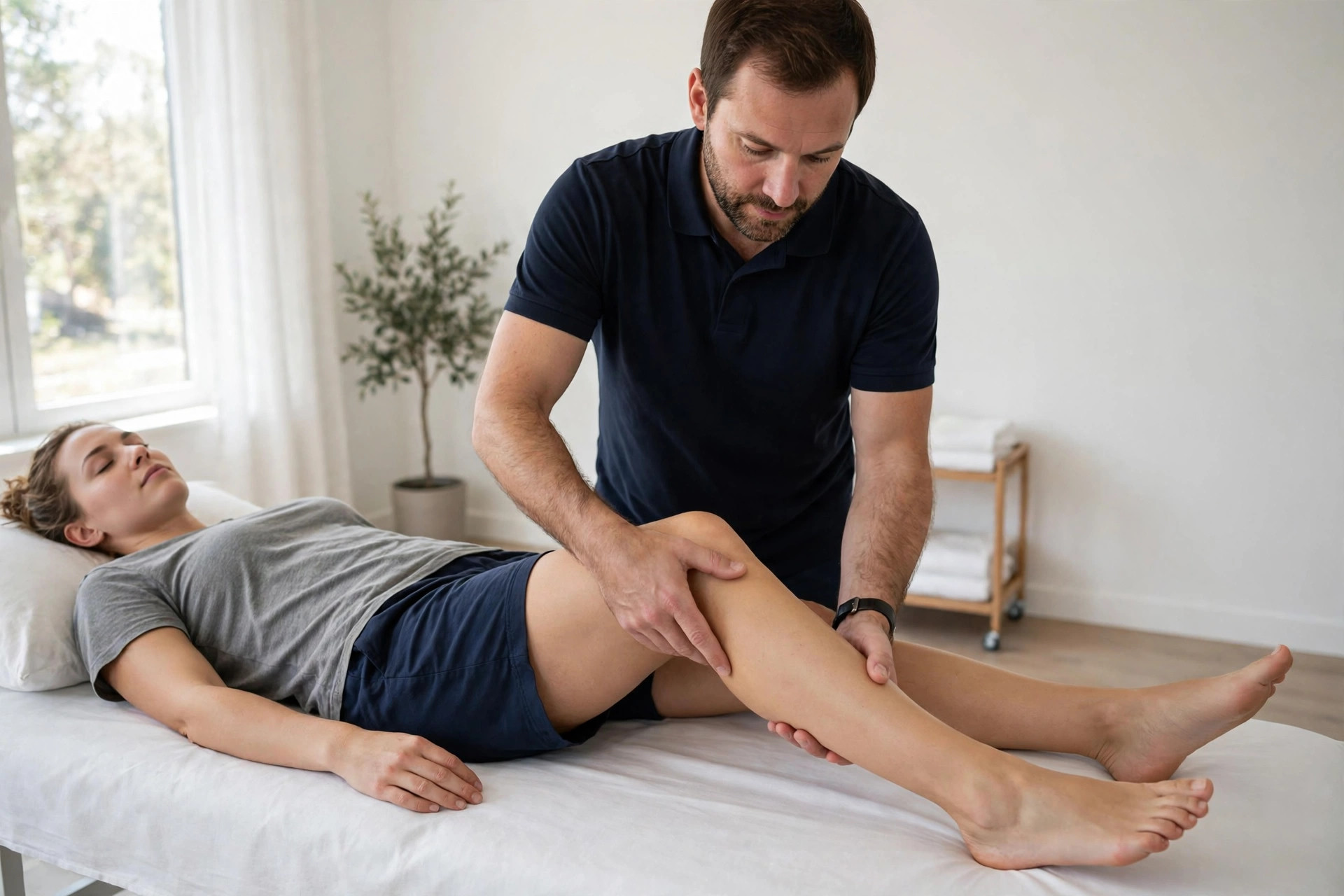
First, your physiotherapist will ask when the pain started, what provokes it, and whether your training, footwear, surface, or work demands changed recently. They will press gently along the bone to find the tender spot, check how the foot and leg move, test calf and hip strength, and watch how you walk.
An X-ray is usually the first imaging test, but it often looks normal in the first two to three weeks. The crack is too small to show, and the bone has not yet started the repair process that makes a fracture visible.
An MRI is the most sensitive test and can show both stress reactions and small cracks an X-ray misses. A bone scan or CT can also help in some cases. Your doctor will decide which test fits your situation. In the meantime, the safest step is to reduce the load on the painful bone rather than waiting for imaging to confirm the diagnosis.
Several problems can mimic a stress fracture. Shin splints cause a broader ache along the shin, a calf strain causes muscle pain that is tender in the soft tissue rather than on the bone, and foot pain can come from plantar fasciitis, Achilles tendon irritation, or a nerve problem. Our guides to calf strain physiotherapy in Brooks and foot pain physiotherapy in Brooks explain how those conditions are assessed.
The first weeks are about protecting the bone while keeping the rest of your body moving. Bone heals when it is loaded the right amount: too much load keeps the crack from healing, but complete rest for too long leaves the muscles weak.
First, stop the activity that caused the pain: no running, jumping, or long walks on hard surfaces. Depending on the site and severity, your doctor may recommend a walking boot, crutches, or a period of non-weight-bearing. Follow that advice carefully, even if the pain eases quickly, because pain often settles before the bone has finished healing.
Next, keep your fitness up in ways that do not load the injured bone. Swimming, deep-water running, cycling, and upper-body conditioning are usually good options, as long as they do not provoke the pain.
Then, give the bone what it needs to rebuild. Eat enough to match your activity level, because under-fuelling slows bone healing, and make sure your diet includes enough protein, calcium, and vitamin D. Talk to your doctor about a vitamin D check, especially during an Alberta winter when sun exposure is low. Sleep matters too, since bone remodelling happens largely during rest, and avoid smoking and limit alcohol, since both interfere with bone healing. Ice can help with soreness after activity: apply a cold pack over the area for 15 to 20 minutes, with a thin cloth between the ice and your skin.
Physiotherapy for a stress fracture is a staged program that changes as the bone heals, built around your goals, whether that is returning to running, getting through a work shift on your feet, or playing your sport again.
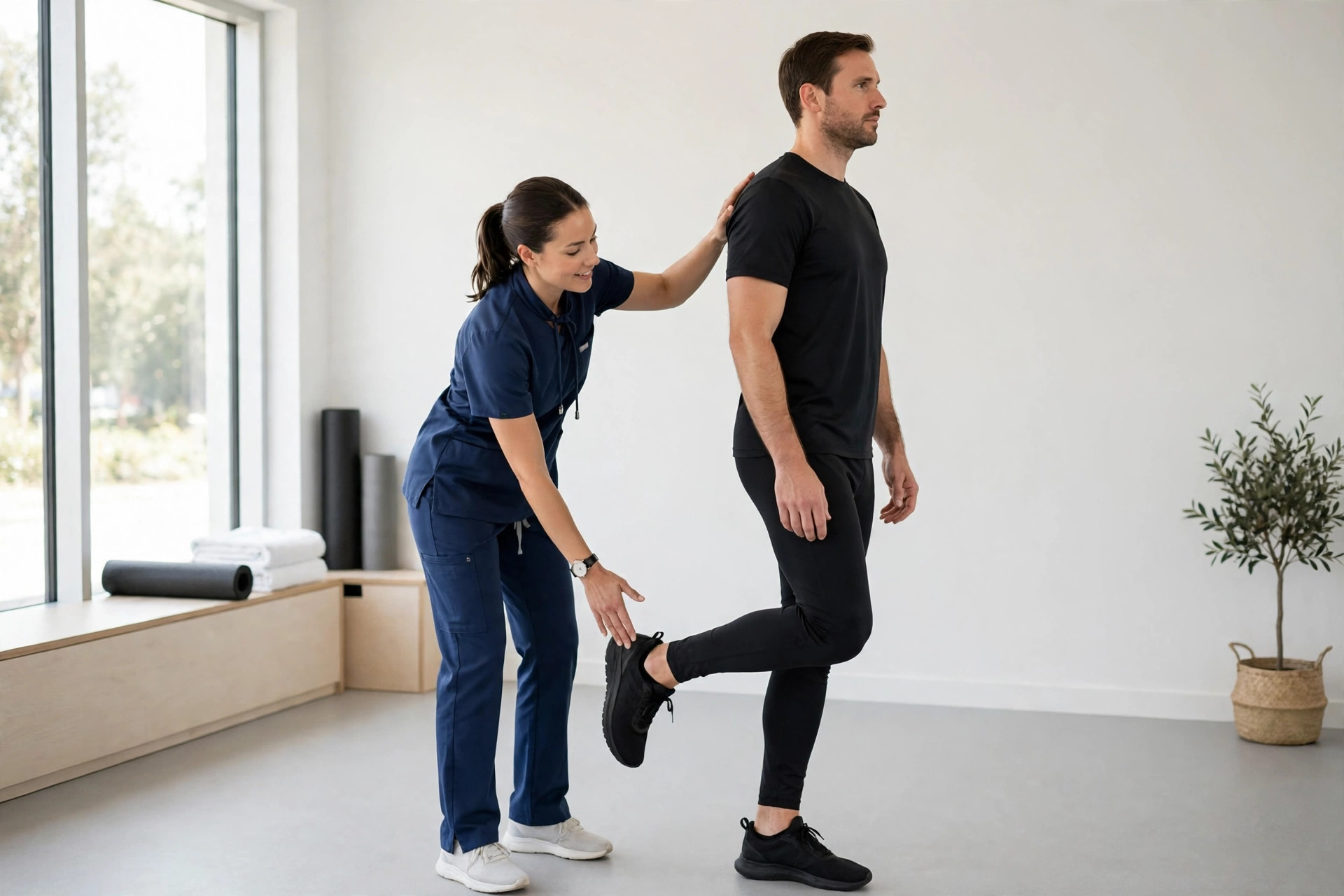
The first session is mostly assessment and planning. Your physiotherapist takes your history, examines the painful area, checks your strength and movement, and reviews any imaging you have had. Together, you agree on goals and on what you can and cannot do for now.
First, the program manages load, with clear rules about how much walking is safe, whether a boot or crutches are needed, and which activities are allowed. Your physiotherapist will also look at the factors that contributed to the injury: training volume, footwear, running surface, and any weakness in the calf, hip, or foot. Fixing those factors is as important as resting the bone.
As healing progresses, the program gradually rebuilds lower-limb strength: strong calves absorb force with every step, strong hips control the leg when you walk and run, and strong foot muscles support the arch. Exercises progress in stages, from gentle activation that does not load the fracture site to loaded exercises for walking, stairs, and sport. The Waterloo Sports Medicine Centre describes the same approach: load management, maintaining fitness, and gradually rebuilding strength and balance before a return to running. You can read more in their guide to stress fractures and physiotherapy.
Next, hands-on treatment can help when the joints and muscles around the fracture have stiffened during the rest period. Soft-tissue work can ease tight calves and feet, while gentle joint mobilization can restore comfortable movement in the ankle and foot. Your physiotherapist will also assess how you walk and run, because gait patterns decide how much load each bone carries.
Finally, activity builds back in stages, each added only when the bone tolerates the previous one. Walking distance increases first, then easy running on soft surfaces, then longer runs and faster work. Our guide to ankle sprain physiotherapy in Brooks explains how ankle injuries are assessed when they appear alongside lower-leg pain.
Every program is tailored to the individual and to the fracture site, but most follow a similar progression. The right exercise should feel challenging but manageable. If an exercise causes sharp bone pain, or pain lingers for more than a day afterwards, it needs adjusting. Do not start a new program on your own if you have groin or deep hip pain or numbness; get assessed first.
These exercises keep the joints moving and the muscles active without loading the healing bone.
As the bone heals and your doctor or physiotherapist clears more loading, the program adds strength work for the muscles that absorb force.
Your physiotherapist will adjust the exercises as you progress. Mild muscle effort during exercise is normal, but sharp pain at the fracture site or new numbness are signs the program needs adjusting.
Returning too quickly is the most common cause of a second stress fracture. The bone may feel fine in daily life long before it is ready for running, so the return needs a plan, not a guess.

Running usually starts only when you can walk pain-free for 30 to 45 minutes, hop on the injured leg without pain, and press on the fracture site without tenderness. Your doctor or physiotherapist will confirm the timing, especially for high-risk sites, and some fractures need a follow-up image before running resumes. Do not use a race date to decide when to run again; use the bone’s readiness.
A typical walk-run plan starts with short intervals, such as 1 minute of easy running followed by 2 minutes of walking, repeated for 15 to 20 minutes on a soft surface. Running time increases by a few minutes each session, and rest days stay in the plan. If pain appears during a run, or the bone is sore the next morning, the plan steps back a stage.
Once you are running again, build volume gradually: increase weekly running time or distance by no more than about 10 percent per week, with a lighter week every third or fourth week. Add only one new stress at a time, more distance, more speed, or hills, but not all three in the same week. Keep at least one full rest day each week, and keep the strength work going two or three times a week as maintenance.
Sport-specific work comes last. Cutting, jumping, and landing drills are added only after straight-line running is comfortable. Our guide to sports injury physiotherapy in Brooks explains how return-to-sport testing works.
Stress fractures heal with consistency, not with a single treatment. Rest may calm symptoms temporarily, but it does not rebuild the bone’s tolerance.
First, load is reduced and the painful activity stops. Pain usually eases noticeably in the first one to two weeks, but that does not mean the bone has healed.
Next, strength work progresses as the bone heals. Walking tolerance improves, and the calf, hip, and foot exercises get harder. Low-risk sites often feel much better by this stage, while high-risk sites may still need a boot or crutches.
Finally, loading builds toward your normal activities, with a walk-run plan for runners or a graded return to work for people on their feet all day. Most low-risk stress fractures heal in about 6 to 8 weeks, with the return to full activity taking a few weeks longer. If there has been no meaningful improvement after about three months, or pain keeps returning, the diagnosis and treatment options should be reassessed with your doctor.
Once the bone heals, a few habits keep it that way:
Because stress fractures often appear alongside other overload problems, it is worth treating the whole pattern rather than one sore spot. Johns Hopkins Medicine notes that stress fractures are small cracks caused by continuous overuse, and that treatment focuses on relieving pain and giving the fracture time to heal, usually around six to eight weeks; see their guide to stress fractures.
Most stress fractures heal well with load management and physiotherapy, but some signs mean you should see a doctor promptly:
If you notice any of these, book a medical assessment rather than pushing through. Otherwise, a stress fracture is well suited to a physiotherapy-first approach once the diagnosis is confirmed.
Most low-risk stress fractures heal in about 6 to 8 weeks with load management, though the return to full activity usually takes a few weeks longer. High-risk sites can take several months.
It depends on the site and severity. Some low-risk stress fractures allow pain-free walking, while others need a walking boot or crutches. Walking through pain is not a good test, because pain often settles before the bone has finished healing.
Often not at first. An X-ray can look normal in the first two to three weeks, because the crack is too small to show and the bone has not yet started the repair process that makes a fracture visible. An MRI is the most sensitive test.
No. Running through bone pain usually makes the crack worse and can turn a stress fracture into a complete fracture, which takes far longer to heal and may need surgery. Stop the activity that causes the pain and get assessed.
A stress fracture does not have to end your running season or keep you off your feet at work. For most people, a staged physiotherapy program protects the bone while it heals, rebuilds the strength that absorbs force, and returns them to activity stronger than before. The earlier you start, the sooner the bone heals.
If you have pain in one spot on your shin or foot that gets worse with activity and appears earlier in each workout, book an assessment at Mission Health Physiotherapy in Brooks. Call (403) 794-0111 or email missionhealthpt@gmail.com. The clinic is at 740 Alberta St W, Brooks, AB T1R 1A9. You can usually book without a doctor’s referral, though some insurance plans require one for reimbursement, so check your policy before your first visit.
Your physiotherapist will assess your leg and foot, explain what is going on in plain language, and build a plan around your goals.
This article is for general information only and is not a substitute for medical advice. If you develop groin or deep hip pain, numbness or weakness, swelling or redness over the painful area, or severe pain after a fall, seek medical care promptly. Always follow the guidance of your physiotherapist or doctor for your individual situation.