
Golfer’s elbow physiotherapy in Brooks: learn the causes, symptoms, exercises and treatment for inner elbow pain that gets you gripping, lifting and working again at Mission Health.
You pick up a toolbox, and a sharp ache shoots through the inside of your elbow. You shake hands with someone, and the grip hurts. You try to lift a laundry basket, and the pain stops you halfway. Maybe you play golf, and every swing sends a twinge through your lead arm. Or maybe you have never held a golf club in your life, and you cannot figure out why the inside of your elbow hurts every time you grip something.
That is golfer’s elbow, and despite the name, most people who get it are not golfers. It is a tendon problem on the inner side of the elbow, caused by repeated gripping, lifting, and twisting. It is the mirror image of tennis elbow, but it affects a different set of tendons and a different side of the joint. It responds well to physiotherapy, and most people recover fully without surgery.
This guide explains golfer’s elbow physiotherapy in Brooks in plain language: what it is, how it differs from tennis elbow, what causes it, the symptoms to watch for, and the treatment that works.
Golfer’s elbow is the common name for medial epicondylitis. It is a problem with the tendons that attach to the bony bump on the inner side of your elbow, called the medial epicondyle. These are the flexor tendons, the tough cords that connect the muscles on the underside of your forearm to the elbow. Every time you grip something, make a fist, bend your wrist forward, or twist your forearm, these tendons pull on that bump.
When those tendons are loaded more than they can handle, day after day, they start to break down. It is not really an inflammation problem, even though the name ends in “itis.” What is actually happening is a slow degeneration of the tendon, sometimes called tendinopathy. The tendon loses strength and structure, and it becomes painful when you use it.
Think of a rope pulled tight over the same sharp edge, over and over. It does not snap all at once. It frays a little at a time. That is what happens to the flexor tendons in golfer’s elbow. The good news is that tendons can rebuild themselves, if they are given the right kind of loading and enough time.
Golfer’s elbow usually affects the dominant arm, the one you use most for gripping and lifting. It most often appears in people between 30 and 60.
Golfer’s elbow and tennis elbow are often confused, because both are elbow tendon problems. But they are different conditions, on opposite sides of the elbow, involving opposite muscle groups, and the treatment and exercises differ too.
Golfer’s elbow is inner elbow pain. The pain sits on the inside of the elbow, the side that faces your body when your arm hangs at your side, palm facing forward. It hurts when you grip, make a fist, bend your wrist forward, or lift with your palm up. The sore spot is the bony bump on the inner elbow.
Tennis elbow is outer elbow pain. The pain sits on the outside of the elbow, and it hurts when you lift with your palm down, extend your wrist backward, or grip with the wrist straight. The sore spot is the bony bump on the outer elbow.
Here is a simple check you can do at home, although it does not replace a proper assessment. Rest your forearm on a table, palm up, and press on the inner bony bump. If that spot is tender, it points toward golfer’s elbow. Turn your palm down and press on the outer bump. If that is the sore spot, it points toward tennis elbow.
The causes differ too. Tennis elbow is often linked to typing, mouse work, and backhands. Golfer’s elbow is linked to gripping, lifting, throwing, and twisting with the palm up or in a neutral grip.
One more difference matters. Golfer’s elbow can involve the ulnar nerve, which runs past the inner elbow to your ring and little fingers. Tennis elbow does not usually involve a nerve. Tingling in those two fingers, along with inner elbow pain, is a golfer’s elbow sign. If you are not sure which one you have, that is normal. A physiotherapy assessment sorts it out in one visit. If your pain is more general, our guide to elbow pain physiotherapy in Brooks explains the common causes and how they are assessed.
Golfer’s elbow does not usually come from one single event. It builds up over weeks or months of repeated loading on the flexor tendons. The tendon is asked to do more than it is ready for, and it never quite gets enough rest to recover. In Brooks, the people we see most often are tradespeople, gym-goers, golfers, throwing athletes, and parents lifting small children.
Golf. The lead arm takes a sudden, forceful load through the flexor tendons at impact, especially if the club hits the ground or the grip is too tight. Beginners are more at risk, because a poor swing puts more stress through the elbow.
Throwing sports. Baseball pitchers, javelin throwers, and anyone who throws repeatedly puts a heavy load on the inner elbow. Young athletes who throw too much are especially vulnerable.
Gripping and lifting at work. This is the biggest cause in Brooks, and it has nothing to do with sport. Tradespeople, mechanics, carpenters, farmers, and warehouse workers spend their days gripping tools, lifting heavy objects, and twisting their forearms. If the work suddenly gets heavier or the hours get longer, the tendons can be pushed past their limit.
Gym and weight training. Pull-ups, chin-ups, curls, deadlifts, and rows all load the flexor tendons. A sudden increase in weight, or a new exercise that grips hard, can trigger golfer’s elbow. This is especially common in winter, when people train harder indoors.
A sudden change in load. This is the pattern we see most often at the clinic. The tendon was coping fine, and then something changed: a new job, a busier week, a new sport, a heavier tool, or a return to activity after a break. The tendon was not ready for the jump.
Golfer’s elbow usually starts gradually. At first, the pain only appears during the activity that causes it, then fades once you stop. Over time, it appears earlier, lasts longer, and shows up during everyday tasks.
Pain on the inner side of the elbow. The main symptom. The pain is centred on the bony bump on the inner elbow, and it can spread down the forearm. It is usually a dull ache, but it can be sharp when you grip or lift.
Pain when you grip something. Shaking hands, holding a mug, carrying a bag, or turning a doorknob can all hurt. The grip feels weak, and you may drop things.
Pain when you bend your wrist forward. The flexor tendons bend the wrist, so resisting that movement reproduces the pain. Wrist and elbow problems often go together, because the same muscles cross both joints. Read our guide to wrist pain physiotherapy in Brooks if your wrist is sore too.
Stiffness and tenderness. The elbow can feel stiff when you wake up, and it loosens as you move. The bony bump on the inner elbow is sore to the touch, one of the clearest signs.
Tingling or numbness in the ring and little fingers. This is the ulnar nerve, the symptom that sets golfer’s elbow apart from tennis elbow. The nerve runs in a groove right behind the inner elbow, close to the flexor tendons. When the area is irritated, the nerve can be compressed, and you feel tingling in those two fingers. Tell your physiotherapist, because it changes the treatment plan.
Pain that gets worse with activity and better with rest. Early on, the pain fades when you stop. As the condition progresses, it can linger for hours after you stop.
A golfer’s elbow assessment at Mission Health is straightforward, and it usually takes one visit to get a clear answer. You do not need a doctor’s referral, or an X-ray or scan, to start treatment.
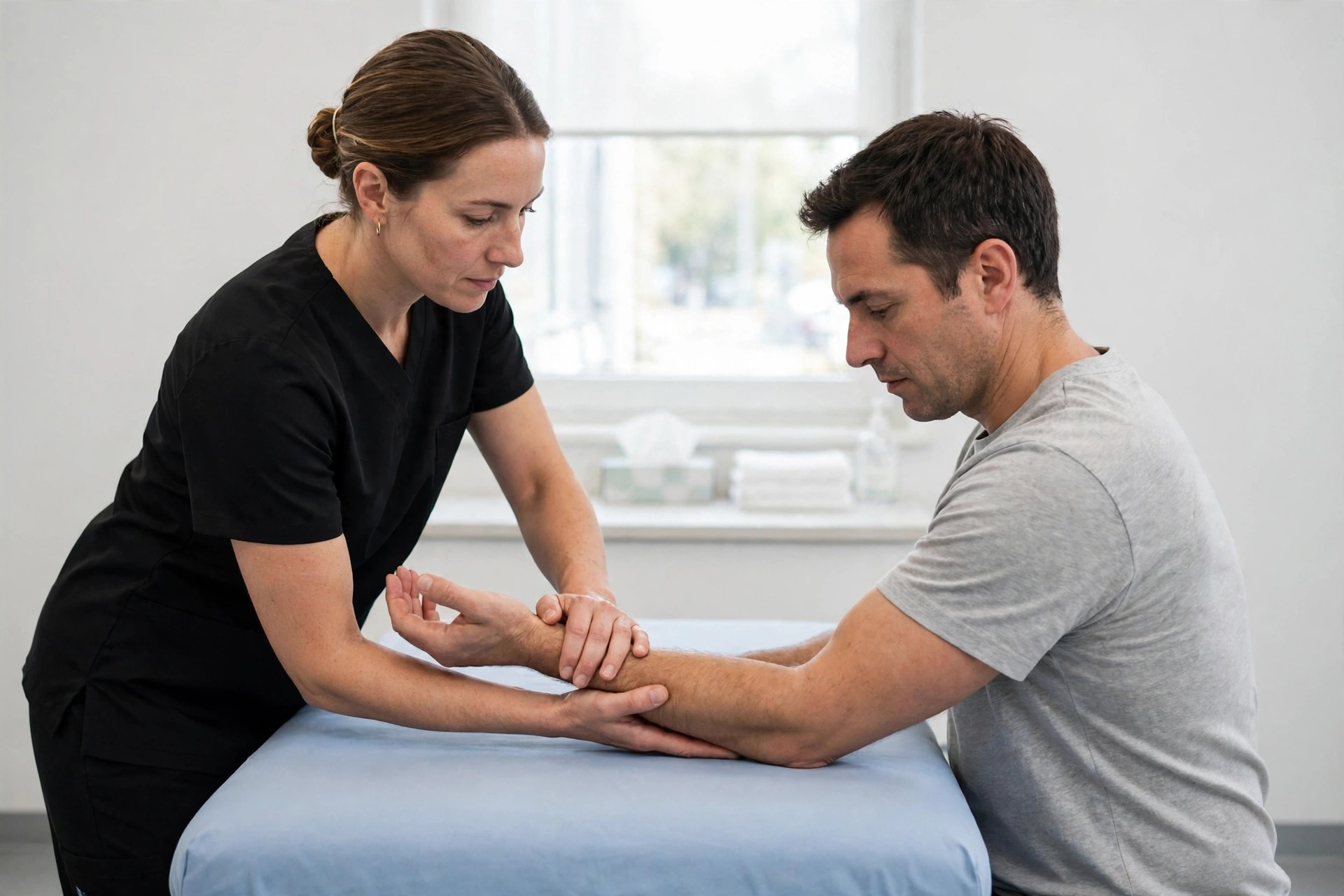
Your physiotherapist will ask about your pain: where it is, when it started, what makes it worse, and what you do for work and fun. The pattern tells us a lot about which tendon is involved.
Next comes the hands-on examination. Your physiotherapist will press on the inner elbow to find the tender spot, check how far your elbow and wrist move, and test your grip and wrist flexor strength. Two simple tests are very useful. In the first, you bend your wrist forward against resistance with your elbow straight. If this reproduces your inner elbow pain, it points to the flexor tendons. In the second, your physiotherapist stretches your wrist backward with your elbow straight. If that is painful on the inner side, it confirms the diagnosis.
Your physiotherapist will also check the ulnar nerve, testing the feeling in your ring and little fingers and seeing whether bending your elbow fully reproduces any tingling. If the nerve is involved, your plan will include nerve gliding exercises and advice about sleeping position, because bending the elbow tightly at night can compress the nerve further.
Your physiotherapist will also check your shoulder, neck, and wrist, because elbow pain can be influenced by problems further up or down the arm. At the end, you will know what the problem is and what the treatment plan looks like.
Golfer’s elbow heals best with a structured, phased approach. The tendon needs to be calmed down first, then gradually loaded so it rebuilds stronger, then tested against the real demands of your work or sport. Skipping a phase, or loading too hard too soon, is the most common reason people stay stuck.
The goal is to reduce pain and stop the tendon from getting worse. This does not mean complete rest, which actually makes tendons weaker. It means relative rest: keep using your arm for everyday tasks, but reduce or modify the activities that hurt most. If lifting a heavy toolbox is the trigger, find a lighter way to do the job. If golf is the trigger, take a break for a few weeks.
Ice can help after activity: ten minutes on the inner elbow, a few times a day. A forearm strap can also take some load off the tendon while you grip. It is a tool, not a cure, and it should not be worn all day.
This is the phase that fixes the tendon. Once the pain has settled, the tendon needs progressive loading so it rebuilds stronger, mainly through eccentric exercises.
An eccentric exercise is one where the muscle lengthens under load. For golfer’s elbow, the key exercise is the eccentric wrist curl. Hold a light weight, bend your wrist up with your other hand, then slowly lower it over three to five seconds. That slow lowering stimulates the tendon to rebuild. It is the most evidence-based treatment for tendon problems.
Your physiotherapist will start you on a very light weight, often just one or two pounds, and build up gradually. The exercises should cause mild discomfort, but not sharp pain. If the pain is more than a three out of ten during the exercise, and it does not settle within a day, the load is too high.
Grip strengthening is also part of this phase. A soft ball or grip trainer, used in short sets through the day, rebuilds forearm endurance for a full day of gripping.
Once the tendon is stronger and the pain has settled, the goal is getting you back to the activities that matter, gradually reintroducing the loads you need for work or sport.
If you are a golfer, return to the range gradually, starting with short sessions and a relaxed grip, then building up to a full round. A grip that is too tight is a common problem, and loosening it can make a real difference.
If you work with tools, return to full duties gradually, with attention to how you grip and lift. Sometimes a small change, like a short break every hour, keeps the tendon happy long term.
If you lift weights, return to your previous loads carefully, focusing on grip position and not jumping straight back to your heaviest weights. The same graded approach applies to any sports injury in Brooks, where returning too fast is the most common cause of a setback.
Exercise is the core treatment for golfer’s elbow, but several other treatments can help, especially when the pain is stubborn. These are used alongside exercise, not instead of it.
Dry needling involves placing very fine needles into tight, painful spots in the forearm muscles. It can reduce muscle tension, improve blood flow, and reduce pain. Many people find it helps them tolerate their exercises better. You can read more in our guide to dry needling in Brooks.
Shockwave therapy uses sound waves to stimulate healing in the tendon. It has good evidence for chronic tendon problems, especially when the condition has been present for months and exercise alone has not been enough. A course of three to five sessions is typical. Learn more in our shockwave therapy in Brooks guide.
Massage of the forearm muscles can reduce tension, improve blood flow, and make the arm feel looser. It is a useful addition to the exercise program, especially for people whose forearm muscles are very tight from years of gripping. It does not fix the tendon on its own.
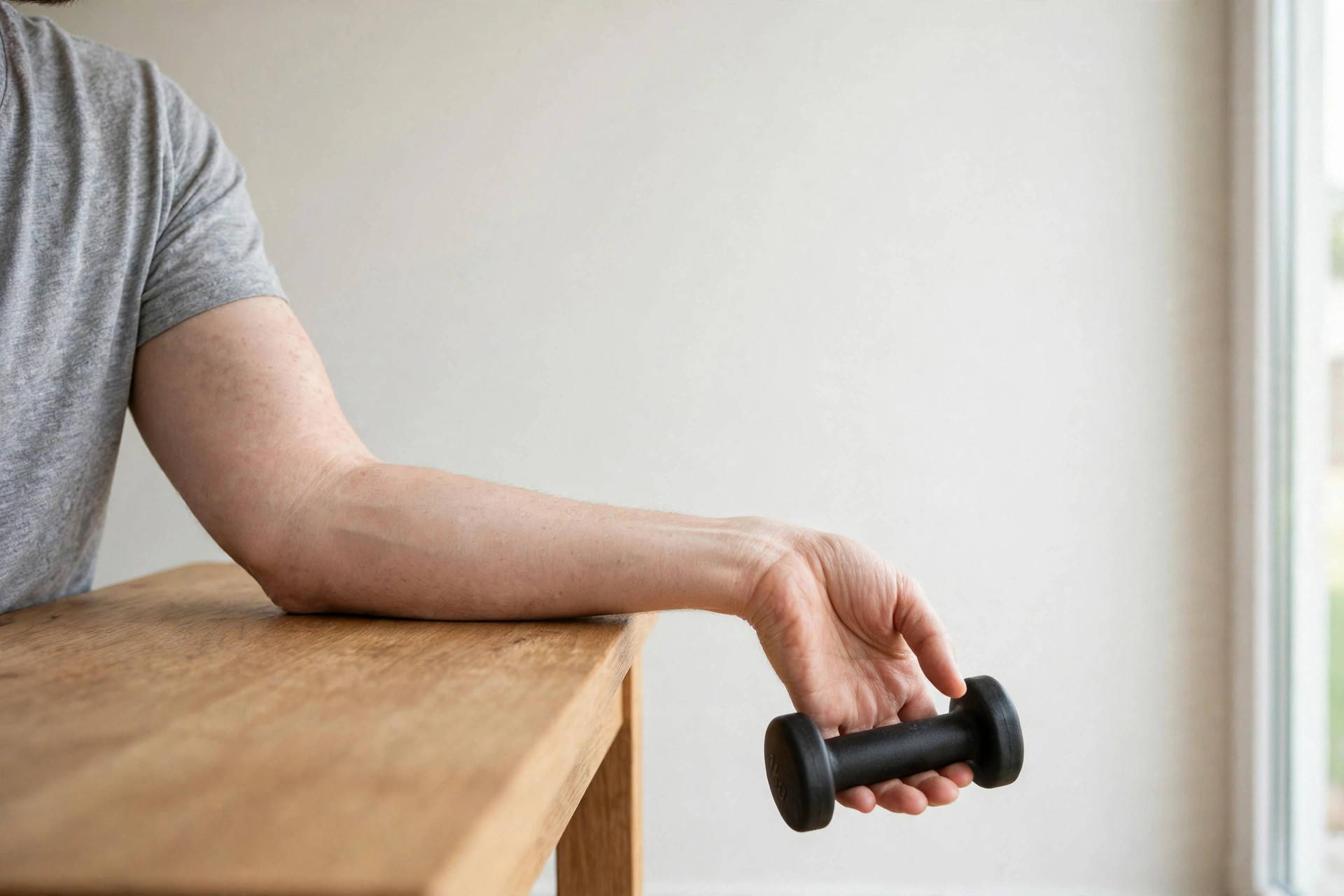
These exercises are safe to start at home, but they are not a substitute for an assessment. If you are unsure about the diagnosis, or you have tingling in your fingers, see a physiotherapist first.
Hold your affected arm out in front of you, palm facing up. Use your other hand to gently pull your fingers back and down, so you feel a stretch on the underside of your forearm. Hold for 20 to 30 seconds, and repeat three times, two or three times a day. It should feel like a stretch, not a sharp pain.
Sit with your forearm resting on a table, palm facing up, with your hand hanging over the edge. Hold a light weight, such as a can of soup. Use your other hand to lift your wrist up, then slowly lower the weight down over three to five seconds. That slow lowering is the important part. Do three sets of 15 repetitions, once a day. Start very light, and increase the weight slowly over weeks, not days.
Squeeze a soft ball or a rolled-up towel in your affected hand. Hold the squeeze for five seconds, then relax. Do three sets of ten repetitions, once or twice a day. As your grip gets stronger, use a firmer ball. The goal is to build endurance, so your forearm muscles can handle a full day of gripping without overloading the tendon.
Resting completely. People stop using their arm entirely, hoping the tendon will heal. It does not. Tendons need load to rebuild, and complete rest makes them weaker. Relative rest is the answer, not total rest.
Pushing through sharp pain. If an activity causes sharp pain that lasts for hours afterward, the load is too high. Pain up to about three out of ten during exercise, that settles within a day, is acceptable. Sharp pain that lingers means back off.
Relying on a brace forever. A forearm strap is a useful tool, but it is not a treatment. If you wear it every day for months without doing the exercises, the tendon never gets stronger, and the pain returns the moment you take it off.
Getting a cortisone injection first. Steroid injections can reduce pain in the short term, but the evidence shows they make tendon problems worse in the long term. They weaken the tendon and delay healing.
Ignoring the ulnar nerve. If you have tingling in your ring and little fingers and you ignore it, the nerve problem can get worse. Nerve symptoms need to be assessed and treated alongside the tendon.
Going back to full activity too soon. The pain may feel better after a few weeks, but the tendon is not yet fully rebuilt. Going straight back to heavy lifting, a full round of golf, or a busy work week can set you back to the start.
If you catch it early, within the first few weeks, most people feel significantly better in six to eight weeks with a good exercise program. If the condition has been present for months, it usually takes three to six months to fully resolve. The tendon rebuilds slowly, and there is no way to rush it.
That does not mean you will be in pain for six months. Most people notice a real improvement in the first few weeks of treatment. The pain during daily activities fades, the grip gets stronger, and the elbow becomes less tender. Full recovery, meaning you can do everything you did before without pain, takes longer than the pain relief does.
People who start treatment early recover faster than people who wait. People who do their exercises consistently recover faster than people who do them occasionally. And people who can modify the activity that caused the problem recover faster than people who keep loading the tendon at full intensity.
The vast majority of people recover fully with physiotherapy alone. Surgery is very rarely needed, and it is only considered after many months of proper conservative treatment have failed.
Book an assessment if any of these sound familiar: your inner elbow has been hurting for more than two weeks, and it is not getting better on its own; the pain is worse when you grip, lift, or bend your wrist; you are dropping things, or your grip feels weak; you have tingling or numbness in your ring and little fingers; the pain is starting to affect your work, your sport, or your sleep; or you have tried resting and painkillers, and the problem is still there.
Seek medical attention sooner if you notice a sudden loss of grip strength, if your hand feels clumsy or you cannot hold things at all, if the tingling in your fingers is getting worse, or if the elbow is hot, swollen, and red, which can be a sign of infection. These are uncommon, but they need prompt checking.
You do not need a doctor’s referral to see a physiotherapist in Alberta. You can book directly, and most extended health plans cover physiotherapy without a referral.
No, although they are related. Golfer’s elbow is pain on the inner side of the elbow, involving the flexor tendons that bend your wrist and grip. Tennis elbow is pain on the outer side, involving the extensor tendons that straighten your wrist. They have different causes, symptoms, and exercises. If you are not sure which one you have, a physiotherapy assessment will sort it out. Read about the other condition in our guide to tennis elbow physiotherapy in Brooks.
Not necessarily, but you will probably need a break from the course for a few weeks while the tendon calms down. Once the pain has settled and you have started the strengthening exercises, return gradually, starting with short practice sessions and a relaxed grip.
Sometimes, if the cause was a short-term overload and you reduce the load, it can settle on its own. But if the problem has been there for more than a few weeks, it usually needs active treatment. Tendons left alone tend to stay weak, and the pain often comes back the next time you load them.
It depends on your job. Desk work is usually possible, although you may need to adjust how you grip things. Jobs that involve heavy lifting, gripping tools, or repetitive manual work are harder, and you may need modified duties for a few weeks.
Very rarely. More than 90 percent of people recover fully with physiotherapy alone. Surgery is only considered when the condition has been present for many months, physiotherapy has not helped, and the pain is significantly affecting daily life.
Golfer’s elbow is frustrating, because it affects the most basic things: gripping, lifting, carrying, and shaking hands. But it is also very treatable. The people who recover best are the ones who get assessed early, understand which tendon is involved, and follow a phased plan that calms the tendon down, then rebuilds it stronger.
If the inside of your elbow hurts when you grip or lift, do not wait and hope it goes away. The earlier you start treatment, the faster you recover.
If you live in Brooks or the surrounding area and the inside of your elbow has been hurting, book an assessment at Mission Health Physiotherapy. We will find out exactly what is going on, explain it in plain language, and build a treatment plan that gets your grip back.
Mission Health Physiotherapy
740 Alberta St W, Brooks, AB T1R 1A9
Phone: +1 403-794-0111
Email: missionhealthpt@gmail.com
Website: www.missionhealthphysio.ca
Book your golfer’s elbow assessment today and take the first step toward getting your grip back.