
Get elbow pain physiotherapy in Brooks with personalized treatment, exercises, and rehabilitation to improve strength, mobility, and arm function.
Elbow pain can make surprisingly simple activities difficult. Gripping a coffee mug, carrying groceries, using a computer mouse, lifting equipment, playing sports, or even turning a doorknob may become uncomfortable when the elbow is irritated or injured.
Some elbow problems begin after a clear injury, while others develop gradually through repetitive movements or increased physical activity. Tennis elbow, golfer’s elbow, tendon irritation, joint problems, and sports injuries can all produce symptoms around the elbow.
For people dealing with persistent or recurring symptoms, Elbow Pain Physiotherapy in Brooks can provide a structured approach to improving movement, strength, function, and tolerance for everyday activities.
At Mission Health Physiotherapy & Sports Rehab in Brooks, treatment is based on an individualized assessment. Your physiotherapist can consider your symptoms, movement, strength, work requirements, sports participation, previous injuries, and personal goals when developing a rehabilitation plan. Physiotherapy in Brooks

The elbow connects the upper arm with the forearm and allows the arm to bend, straighten, rotate, and perform many functional movements.
Because the elbow is involved in lifting, gripping, pushing, pulling, and repetitive hand movements, several conditions can contribute to pain.
Common causes include:
The location of pain can provide useful clues, but it does not always identify the exact cause. For example, pain on the outside of the elbow may occur with tennis elbow, while symptoms on the inside can be associated with golfer’s elbow.
Therefore, persistent symptoms are worth assessing rather than simply assuming they are caused by overuse.
Elbow problems can present differently depending on the underlying condition.
You may notice:
Some people experience pain only during particular activities. Others may notice symptoms throughout the day.
For example, a person working with tools may notice discomfort after repeated gripping, while a tennis player may experience symptoms during a backhand stroke.
Mild elbow discomfort may sometimes settle after reducing the activity that aggravated it. However, professional assessment can be helpful when symptoms persist or begin interfering with work, exercise, or daily activities.
Consider Elbow Pain Physiotherapy in Brooks if:
A physiotherapy assessment can help identify factors contributing to your symptoms and determine whether rehabilitation is appropriate.
Physiotherapy for elbow problems is not simply about reducing pain.
A well-designed rehabilitation program can also address strength, mobility, grip function, movement patterns, and the physical demands of your daily activities.
Your physiotherapist may assess:
The assessment helps determine which factors may be contributing to your symptoms.
Stiffness can make everyday arm movements more difficult.
Depending on the condition, rehabilitation may include controlled exercises designed to improve elbow and forearm mobility.
Your program should be adjusted to your symptoms and injury stage. More aggressive movement is not necessarily better, particularly during the early stages of an injury.
Strengthening is often an important part of elbow rehabilitation.
Depending on your condition, exercises may target:
The amount of resistance can gradually increase as your tolerance improves.
This progressive approach helps prepare the arm for the activities you actually need to perform.
Tennis elbow is commonly associated with pain around the outside of the elbow.
Despite its name, you do not have to play tennis to develop it.
People who perform repetitive gripping, lifting, wrist movements, or manual work can also experience symptoms.
Activities that may aggravate symptoms include:
Rehabilitation may involve progressive strengthening of the wrist and forearm, activity modification, education, and gradual exposure to the movements that trigger symptoms.
The objective is not necessarily to avoid using the arm forever. Instead, rehabilitation can gradually increase the arm’s ability to tolerate physical demands.
Golfer’s elbow generally involves pain around the inside of the elbow and can be associated with repetitive gripping and wrist movements.
Despite its name, the condition is not limited to golfers.
It can occur in people who perform repetitive manual tasks, lifting, throwing, or other activities involving the forearm.
A rehabilitation program may focus on:
Your physiotherapist can adjust the exercises according to your symptoms and work or sports requirements.
Sports can place significant demands on the elbow.
Throwing, racquet sports, weight training, gymnastics, hockey, and other activities may involve repetitive or high-force movements through the arm.
An injury may occur suddenly or develop gradually.
For athletes, rehabilitation should eventually reflect the demands of their sport rather than stopping at basic pain-free movement.
Mission Health’s sports injury rehabilitation program provides personalized rehabilitation and progressive exercise for athletes and active individuals working toward a return to their preferred activities. Sports Injury Rehab in Brooks
A gradual return may involve:
The exact progression depends on the injury and the physical demands of your sport.
Yes, rehabilitation can be particularly useful when your job involves repetitive arm movements.
Common occupational demands include:
For example, a tradesperson may need to regain the ability to use tools repeatedly, while an office worker may need strategies for managing prolonged computer use.
Your physiotherapist can consider these specific demands when developing your rehabilitation program.
Elbow and forearm problems can affect grip strength.
A weaker grip can make everyday tasks more difficult, including:
Grip strengthening can therefore become an important part of rehabilitation when appropriate.
However, the exercise intensity should be progressed gradually. Excessive loading while symptoms are highly irritable can make recovery more difficult.
The arm functions as a connected kinetic chain.
The shoulder, elbow, wrist, and hand work together during lifting, throwing, gripping, and other movements.
Consequently, your physiotherapist may examine movement beyond the elbow when assessing your symptoms.
This broader assessment can help identify whether shoulder or wrist movement, strength, or coordination may be influencing the way your elbow is being loaded.
Home management depends on the cause and severity of your symptoms.
Some general strategies may include:
However, there is no universal exercise routine for all elbow pain.
A strengthening program that is appropriate for tennis elbow may not be appropriate for a fracture, ligament injury, or another condition.
For that reason, persistent or unexplained elbow pain should be assessed rather than treated solely with generic internet exercises.
Recovery time varies considerably.
A mild overuse problem may improve with appropriate activity modification and progressive rehabilitation, while a significant injury, fracture, surgical recovery, or chronic tendon problem may require considerably more time.
Recovery can be influenced by:
Instead of focusing only on a fixed number of days, it is often more useful to assess whether your elbow has regained the strength, movement, and capacity required for your normal activities.
Some elbow problems require medical assessment rather than physiotherapy alone.
Seek medical attention if:
A significant injury may require imaging or other medical management before rehabilitation can safely progress.
Effective rehabilitation should reflect your specific condition and physical requirements.
Mission Health Physiotherapy & Sports Rehab in Brooks provides personalized physiotherapy for people dealing with injuries, persistent pain, mobility limitations, and activity-related problems.
Treatment may include:
The clinic’s physiotherapy service focuses on personalized treatment plans designed around each patient’s symptoms, lifestyle, and goals. Mission Health Physiotherapy in Brooks
For athletes, the sports injury rehabilitation program can incorporate progressive exercise and sport-specific conditioning as part of the return-to-activity process.
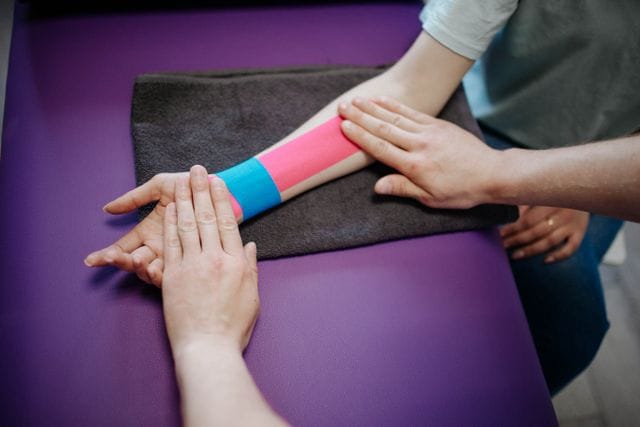
Physiotherapy can help with many musculoskeletal elbow problems by addressing strength, mobility, function, and activity tolerance. Treatment depends on the underlying condition.
You can generally contact a physiotherapy clinic directly in Alberta. However, some insurance plans have specific requirements, so check your coverage before booking if you plan to submit the treatment through benefits.
Yes. Rehabilitation may include progressive forearm strengthening, activity modification, education, and gradual return to activities that place stress on the elbow.
Yes. Tennis elbow is not limited to tennis players. Repetitive gripping, lifting, wrist movements, and manual work can also contribute to symptoms.
Physiotherapy may help address strength, mobility, loading tolerance, and activity-related factors associated with golfer’s elbow.
Recovery varies between individuals. Persistent tendon-related symptoms can take time to improve, particularly when the aggravating activity continues. A physiotherapist can help establish an appropriate progression.
It depends on the cause and severity of your symptoms. Some exercises may need to be modified temporarily, while appropriate strengthening can form an important part of rehabilitation.
Seek medical assessment if severe pain, significant swelling, deformity, major weakness, numbness, or an inability to move or use the arm develops, particularly after trauma.
Elbow pain can affect work, exercise, sports, and ordinary daily activities. While some mild problems may improve with appropriate activity modification, persistent symptoms can benefit from a structured rehabilitation approach.
Through assessment, progressive strengthening, mobility work, education, and functional rehabilitation, Elbow Pain Physiotherapy in Brooks can help you work toward better movement and physical capacity.
If elbow pain is limiting your activities or preventing you from returning to work, exercise, or sports, consider booking an assessment with Mission Health Physiotherapy & Sports Rehab in Brooks.
Mission Health Physiotherapy & Sports Rehab
740 Alberta Street W
Brooks, AB T1R 1A9
Phone: (403) 794-0111