
Rotator cuff physiotherapy in Brooks: learn the causes, symptoms, exercises and treatment for shoulder weakness and pain that gets you lifting, reaching and working overhead again at Mission Health.
You reach up to put a box on a high shelf, and your shoulder gives way. You try to lift your arm to wash your hair, and the pain stops you halfway. You wake up at night because you rolled onto your sore shoulder. Or you notice you can no longer lift as much as you used to, and your arm feels weak when you reach overhead.
That is very often a rotator cuff problem. The rotator cuff is a group of four small muscles and tendons that hold your shoulder together and power every overhead movement. When they are overloaded, worn down, or torn, the shoulder becomes painful and weak, and everyday tasks like lifting, reaching, and carrying become hard. This guide explains rotator cuff physiotherapy in Brooks in plain language: what the cuff is, how it differs from frozen shoulder, its causes and symptoms, and the treatment that works.
The rotator cuff is not one muscle. It is four muscles and their tendons wrapping around the ball of your shoulder joint like a cuff, holding the ball in its socket and controlling how your arm moves. The four are the supraspinatus, the infraspinatus, the teres minor, and the subscapularis, remembered by the letters SITS.
Each one does a different job. The supraspinatus, the one most often injured, lifts your arm out to the side and starts the overhead movement. The infraspinatus and teres minor rotate your arm outward, for reaching behind your head or throwing a ball. The subscapularis rotates your arm inward, for reaching behind your back.
Together, they keep the ball of the upper arm bone centred in its shallow socket and power the fine control of the arm. The shoulder is the most mobile joint in the body, and that mobility comes at a cost: without the cuff, the ball would slide around and pinch the tissues above it. These small tendons work hard, taking load every time you lift your arm overhead. Over years of use, or after a sudden overload, they can wear down, fray, or tear.
Rotator cuff problems and frozen shoulder are the two most common shoulder conditions, and they are often confused, because both cause shoulder pain. But they are different problems, with different symptoms and treatment, and getting the diagnosis right matters.
A rotator cuff problem is mainly weakness and painful movement. The shoulder is sore when you use it, especially overhead or out to the side, and it feels weak. But if someone else moves your arm for you, it usually goes further than you can move it yourself. The joint itself is not stuck.
Frozen shoulder is mainly stiffness. The shoulder is stiff in every direction, even when someone else tries to move it for you. You cannot lift your arm overhead or reach behind your back, and the stiffness does not change much from day to day. The problem is the capsule around the joint, which has tightened up. Read our guide to frozen shoulder physiotherapy in Brooks if stiffness is your main problem.
Here is a simple check you can do at home, although it does not replace a proper assessment. Try to lift your affected arm out to the side and up overhead. If it hurts and feels weak, but someone else can lift it higher for you without the same resistance, that points toward the rotator cuff. If the arm will not go up even when someone else lifts it, that points toward frozen shoulder.
Night pain happens in both, but for different reasons. In a rotator cuff problem, lying on the sore shoulder compresses the irritated tendon and wakes you up. In frozen shoulder, the pain is more constant and stiffness is the main complaint. Frozen shoulder most often appears between 40 and 60, often after a period of not using the shoulder. Rotator cuff problems appear across a wider age range, from overhead workers in their thirties to people in their seventies with worn-down tendons. If your pain is more general, our guide to shoulder pain physiotherapy in Brooks explains the common causes.
Not every rotator cuff problem is a tear. In fact, most are not. Understanding which one you have matters, because the treatment is different.
Tendinopathy is the most common problem. It means the tendon has degenerated over time: the fibres inside it have become disorganised and weaker, a bit like a rope that has frayed. It is not really an inflammation problem, even though it is often called tendonitis. Anti-inflammatory tablets and rest alone do not fix it, because the tendon needs to be rebuilt, not just calmed down. It develops slowly, over months or years of overload.
A partial tear means some tendon fibres have torn, but not all the way through. It is usually painful, and the shoulder feels weak, but the tendon is still partly attached. Partial tears can heal with physiotherapy, because the remaining fibres can be strengthened.
A full-thickness tear means the tendon has torn all the way through, and part of it has pulled away from the bone. The arm may feel very weak, and you may not be able to lift it overhead at all. Some full tears still do well with physiotherapy, especially in older adults, because the other three tendons can compensate. Others need surgery, particularly in younger people or after a sudden injury.
A tear can happen suddenly, from a fall onto an outstretched arm or lifting something far too heavy. But most tears in people over 50 are degenerative: the tendon was already worn down and finally gave way during an ordinary movement, such as reaching for a suitcase. An ultrasound or MRI can show whether the tendon is torn and how big the tear is, but imaging is not always needed. Many people have small tears on a scan and no pain, and many people with pain have no tear. The assessment matters more than the picture.
Rotator cuff problems do not usually come from one single event. They build up over time, when the tendons are asked to do more than they are ready for, day after day. Poor shoulder mechanics add to the load: if the shoulder blade does not move well, or the muscles around it are weak, the cuff has to work harder. In Brooks, the people we see most often are tradespeople, farmers, warehouse workers, gym-goers, throwing athletes, and anyone whose work involves reaching overhead.
Overhead work. Painting ceilings, installing drywall, stacking shelves, and pruning trees all load the rotator cuff heavily. The supraspinatus tendon is squeezed under the shoulder roof every time the arm goes overhead, and doing that hundreds of times a day wears it down. Throwing and racquet sports do the same, as does lifting heavy objects above shoulder height.
A sudden change in load. This is the pattern we see most often at the clinic. The tendon was coping fine, and then something changed: a new job, a busier week, a renovation project, or a return to sport after months off. The tendon was not ready for the jump. Smoking and diabetes also slow tendon healing.
Rotator cuff problems usually start gradually. At first, the pain only appears during the activity that causes it, then fades once you stop. Over time, it appears earlier and lasts longer.
Weakness when you lift overhead. The main symptom, and the one that separates a rotator cuff problem from frozen shoulder. You try to lift your arm overhead or out to the side, and it feels weak, as if the arm will not obey. You may need your other arm to help it up. As the cuff weakens, the arm feels less reliable, and you may drop things you used to carry easily.
Pain in the arc. The pain is often worst when the arm is between about 60 and 120 degrees out to the side, the middle of the lift, and it eases once the arm is fully overhead. This painful arc is a classic rotator cuff sign.
Night pain. Lying on the sore shoulder hurts, and the pain can wake you up. Many people sleep badly for months, which makes everything else harder.
Pain at the front or side of the shoulder. The pain is usually felt on the outer side of the upper arm, sometimes spreading toward the elbow. It is a dull ache most of the time, but it can be sharp when you lift or reach. Reaching behind your back can also hurt, because the subscapularis tendon is involved. The shoulder may click or catch as you move it.
A rotator cuff assessment at Mission Health is straightforward, and it usually takes one visit to get a clear answer. You do not need a doctor’s referral, or a scan, to start treatment.
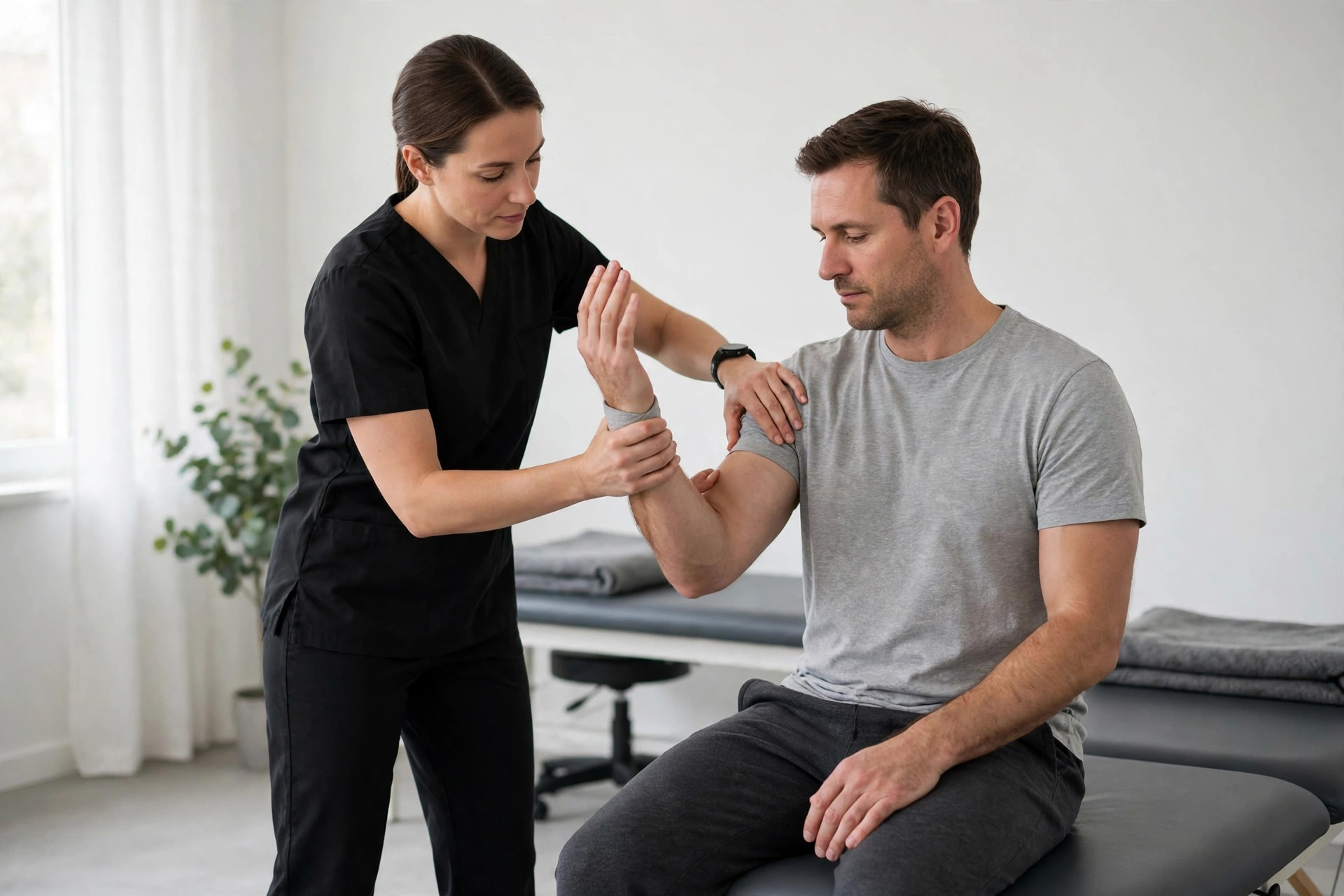
Your physiotherapist will ask about your pain: where it is, when it started, what makes it worse, and what you do for work and fun. The pattern tells us a lot about which tendon is involved. Next comes the hands-on examination: how far your shoulder moves when you move it yourself, and when the physiotherapist moves it for you. If you can move it further with help than on your own, that points toward the cuff.
Then come the strength tests. Your physiotherapist will ask you to hold your arm in different positions while they gently push against it. If you cannot hold the position, or it reproduces your pain, that tells us which tendon is weak. Holding the arm out to the side, thumb pointing down, tests the supraspinatus. Rotating the forearm outward against resistance, elbow at your side, tests the infraspinatus.
Your physiotherapist will also check your shoulder blade, neck, and upper back, because problems there change how the cuff works. An X-ray is sometimes useful to check for arthritis or a bone spur. An ultrasound or MRI is only needed if a tear is suspected and it would change the treatment plan, or if surgery is being considered.
A rotator cuff heals best with a structured, phased approach: calm it down first, then gradually load it so it rebuilds stronger, then test it against the real demands of your work or sport. Skipping a phase, or loading too hard too soon, is the most common reason people stay stuck.
The goal is to reduce pain and stop the tendon from getting worse. This does not mean complete rest, which makes tendons weaker. It means relative rest: keep using your arm for everyday tasks below shoulder height, but stop the overhead activities that hurt most for a few weeks. Ice can help after activity: ten minutes on the shoulder, a few times a day. Sleep on your back, or on the good side with a pillow supporting the sore arm. Gentle hands-on treatment can ease stiffness and muscle tension.
This is the phase that actually fixes the tendon. Once the pain has settled, the tendon needs progressive loading so it rebuilds stronger, mainly through external rotation and scapular strengthening. External rotation is the most important movement: the infraspinatus and teres minor rotate the arm outward, and they are often the weakest. Start very light, with a resistance band and elbow tucked at your side, and build up gradually. The exercises should cause mild discomfort, but not sharp pain. If the pain is more than a three out of ten and does not settle within a day, the load is too high.
Scapular strengthening is the other half. The shoulder blade is the platform the rotator cuff works from, and if it is weak or poorly controlled, the cuff has to work harder. Exercises that squeeze the shoulder blades together and control how the blade moves when you lift your arm take load off the cuff. As the tendon gets stronger, the exercises progress gradually, over weeks, not days.
Once the tendon is stronger and the pain has settled, the goal is getting you back to the activities that matter, gradually reintroducing the loads you need. If you work overhead, this means a graded return to full duties, starting with short periods of overhead work and building up. A small change, like using a step ladder instead of reaching, or taking a short break every hour, can keep the tendon happy long term.
If you play a throwing or racquet sport, this means a gradual throwing programme, starting with short, easy throws and building up over weeks. Returning to full throwing too fast is the most common cause of a setback. If you lift weights, return to overhead pressing and pulling carefully, without jumping straight back to your heaviest weights. The same graded approach applies to any sports injury in Brooks, where returning too fast is the most common cause of a setback.
Exercise is the core treatment, but several other treatments can help, especially when the pain is stubborn. These are used alongside exercise, not instead of it.
Dry needling places very fine needles into tight, painful spots in the shoulder and upper back muscles. It can reduce muscle tension, improve blood flow, and reduce pain, and many people find it helps them tolerate their exercises better. You can read more in our guide to dry needling in Brooks.
Shockwave therapy uses sound waves to stimulate healing in the tendon. It has good evidence for chronic tendon problems, especially when the condition has been present for months and exercise alone has not been enough. A course of three to five sessions is typical. Learn more in our shockwave therapy in Brooks guide.
Massage of the shoulder, neck, and upper back muscles can reduce tension, improve blood flow, and make the shoulder feel looser. It is a useful addition to the exercise programme, especially for people whose upper back and neck are very tight from years of overhead work. It does not fix the tendon on its own.
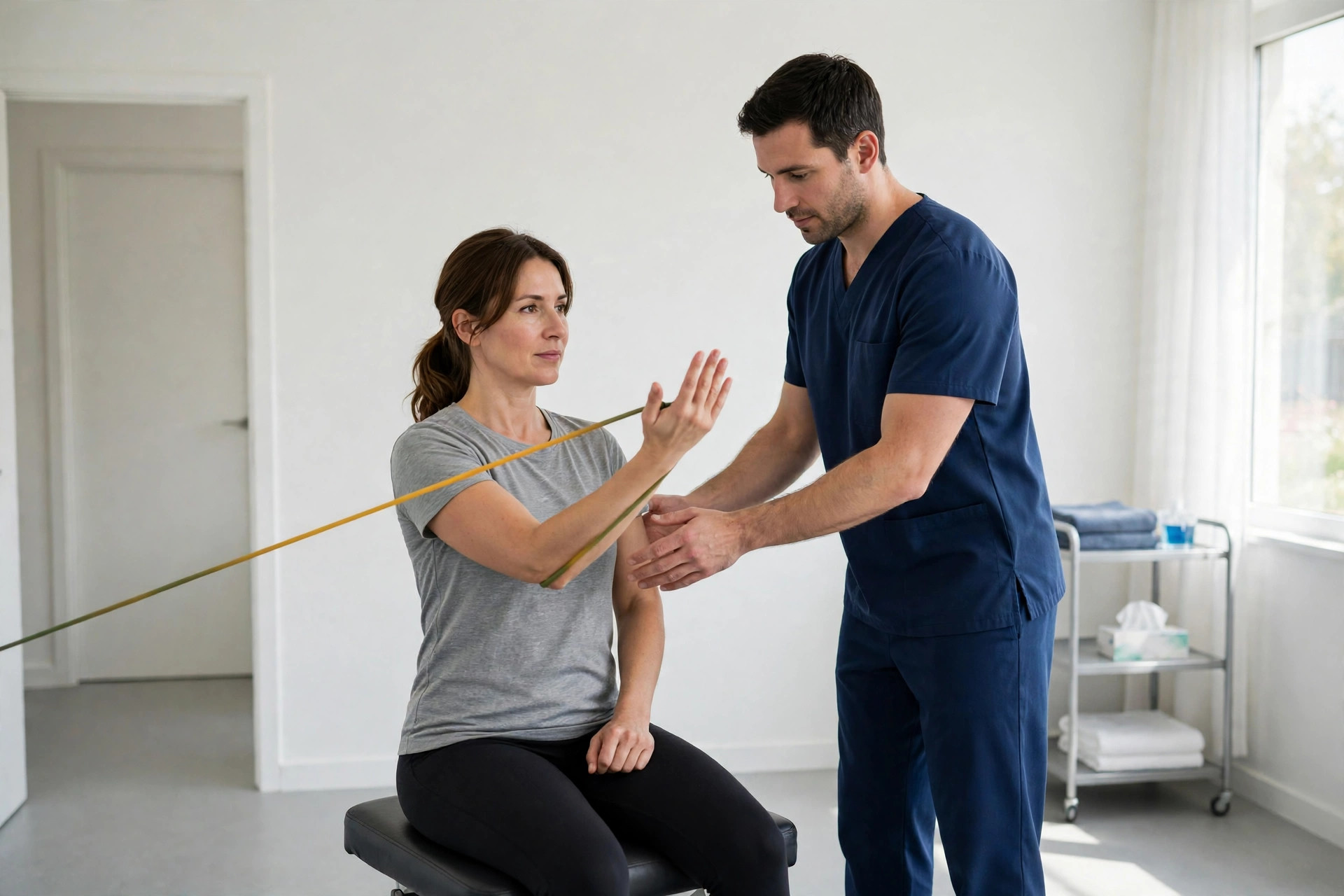
These exercises are safe to start at home, but they are not a substitute for an assessment. If you are unsure about the diagnosis, or you have numbness or tingling in your arm, see a physiotherapist first.
Stand or sit with your elbow bent at 90 degrees and tucked at your side, holding a light resistance band. Slowly rotate your forearm outward, then return slowly. Keep your elbow glued to your side and do not let your shoulder shrug up. Do three sets of 15, once a day. Start very light, and increase the resistance slowly over weeks. This is the single most important exercise for a rotator cuff problem.
Sit or stand tall, and gently squeeze your shoulder blades together and slightly down, as if you are trying to hold a pencil between them. Hold for five seconds, then relax. Do three sets of ten, once or twice a day. This builds the muscles that stabilise the shoulder blade.
Lie on your good side with a small towel rolled up under your sore arm, elbow bent at 90 degrees. Hold a very light weight, such as a can of soup, and slowly rotate your forearm upward, then lower it back down over three to five seconds. That slow lowering is the important part. Do three sets of 10, once a day.
Resting completely. People stop using their arm entirely, hoping the tendon will heal. It does not. Tendons need load to rebuild, and complete rest makes them weaker. Relative rest is the answer, not total rest. The same principle applies to tendons elsewhere in the body, including golfer’s elbow, where the forearm flexor tendons need the same graded loading.
Pushing through sharp pain. If an activity causes sharp pain that lasts for hours afterward, the load is too high. Pain up to about three out of ten during exercise, that settles within a day, is acceptable. Sharp pain that lingers means back off.
Getting a cortisone injection first. Steroid injections can reduce pain in the short term, but they make tendon problems worse in the long term. They weaken the tendon and delay healing. Exercise is the first-line treatment.
Going back to full overhead work too soon. The pain may feel better after a few weeks, but the tendon is not yet fully rebuilt. Going straight back to painting ceilings, throwing, or heavy overhead lifting can set you back to the start.
If you catch it early, most people feel significantly better in six to eight weeks. If the condition has been present for months, it usually takes three to six months to fully resolve. The tendon rebuilds slowly, and there is no way to rush it. Most people notice a real improvement in the first few weeks, as the pain fades and the strength comes back. Full recovery, meaning you can lift, reach, and work overhead without pain, takes longer than the pain relief does.
A partial tear takes longer than tendinopathy, and a full-thickness tear takes longer still. If surgery is needed, the shoulder is usually in a sling for four to six weeks, and full strength returns over four to six months, with physiotherapy essential throughout. People who start early, exercise consistently, and modify the activity that caused the problem recover fastest. Most people recover fully with physiotherapy alone. Surgery is only considered after many months, when a proper course of physiotherapy has not helped.
Book an assessment if any of these sound familiar: your shoulder has been hurting for more than two weeks and is not getting better; the pain is worse when you lift your arm overhead or out to the side; your arm feels weak when you reach or lift; you cannot sleep on the sore shoulder; you are dropping things; or you have tried resting and painkillers, and the problem is still there.
Seek medical attention sooner if you notice a sudden loss of strength after a fall or injury, if you cannot lift your arm at all, if your arm feels numb or tingly, or if the shoulder is hot, swollen, and red, which can be a sign of infection. These are uncommon, but they need prompt checking. You do not need a doctor’s referral to see a physiotherapist in Alberta.
No, although they are related. A rotator cuff problem is mainly weakness and pain when you use the shoulder, and someone else can usually move your arm further than you can. Frozen shoulder is mainly stiffness: the shoulder will not move in any direction, even with help, because the capsule around the joint has tightened. They have different causes, symptoms, and treatment. If you are not sure which one you have, an assessment will sort it out in one visit.
Usually not. Most rotator cuff problems, including many partial tears and some full tears, recover well with physiotherapy alone. Surgery is only considered when the tear is large, the weakness is severe, the person is young and active, or many months of proper physiotherapy have not helped. Even then, physiotherapy is essential before and after surgery.
It depends on your job. Desk work is usually possible, although you may need to adjust how you reach for things. Jobs that involve heavy overhead work, lifting above shoulder height, or repetitive reaching are harder, and you may need modified duties for a few weeks. Your physiotherapist can advise on what is safe and write a note for your employer if needed.
Sometimes, if the cause was a short-term overload and you reduce the load, it can settle on its own. But if the problem has been there for more than a few weeks, it usually needs active treatment. Tendons left alone tend to stay weak, and the pain often comes back the next time you load them. A structured strengthening programme is the most reliable way to fix it.
Avoid heavy overhead pressing, upright rows with a narrow grip, and any exercise that causes sharp pain. Avoid sleeping on the sore shoulder, and avoid lifting heavy objects above shoulder height until your physiotherapist clears you. Gentle movement below shoulder height is fine, and the exercises in this guide are designed to load the tendon safely.
A rotator cuff problem is frustrating, because it affects the most basic things: lifting, reaching, carrying, and sleeping. But it is also very treatable. The people who recover best get assessed early, understand which tendon is involved, and follow a phased plan that calms the tendon down, then rebuilds it stronger.
If your shoulder feels weak when you lift overhead, or the pain is stopping you from working, sleeping, or doing the things you enjoy, do not wait and hope it goes away. The earlier you start treatment, the faster you recover.
If you live in Brooks or the surrounding area and your shoulder has been hurting, book an assessment at Mission Health Physiotherapy for rotator cuff physiotherapy in Brooks. We will find out exactly what is going on, explain it in plain language, and build a plan that gets your strength back.
Mission Health Physiotherapy
740 Alberta St W, Brooks, AB T1R 1A9
Phone: +1 403-794-0111
Email: missionhealthpt@gmail.com
Website: www.missionhealthphysio.ca
Book your rotator cuff assessment today and take the first step toward getting your strength back.